
Myofascial release Paphos: what it is and how I use it
In short
Myofascial release is slow, sustained pressure into restricted connective tissue so that layers glide again. For myofascial release Paphos, I bring the table to your home and work the fascia mechanically, not the surface.
I am often asked what myofascial release in Paphos actually involves, and whether it differs from a firm massage. It does. Myofascial release is sustained, slow pressure into restricted connective tissue, held until the layers begin to glide again. Here is how I understand it and how I apply it at your home.
What fascia is and why it matters
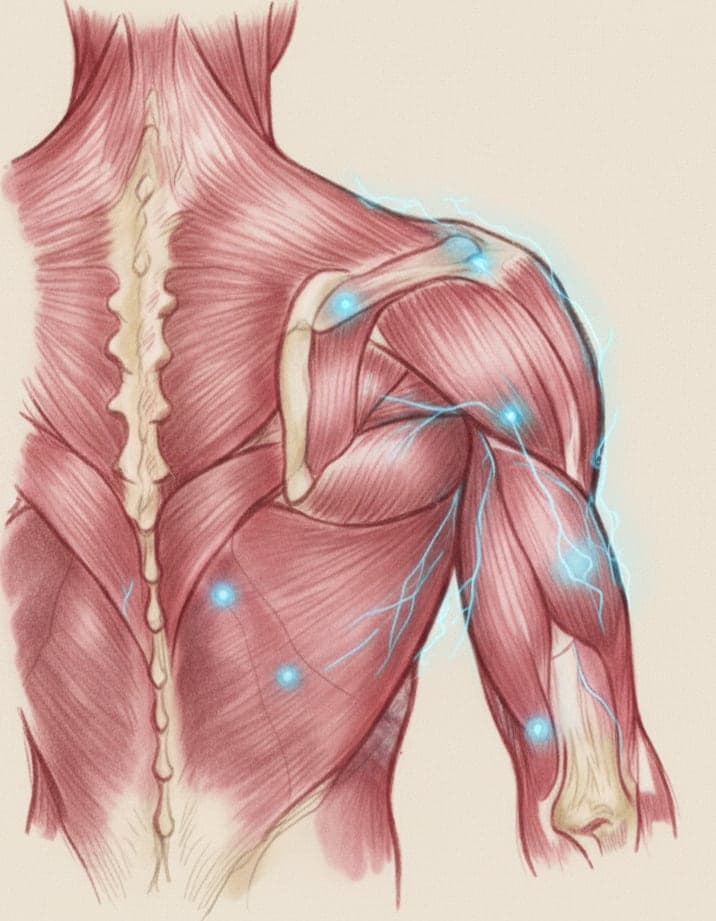
Fascia is the continuous sheet of connective tissue that wraps and threads through every muscle, bone, nerve and vessel in the body. It is not a passive packaging material. It transmits force between muscles, holds tension patterns, and carries a dense supply of sensory nerve endings. When it is healthy it is slippery and elastic, and adjacent layers slide over each other freely.
When it is not healthy, that gliding is lost. Repetitive strain, long hours in one position, an old injury, surgery, or simply years of a guarded posture cause the tissue to thicken and to stick to its neighbours. The result is a pull that can be felt far from where the restriction sits, which is why so many people describe a pain that "moves around" or never quite settles.
The patterns I see most often in Paphos district come from a few sources:
- Long hours at a desk or driving, with the hips flexed and the chest closed
- Building and garden work with repetitive overhead or bent-over loading
- Old ankle or knee injuries that changed the walking pattern years ago
- Post-surgical scarring, especially around the abdomen or shoulder
- Sport done in bursts after weeks of sitting
None of these is unusual. What they share is that the tissue has been asked to hold the same shape for a long time, and it has obliged.
What myofascial release actually is
Myofascial release Paphos, as I practise it, is a specific way of applying pressure rather than a separate treatment on a menu. The word combines "myo" for muscle and "fascial" for the connective tissue, and the technique addresses both together, because in the body they cannot be separated.
The classic definition is gentle sustained pressure held for ninety seconds or longer, allowing the tissue to lengthen. That is a fair starting point, but in a chronic presentation the pressure usually needs to be deeper and the hold longer than most people expect. The three things I am always working with are:
When these three are in place, you can feel the change under the pressure: a slow yielding, followed by a sense of the area being lighter and easier to move.
How myofascial release differs from massage
Clients often ask whether they have already had this in a deep-tissue session. Sometimes they have; more often they have had firm, moving strokes over muscle, which is valuable but different. The distinction is worth setting out plainly.
| Relaxation or deep-tissue massage | Myofascial release | |
|---|---|---|
| Main aim | Reduce muscle tone, ease general tension | Restore glide between tissue layers |
| Pressure | Rhythmic, moving strokes | Sustained, slow, largely static |
| Depth | Skin and muscle belly | The connective tissue between and around muscles |
| Time on one spot | Seconds | Minutes |
| Coverage | Usually the whole body or a large region | A few targeted restrictions per session |
The two are not in competition. In a typical session I will use both, because tissue that has been warmed with broader strokes accepts sustained pressure far better than cold tissue does. If your priority is general recovery rather than a specific restriction, deep tissue massage in Paphos may be the better fit, and I will say so.
How I work the fascia at your home in Paphos
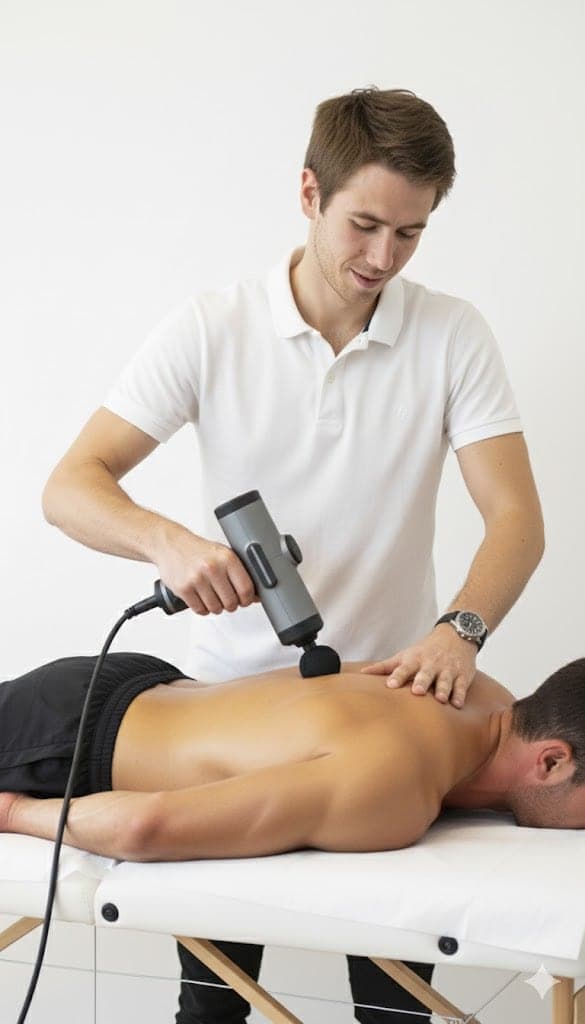
I trained and worked manually for years before moving to a mechanical approach for the deeper fascial work. The reason was practical. Holding heavy, precise pressure on one spot for several minutes is tiring, and tired hands drift. A mechanical tool lets me set the depth and hold it steadily for as long as the tissue needs, and to reproduce the same load next week.
The device does not replace assessment or judgement. I still find the restriction by hand, I still read your breathing and the muscle's response, and I still adjust constantly. What it gives me is the ability to sustain the work without the quality falling off towards the end of a session.
I bring the treatment table, towels and everything else. You need a room with space to walk around the table, and that is all.
What a session looks like
Sessions are 60 or 90 minutes and are described on the pricing page; the longer session suits anyone with restrictions in more than one region. What happens in the room follows a fairly consistent order.
- A short assessment — I watch you walk, reach overhead, turn and bend, and I palpate the areas that seem to be doing more than their share. This tells me where the restrictions are, which is often not where the pain is.
- Warming and broader strokes — a few minutes of general work so the tissue is pliable before I settle on one spot.
- Sustained pressure — I hold each restriction for several minutes, easing deeper only as the tissue yields. This is the part people describe as intense but productive; it should never feel sharp or make you brace.
- Retesting — we go back to the movements from the start and compare. Range and ease usually change within the session; how long that holds is what we track across sessions.
- A plan — I tell you what I found and what a sensible interval looks like, which for a chronic pattern is usually weekly at first and then further apart.
Mild soreness the following day is common and settles quickly. It feels like the ache after unaccustomed exercise, in the areas we worked.
Common misunderstandings about fascial work
Fascia has become a popular word, and some of what is attached to it does not hold up. A few points I find myself repeating.
I would rather you arrive with realistic expectations than be surprised by any of these.
Who it suits and who should see a doctor first
Myofascial work suits long-standing stiffness, a pain that shifts or refers, restricted range after an old injury, scar tissue that pulls, and the tight, "wrapped" feeling many desk workers describe across the back and hips. It also suits people who have had plenty of massage that felt good on the day but did not last.
Here is what I can and can't help with: I can work with mechanical restriction in muscle and fascia, but see a doctor first if your pain began with a fall or accident, comes with numbness or weakness in a limb, wakes you at night, is accompanied by fever or unexplained weight loss, or follows recent surgery that has not been signed off. Those need a diagnosis before hands go anywhere near them.
Things I would want to know before we start:
- Any diagnosed condition affecting bones, joints or clotting
- Recent surgery, injections or acute inflammation in the area
- Pregnancy, so I can adapt position and pressure
- Whether the pain is getting steadily worse rather than fluctuating
If any of these are present, I may still be able to work, but I would prefer to do so knowing the full picture, and sometimes I will ask you to check with your doctor first.
Frequently asked questions
Is myofascial release the same as deep tissue massage?
No, though they overlap. Deep tissue massage uses firm moving strokes to reduce tone in the muscle belly. Myofascial release uses slow, sustained pressure held on one restriction for minutes at a time, aiming to restore glide between tissue layers. In practice I use both in one session, warming the tissue with broader work before settling into the sustained holds.
Does myofascial release hurt?
It is uncomfortable while a restriction is being worked, in the way a deep stretch is uncomfortable, and most people describe it as intense but productive. It should never be sharp, and you should never need to brace or hold your breath. I adjust the depth constantly, and if you tell me it is too much I ease off immediately. Mild soreness the next day is normal.
How many sessions will I need?
That depends on how long the pattern has been there. A recent restriction can shift in one or two visits. A chronic pattern usually needs a short series, often weekly at first and then spaced out as the change holds. I reassess at every session and I will tell you plainly if progress has stalled, rather than booking you indefinitely.
Do you bring everything to my home?
Yes. I bring the treatment table, towels, oil and the tools I use, and set up wherever there is enough floor space to walk around the table. I cover the whole Paphos district from my base in Chlorakas, including villas and apartments in the surrounding villages. You do not need to prepare anything beyond a clear space and a glass of water.
Can I foam roll between sessions?
You can, and for general maintenance it is a reasonable habit. Keep it slow and moderate rather than grinding hard on a sore spot, and treat it as warm-up rather than treatment. It will not reach a deep restriction the way sustained manual pressure does, but it helps keep the surrounding tissue moving between visits, which is what maintains what we gain.
How much does myofascial release cost in Paphos?
A 60-minute session is €90 and a 90-minute session is €130, at your home anywhere in Paphos district. Every fifth session is free. Most fascial work benefits from the longer session because sustained holds take time, but I will advise you honestly after the first assessment. Booking is by WhatsApp or phone.
Written by
Chris
Massage therapist & body mechanics specialist
Norwegian-certified with a Bachelor’s in Physical Education and Nutrition and over ten years of clinical practice, working from a portable table in clients’ homes across the Paphos district.
- Norwegian-certified
- BSc Physical Education & Nutrition
- 10+ years clinical practice
- Based in Chlorakas · all of Paphos district
- No call-out fee anywhere in Paphos district
Last reviewed
This article is general information from clinical practice, not a medical diagnosis. If you have severe, worsening or unexplained pain, numbness, weakness, or pain after an accident, see a doctor first.