
Trigger point therapy Paphos: how I find and release referred pain
In short
Trigger point therapy Paphos: I locate the taut muscle knots that refer pain elsewhere, hold precise pressure until they soften, then restore length. Done at your home across Paphos district; €90 for 60 minutes.
I am Chris, and most of the people who book trigger point therapy in Paphos with me have already tried stretching, foam rolling and general massage. The pain keeps coming back because nobody has found the small, taut spot in the muscle that is actually producing it. This article explains what I look for and how I treat it.
What a trigger point actually is
A trigger point is a hyperirritable spot inside a taut band of skeletal muscle. A handful of muscle fibres stay shortened, blood flow through that patch drops, waste products build up, and the local nerve endings become sensitised. Press on it and you feel a distinct, often surprisingly sharp ache that may spread somewhere else entirely.
Under my fingers it feels like a firm pea or a rope within otherwise softer tissue. The person on the table usually recognises it immediately, and often says something like "that is exactly the pain I get at work".
There are two kinds worth knowing about:
- Active trigger points hurt on their own, without being touched. These are what bring people to me.
- Latent trigger points are quiet until pressed, but they still shorten the muscle, restrict range of motion and change how you move. Runners and desk workers in Paphos carry a lot of these without knowing.
- Satellite trigger points develop in muscles that have been compensating for a primary one, which is why treating a single sore spot in isolation rarely settles things.
- Key trigger points are the primary drivers; release them and several satellites often calm down without direct work.
Why the pain is often not where the problem is
The defining feature of a trigger point is referred pain: the ache appears at a predictable distance from the knot itself. This is why so many people rub the place that hurts and get nowhere. The pattern I see most often across Paphos district is neck and shoulder tension that turns out to be driven from the upper trapezius and levator scapulae, referring up into the base of the skull as a tension-type headache.
Referral patterns are consistent enough that they were mapped in the clinical literature decades ago, and I use those maps as a starting point every session.
| Where it hurts | Where I usually find the trigger point | How the referral typically feels |
|---|---|---|
| Side of the head, behind the eye | Upper trapezius, sternocleidomastoid, suboccipitals | Band-like pressure, worse late in the day |
| Front of the shoulder, hard to reach behind the back | Subscapularis, pectoralis minor, infraspinatus | Deep ache, sometimes down the arm |
| Low back, one side | Quadratus lumborum, gluteus medius | Deep ache after sitting or driving |
| Outer hip and thigh | Gluteus minimus, tensor fasciae latae | Aching that can mimic sciatica |
| Heel and sole of the foot | Gastrocnemius, soleus | Morning stiffness, pain on the first steps |
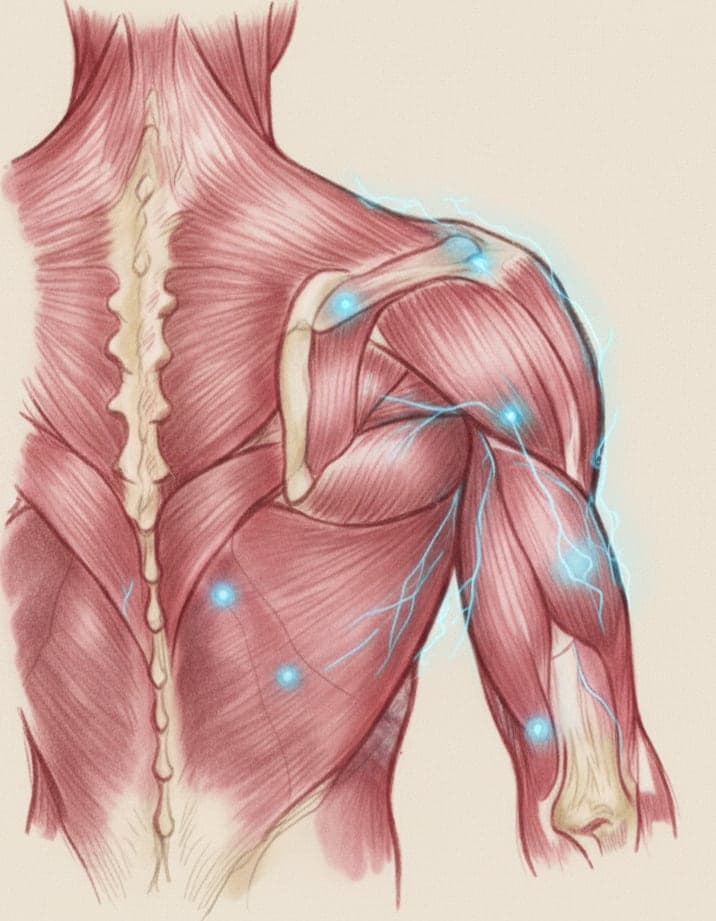
None of these are diagnoses. They are the first places I look when someone describes a familiar pattern, and palpation confirms or rules them out.
How I assess before I treat
I do not start pressing on the first sore spot. A trigger point session at your home begins with a short conversation and a look at how you move, because the referral pattern and the movement restriction together tell me where to search.
Reproducing your familiar pain is the important step. A tender spot that just hurts locally is not necessarily a trigger point; a spot that sends the ache to the place you were complaining about almost certainly is. Once I have that, I have a target rather than a guess.
I also pay attention to the order of things. Proximal muscles around the neck, shoulder girdle and pelvis tend to drive problems further out in the arm or leg. What presents as tennis elbow, for instance, is often kept going by trigger points in the forearm extensors, but those in turn are frequently loaded by a shoulder that is not moving well. If I only treat the forearm, the relief tends to be short.
What a session of trigger point therapy Paphos-wide looks like
I come to you, whether that is a flat in Kato Paphos, a villa in Tala or a rental in Coral Bay, with a treatment table and everything else needed. A 60-minute session (€90) covers one region thoroughly; 90 minutes (€130) lets me address a primary area and the compensating muscles around it, which is what most chronic patterns need. Every fifth session is free, and current details are on the pricing page.
The treatment itself is straightforward and quite different from a general massage:
- I warm the tissue with slower, broader strokes so the muscle is not guarding when I go deeper.
- I locate the taut band and the specific spot within it that reproduces your pain.
- I hold steady, precise pressure on that spot, typically for somewhere between 30 and 90 seconds, at a level you can breathe through, until it softens or the referred ache fades.
- I release, work along the band, and repeat on the next point.
- I finish by gently taking the muscle through its length so it does not simply shorten back.
Afterwards you may feel a little bruised in the treated area for a day or two, which is normal. Light walking, warmth and drinking water help; heavy training on that muscle group the same day does not.
Why I work with a mechanical device as well as my hands
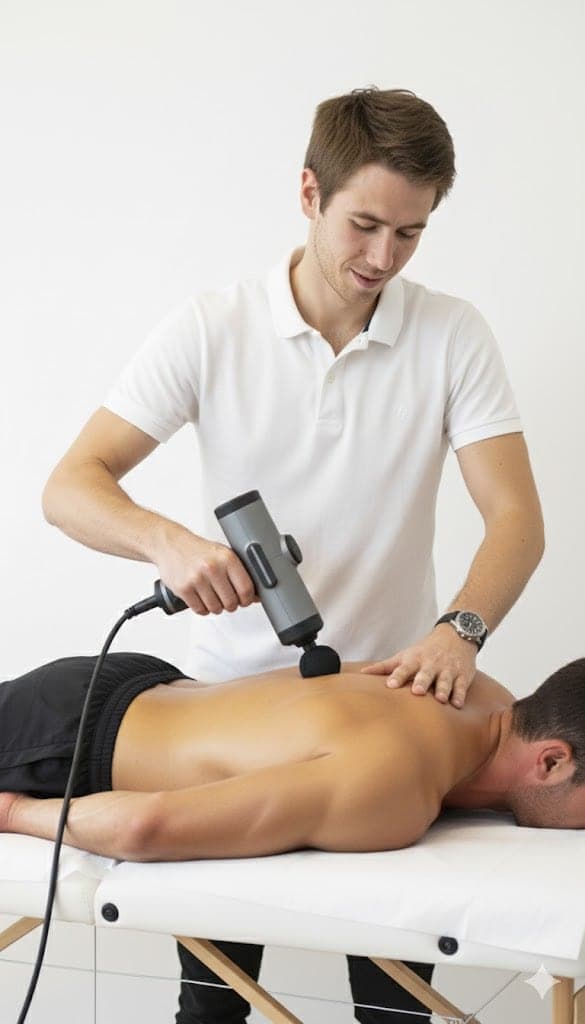
My background is a BSc in Physical Education and Nutrition from Norway, Norwegian massage certification and more than ten years of hands-on practice, and for the first years I worked purely manually. Two things pushed me towards adding a mechanical deep-tissue device.
The first was depth. Muscles such as the subscapularis, quadratus lumborum and the deep hip rotators sit under several layers of tissue, and holding accurate, sustained pressure there by thumb alone is hard on the therapist and inconsistent for the client. The second was consistency: on the fifth session of a day my thumbs are not as precise as on the first, and clients paying for focused work deserve the same quality every time.
The device does not replace palpation. My hands find the point; the tool lets me hold exactly the right pressure at exactly the right depth without drifting.
- Adjustable pressure and amplitude, so I can work gently on an irritable area and much more firmly on dense, trained tissue
- A rhythmic component that many people find easier to tolerate than static thumb pressure at the same depth
- Steady contact for the full hold, which is what a trigger point needs to let go
- Less strain on my hands, so the last person of the day gets the same session as the first
Some clients simply prefer hands, and for superficial trigger points that is fine. For deep, long-standing ones, the combination gets better results in my experience than either alone. If you would like broader work across whole muscle groups rather than pinpoint release, my deep tissue massage service may be the better fit.
Who this suits, and who should see a doctor first
Trigger point work suits people whose pain is muscular in origin: tension headaches, a stiff and aching neck from desk work, one-sided low back pain that follows long drives, hip and buttock aching that behaves like sciatica but has no true nerve findings, and the tight calves and heel pain common among people who walk the coastal path in the wrong shoes. Latent points in athletes are also worth addressing before they start to limit range of motion.
I can help with muscular pain that follows a referral pattern, tightness and restricted movement; I cannot help with, and will not treat, anything that looks structural, inflammatory or neurological, so see a doctor first if your pain came on after a fall or accident, wakes you at night regardless of position, is accompanied by numbness, weakness, fever, unexplained weight loss or bladder changes, or if you are on blood thinners or have a diagnosis you have not yet discussed with a physician.
Realistically, a chronic pattern that has been present for months rarely settles in one visit. Most people notice a clear change after the first session and need a handful more, spaced a week or two apart, then very occasional maintenance if the underlying load, whether that is a desk, a steering wheel or a training programme, has not changed.
Frequently asked questions
How is trigger point therapy different from deep tissue massage?
Deep tissue massage works broadly across a muscle group to reduce overall tension. Trigger point therapy is narrower: I search for the specific spot that reproduces your familiar pain and hold sustained pressure on that spot until it releases, then lengthen the muscle. The two often sit well together in one session, but the trigger point work is what addresses referred pain rather than general tightness.
Does trigger point therapy hurt?
It is uncomfortable rather than painful in the way an injury is. Pressing on an active point recreates the ache you already know, and most people describe it as intense but manageable. I keep the pressure at a level where you can still breathe slowly and stay relaxed, because a muscle that is guarding will not release. Expect some tenderness in the area for a day or two afterwards.
How many sessions will I need?
It depends on how long the pattern has been there and what keeps loading the muscle. A recent, single-region complaint often improves noticeably in one or two visits. Something that has been building for months usually needs several sessions a week or two apart, then occasional maintenance. I will give you an honest estimate after the first assessment rather than a fixed package.
Can I exercise after a session?
Gentle movement the same day is helpful: walking, easy mobility work, a warm shower. I would avoid heavy or repetitive loading of the treated muscles for 24 to 48 hours so the tissue can settle. If you are training for something in Paphos, tell me and I will place the session where it interferes least with your programme.
Will the trigger points come back?
They can, if the thing that created them does not change. A point released in the upper trapezius will reform if you go straight back to eight hours hunched over a laptop. Part of each session is showing you the movements, positions and simple self-release techniques that keep the muscle from shortening again, so that follow-up visits become occasional rather than routine.
Do you travel across the whole Paphos district?
Yes. I am based in Chlorakas and cover Paphos town, Kato Paphos, Geroskipou, Tala, Emba, Kissonerga, Coral Bay and Pegeia, and villages further out by arrangement. Book by WhatsApp or phone, tell me roughly what is bothering you and where you are staying, and I bring the table and equipment to you.
Written by
Chris
Massage therapist & body mechanics specialist
Norwegian-certified with a Bachelor’s in Physical Education and Nutrition and over ten years of clinical practice, working from a portable table in clients’ homes across the Paphos district.
- Norwegian-certified
- BSc Physical Education & Nutrition
- 10+ years clinical practice
- Based in Chlorakas · all of Paphos district
- No call-out fee anywhere in Paphos district
Last reviewed
This article is general information from clinical practice, not a medical diagnosis. If you have severe, worsening or unexplained pain, numbness, weakness, or pain after an accident, see a doctor first.