Thai Massage Geroskipou: Advanced Deep-Tissue Treatment That Delivers Lasting Results
In short
Discover authentic deep-tissue Thai massage in Geroskipou with a specialist who combines 10 years of experience, university-level expertise in body mechanics, and precision machine-assisted techniques for lasting pain relief.
I remember my first client in Geroskipou who came to me after spending over €800 on traditional Thai massage sessions. She’d been going twice a week for four months, leaving each session feeling temporarily relaxed, only to wake up the next morning with the same shoulder tension that had plagued her for years. Within three sessions using my mechanical deep-tissue method, her chronic pain was gone. Not masked. Not temporarily relieved. Gone.
That’s the fundamental difference between what I do and what you’ll find at conventional Thai massage establishments in Geroskipou. After a decade of specializing in advanced body mechanics and holding a Bachelor’s degree in Physical Education and Nutrition from Norway, I’ve learned a critical truth: most massage fails because it treats symptoms, not causes.
Why Traditional Thai Massage in Geroskipou Falls Short
Traditional Thai massage has a rich 2,500-year history rooted in Buddhist healing practices. I respect that tradition deeply. However, the typical Thai massage experience in Geroskipou—and elsewhere—operates on a fundamentally flawed premise: that surface-level manipulation and temporary relaxation constitute effective treatment.
Let me be direct about what happens in most Thai massage sessions:
- Therapists apply pressure using hands, elbows, and body weight—techniques limited by human strength and consistency
- Treatments focus on general relaxation rather than targeting specific mechanical dysfunctions
- Sessions provide temporary relief that dissipates within 24-48 hours
- The underlying muscular imbalances and fascial restrictions remain unaddressed
- Clients become dependent on recurring sessions without ever achieving lasting resolution
I’ve seen this pattern repeatedly with clients who come to me after months or years of traditional Thai massage. They’ve invested significant time and money into a system that keeps them coming back but never sets them free.
The Science Behind Chronic Muscular Dysfunction
Understanding why traditional approaches fail requires understanding basic biomechanics. Your musculoskeletal system operates as an integrated kinetic chain. When one component develops dysfunction—whether from repetitive stress, poor posture, athletic overuse, or acute injury—compensatory patterns emerge throughout the entire system.
These compensations create what I call “mechanical debt”: accumulated tension, fascial adhesions, and trigger points that exist in deep tissue layers beyond the reach of standard manual therapy. Addressing this debt requires precision, power, and consistency—three elements human hands simply cannot deliver reliably.
Advanced Mechanical Deep-Tissue Massage: The Geroskipou Solution
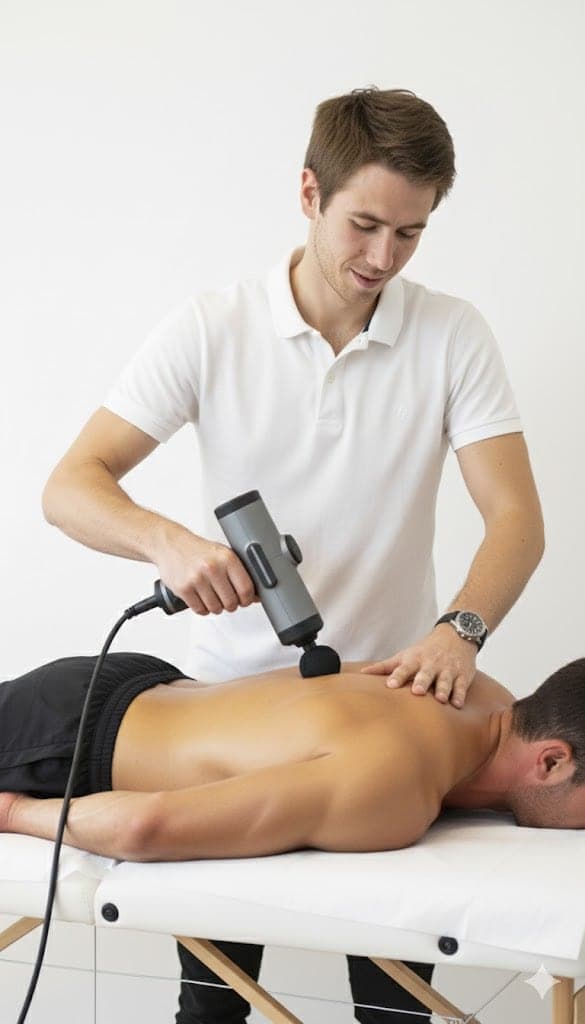
My specialized method for Thai massage in Geroskipou represents a complete paradigm shift from traditional approaches. I utilize a precision mechanical device that allows me to work deeper, more accurately, and more consistently than any manual technique can achieve.
This isn’t a relaxation massage. This is clinical intervention designed to produce measurable, lasting results.
Precision: Targeting the Root Cause
The mechanical tool I use allows for millimeter-precise targeting of specific muscular structures, fascial planes, and trigger points. During assessment, I identify exactly which tissues are harboring mechanical dysfunction. Then I systematically address each area with controlled, sustained pressure that reaches depths of 8-10 centimeters when necessary.
One client—a competitive cyclist training for international events—came to me with chronic iliotibial band syndrome that had resisted six months of conventional treatment. Using precise mechanical pressure along the fascial planes connecting his hip flexors, tensor fasciae latae, and lateral thigh structures, I released adhesions that manual therapy couldn’t access. He returned to full training capacity within two weeks.
Power: Deeper Than Human Hands
Human thumbs, elbows, and body weight have inherent limitations. Even the strongest therapist fatigues. Even the most skilled practitioner cannot maintain consistent pressure at therapeutic depths for extended periods.
My mechanical system delivers sustained force ranging from gentle superficial work to powerfully deep penetration—adjusted precisely to each client’s tolerance and therapeutic requirements. This capability is not about causing pain; it’s about reaching the tissue layers where chronic dysfunction actually lives.
I had a client in Geroskipou who worked construction for 25 years. His trapezius and rhomboid muscles had developed calcified trigger points that created constant referral pain down his arms. Traditional massage had touched these structures superficially without effect. Using controlled mechanical pressure, I systematically broke down these calcifications over four sessions, restoring full functional capacity to muscles that hadn’t worked properly in over a decade.
Consistency: Eliminating the Variable of “Bad Days”
Every manual therapist has off days. Fatigue, personal stress, minor illness—these factors inevitably affect performance. The mechanical approach eliminates this variable entirely.
Every session I provide delivers identical power, precision, and effectiveness. Your fourth treatment will be exactly as thorough as your first. This consistency is crucial for protocols requiring progressive tissue adaptation over multiple sessions.
Understanding the Treatment Philosophy: Partnership, Not Dependency
When I work with clients in Geroskipou seeking Thai massage, I’m not offering a product—I’m proposing a partnership aimed at lasting resolution. This distinction fundamentally separates my approach from the traditional massage model.
Customized Treatment Protocols
During our initial assessment, I conduct a comprehensive biomechanical evaluation:
- Movement Analysis: I observe how your body moves through functional patterns, identifying compensations and restrictions
- Palpation Assessment: I manually examine tissue quality, identifying areas of hypertonicity, adhesion, and trigger point activity
- Pain Mapping: We establish exactly where you experience discomfort and correlate this with underlying mechanical dysfunction
- Goal Setting: We define specific, measurable outcomes—not vague notions of “feeling better”
Based on this assessment, I design a customized protocol. For acute issues, this might involve 2-3 intensive sessions. For chronic conditions developed over years, we might plan 6-8 sessions with specific milestones at each stage.
Education and Empowerment
Part of our partnership involves education. I explain exactly what’s happening in your tissues, why certain areas have developed dysfunction, and what we’re doing to address it. You’re not a passive recipient of treatment—you’re an active participant in your own restoration.
I also provide guidance on movement patterns, postural adjustments, and maintenance strategies to preserve the results we achieve. My goal is to make you independent, not dependent.
Common Conditions I Address in Geroskipou
Over ten years of specialized practice, I’ve developed protocols for virtually every musculoskeletal condition affecting adults. Clients come to me in Geroskipou for Thai massage when they’re really seeking solutions for:
| Condition | Traditional Approach | My Mechanical Protocol | Expected Timeline |
|---|---|---|---|
| Chronic Lower Back Pain | Temporary relief through general massage | Targeted release of psoas, quadratus lumborum, and lumbar erectors | 4-6 sessions for lasting resolution |
| Frozen Shoulder | Months of passive stretching | Deep capsular release and rotator cuff restoration | 6-8 sessions for full mobility |
| Tension Headaches | Medication and surface neck massage | Suboccipital release and cervical fascial treatment | 2-4 sessions to eliminate triggers |
| Plantar Fasciitis | Endless stretching and orthotics | Deep fascial release of foot and calf complex | 3-5 sessions for pain-free walking |
| Athletic Performance Plateau | More training volume | Systematic release of movement restrictions | 2-3 sessions for measurable improvement |
Real Cases from My Geroskipou Practice
Case Study: The Office Manager
A 42-year-old office manager contacted me after developing severe upper trapezius pain that radiated into her skull, causing daily headaches. She’d tried three different Thai massage therapists in Geroskipou over six months without lasting improvement.
During assessment, I identified the actual problem: chronic hypertonicity in her scalene muscles (anterior neck) was creating a traction injury on her trapezius. The scalenes were the cause; the trapezius pain was the symptom. Every previous therapist had worked on her upper back—the painful area—while missing the root cause entirely.
Using mechanical precision, I released her scalene muscles over two sessions, then addressed the secondary trapezius tension. After session three, her headaches were gone. Six months later, they haven’t returned.
Case Study: The Weekend Athlete
A 38-year-old amateur footballer came to me with chronic hamstring tightness that limited his performance and caused recurrent minor strains. He’d been stretching religiously for two years without improvement.
The issue wasn’t muscle length—it was trigger point activity in his gluteus medius creating referred tension down the posterior chain. Once I released these deep trigger points using sustained mechanical pressure, his hamstring “tightness” resolved immediately. He hasn’t had a strain in over a year.
These cases illustrate a critical principle: where you feel pain is rarely where the problem actually lives.
The Investment in Long-Term Health
When clients ask about pricing for Thai massage in Geroskipou, I reframe the question entirely. You’re not purchasing a massage session. You’re investing in lasting resolution of mechanical dysfunction that’s affecting your quality of life, work performance, athletic capacity, or daily comfort.
Consider the economics:
- Traditional massage at €40-60 per session, required weekly or bi-weekly indefinitely = €2,080-4,680 annually
- My intensive protocol at higher per-session rates for 4-8 sessions = complete resolution and freedom from ongoing costs
Which represents better value? The answer becomes obvious when you shift from thinking about temporary relief to thinking about lasting results.
What Makes This an Investment, Not an Expense
An expense is money spent on something that provides temporary benefit and requires replacement. An investment is money spent on something that generates ongoing returns.
My treatment protocols are investments because they:
- Eliminate the need for ongoing massage dependency
- Restore full functional capacity for work and recreation
- Prevent the progression of minor dysfunction into serious injury
- Improve athletic performance through optimized movement mechanics
- Enhance quality of life by eliminating chronic pain
One client calculated that within six months of completing his protocol, he’d saved enough on weekly massage sessions to cover the entire cost—while simultaneously achieving results he’d never obtained from traditional treatment.
The Convenience Factor: Mobile Service Throughout Geroskipou
I travel to your location anywhere in Geroskipou and surrounding areas. I bring everything required: professional treatment bench, mechanical equipment, and all necessary supplies. You receive clinical-grade treatment in the comfort and privacy of your own space.
This mobile approach serves multiple purposes:
- Time Efficiency: No travel time to a clinic, no waiting rooms, no schedule disruptions
- Privacy: Many clients prefer the confidentiality of home-based treatment, particularly when addressing sensitive areas or undressing
- Consistency: Treatment in your familiar environment eliminates variables that might affect your response to therapy
- Convenience: Schedule sessions around your life rather than adapting your life around clinic hours
For athletes, I can set up in training facilities. For busy professionals, I accommodate early morning or evening sessions at home. For individuals with mobility limitations, I eliminate the challenge of traveling while in pain.
Who Benefits Most from Advanced Deep-Tissue Treatment
While I can help anyone with musculoskeletal dysfunction, certain populations benefit especially dramatically from my approach:
Chronic Pain Sufferers
If you’ve lived with persistent pain for months or years, tried multiple therapists without lasting improvement, and been told to “just manage it,” you’re exactly the client I specialize in helping. Chronic pain is not a life sentence—it’s a mechanical problem requiring mechanical solution.
Athletes and Active Individuals
Weekend warriors, competitive athletes, and fitness enthusiasts frequently develop movement restrictions that limit performance before causing pain. Systematic release of these restrictions produces immediate, measurable improvements in strength, flexibility, and athletic output.
I’ve worked with cyclists who gained 15-20 watts in threshold power after hip flexor release. Runners who dropped 30 seconds per kilometer after addressing plantar and calf dysfunction. CrossFit athletes who achieved new personal records in Olympic lifts after shoulder girdle optimization.
Desk Workers and Professionals
The modern workplace creates predictable patterns of dysfunction: forward head posture, rounded shoulders, thoracic kyphosis, and hip flexor shortening. Left unaddressed, these patterns progress from minor discomfort to debilitating pain.
Addressing these issues early—before they escalate—represents true preventive healthcare. Most of my professional clients wish they’d found me years earlier, before their postural dysfunction became severe.
Post-Injury Recovery
After acute injury, tissues heal but often with adhesions, compensatory patterns, and residual restrictions that limit full recovery. These residual dysfunctions create vulnerability to re-injury and prevent return to pre-injury performance levels.
My protocols systematically address these residual restrictions, completing the recovery process that physical therapy initiated but couldn’t finish.
Frequently Asked Questions About Thai Massage Geroskipou
Is mechanical deep-tissue massage painful?
There’s a critical distinction between therapeutic discomfort and damaging pain. My treatments frequently involve discomfort—you’re feeling the release of chronically tight tissue that’s been dysfunctional for extended periods. However, pain is always kept within your tolerance. I adjust intensity continuously based on your feedback and tissue response. The majority of clients describe the sensation as “intense but satisfying” rather than painful.
How is this different from traditional Thai massage?
Traditional Thai massage uses manual techniques—hands, elbows, feet, body weight—to provide general relaxation and temporary relief. My mechanical approach uses precision equipment to deliver therapeutic pressure at depths and with consistency that manual work cannot achieve. The goal isn’t relaxation; it’s lasting resolution of mechanical dysfunction. Think of it as the difference between general maintenance and surgical precision.
How many sessions will I need?
This depends entirely on the condition being addressed, how long it’s existed, and your individual tissue response. Acute issues (recent onset, single location) often resolve in 2-4 sessions. Chronic conditions (months or years of dysfunction, multiple compensatory patterns) typically require 6-10 sessions. During initial assessment, I provide a realistic timeline based on your specific situation.
Do I need ongoing maintenance sessions?
For most clients, no. My goal is lasting resolution, not dependency. However, some individuals choose occasional maintenance—perhaps quarterly or semi-annually—particularly if they have demanding athletic pursuits or occupational stress patterns. This is choice, not necessity.
What should I expect during my first session?
Your first appointment includes comprehensive assessment (20-30 minutes) followed by initial treatment (60-90 minutes). We’ll discuss your history, conduct movement analysis, perform palpation assessment, and establish treatment goals. The first session typically involves less aggressive intervention while I gauge your tissue response and tolerance. Subsequent sessions progress more intensively as your tissues adapt.
Is this treatment suitable for elderly clients?
Absolutely. I adjust intensity appropriately for each individual’s tissue tolerance. Many of my most satisfied clients are over 60, dealing with decades of accumulated mechanical dysfunction. Age is not a contraindication—it’s often an indication that intervention is overdue.
Can you help with conditions like arthritis or herniated discs?
While I don’t treat arthritis or disc pathology directly (those are medical conditions), I absolutely address the muscular dysfunction surrounding these conditions. Often, 80% or more of the pain attributed to arthritis or disc issues actually originates from muscular trigger points and fascial restrictions. Releasing these structures provides dramatic relief even when underlying pathology remains.
Do you work with medical professionals?
Yes. I frequently receive referrals from physicians, physiotherapists, and chiropractors who recognize that certain conditions require the depth and precision my approach provides. I also refer clients for medical evaluation when I identify conditions requiring medical intervention beyond my scope.
Why Location Matters: Thai Massage in Geroskipou
Geroskipou has become home to numerous massage establishments, from hotel spas to traditional Thai massage parlors. The competition for your business is intense. However, competition based on price and convenience misses the fundamental question: does the treatment actually solve your problem durably?
I’ve chosen to serve the Geroskipou area because I’ve identified a significant gap between what’s available and what people actually need. The tourism industry has created abundant options for relaxation massage. What’s lacking is clinical-grade intervention for residents and long-term visitors dealing with real mechanical dysfunction.
Serving Both Residents and Visitors
For Geroskipou residents, I offer the partnership-based approach described throughout this article: comprehensive assessment, customized protocols, and commitment to lasting resolution.
For visitors spending extended time in the area—whether for work, winter residence, or extended vacation—I provide intensive protocols designed to maximize results within your available timeline. If you’re here for three weeks, we’ll schedule sessions strategically to produce significant progress before you depart.
The Science Behind the Results
My approach is grounded in evidence-based understanding of musculoskeletal physiology. When I apply sustained mechanical pressure to dysfunctional tissue, several physiological processes occur:
Fascial Release
Fascia—the connective tissue surrounding every muscle fiber, muscle group, and organ—becomes restricted through injury, chronic tension, and poor movement patterns. These restrictions create “adhesions” that limit tissue mobility and generate pain signals. Sustained mechanical pressure induces fascial release through a process called thixotropy, where organized collagen fibers temporarily liquefy under pressure, allowing reorganization into healthier patterns.
Trigger Point Deactivation
Trigger points are hyperirritable spots within taut bands of muscle that produce local and referred pain. Research by Travell and Simons (the definitive texts on myofascial pain) demonstrates that sustained pressure—precisely what my mechanical approach delivers optimally—is the most effective method for deactivating these trigger points durably.
Neural Reset
Chronic dysfunction creates aberrant neural patterns where the nervous system continuously signals muscles to maintain tension. Intensive treatment essentially “reboots” these patterns through a process called autogenic inhibition, where sustained pressure on muscle-tendon junctions causes reflexive relaxation and neural reset.
Improved Tissue Perfusion
Chronically tight muscles have compromised blood flow, reducing oxygen and nutrient delivery while allowing metabolic waste accumulation. Deep tissue work dramatically increases local blood flow, accelerating healing and restoring optimal tissue function.
Making the Decision: Next Steps
If you’ve read this far, you’re likely someone who:
- Has tried conventional approaches without achieving lasting results
- Understands the difference between temporary relief and lasting resolution
- Values expertise, precision, and results over generic relaxation
- Recognizes that your pain or dysfunction deserves professional attention, not resignation
The decision to work with me isn’t complicated. Either you’re ready to invest in lasting resolution of your mechanical dysfunction, or you’re comfortable continuing with approaches that haven’t worked.
I don’t market to people seeking cheap relaxation. I work with people who want their bodies to function optimally, durably, and are willing to invest appropriately to achieve that outcome.
When you’re ready to move beyond temporary fixes and actually solve your musculoskeletal problems, contact me. We’ll schedule a comprehensive assessment, establish clear goals, and design a protocol that gets you there.
Understanding the Broader Context of Manual Therapy
Thai massage—traditional or modern—exists within the larger ecosystem of manual therapy modalities. Understanding where each approach fits helps clarify why my mechanical method delivers superior results for mechanical problems.
The Manual Therapy Spectrum
| Modality | Primary Purpose | Depth | Clinical Effectiveness |
|---|---|---|---|
| Swedish Massage | Relaxation, circulation | Superficial | Low for dysfunction |
| Traditional Thai | Flexibility, relaxation | Superficial-moderate | Moderate, temporary |
| Sports Massage | Recovery, performance | Moderate | Moderate for acute issues |
| Manual Deep Tissue | Chronic tension release | Moderate-deep | High but inconsistent |
| Mechanical Deep Tissue | Lasting dysfunction resolution | Deep-very deep | Very high, consistent |
Each modality has appropriate applications. When you need relaxation and stress relief, Swedish or traditional Thai massage serves well. When you need lasting resolution of mechanical dysfunction that’s affecting your life quality, work capacity, or athletic performance, mechanical deep-tissue intervention is the appropriate choice.
The Professional Standards I Maintain
My background in Physical Education and Nutrition, combined with a decade of specialized practice, means I approach bodywork from a fundamentally different perspective than most massage therapists. I think like an exercise physiologist who happens to use manual intervention as the primary tool.
This background manifests in several ways:
Evidence-Based Practice
Every technique I use has research support demonstrating its effectiveness for specific conditions. I don’t employ modalities because they’re trendy or because clients request them. I use what works, proven through both clinical evidence and my own decade of outcomes tracking.
Continuous Professional Development
The field of manual therapy continues evolving. I regularly review new research on fascial mechanics, pain neuroscience, and treatment methodologies. My approach today incorporates understanding that didn’t exist when I started practicing.
Outcome Measurement
Unlike traditional massage where “success” is subjective feeling, I track objective outcomes: range of motion improvements, pain scale reductions, functional capacity gains. This data-driven approach ensures that my protocols are actually producing the results I claim.
Final Thoughts on Thai Massage in Geroskipou
The massage industry has conditioned people to accept temporary relief as success. Bi-weekly sessions become routine, accepted as necessary maintenance. Pain becomes something to manage rather than eliminate.
I reject this paradigm entirely.
Your body is a mechanical system. When mechanical systems develop dysfunction, they require mechanical correction—not repetitive palliative measures. The right intervention, applied with sufficient precision and power, produces lasting resolution. This isn’t wishful thinking; it’s mechanical reality I’ve demonstrated hundreds of times over ten years of practice.
If you’re in Geroskipou seeking Thai massage, ask yourself what you’re actually seeking. If it’s an hour of relaxation and temporary stress relief, numerous establishments will serve you well. If it’s lasting resolution of pain or dysfunction that’s diminishing your life quality, I offer something fundamentally different and demonstrably more effective.
The question isn’t whether your problem can be solved durably. The question is whether you’re ready to stop settling for temporary solutions.
When you are, I’m here—with the expertise, equipment, and commitment to get you there.
Written by
Chris
Massage therapist & body mechanics specialist
Norwegian-certified with a Bachelor’s in Physical Education and Nutrition and over ten years of clinical practice, working from a portable table in clients’ homes across the Paphos district.
This article is general information from clinical practice, not a medical diagnosis. If you have severe, worsening or unexplained pain, numbness, weakness, or pain after an accident, see a doctor first.