Remedial Massage Education and Certification: The Complete Professional Pathway
In short
Discover what it takes to become a certified remedial massage therapist, from foundational education to advanced specialization, and why credentials matter in delivering lasting therapeutic results.
The remedial massage field attracts individuals seeking to make a genuine difference in people’s lives through skilled, therapeutic intervention. Yet there exists a substantial gap between those who complete basic massage training and professionals who deliver measurable, lasting clinical outcomes. After a decade of specialized practice and holding a Bachelor’s degree in Physical Education and Nutrition from Norway, I’ve witnessed firsthand how education quality directly determines treatment effectiveness.
Remedial massage education and certification requirements vary significantly across jurisdictions, but the underlying principle remains constant: comprehensive training in anatomy, biomechanics, and pathology separates competent practitioners from those merely going through motions. This article examines the essential requirements, advanced specializations, and critical distinctions that define excellence in this therapeutic discipline.
Understanding Remedial Massage as a Clinical Discipline
Remedial massage represents a fundamentally different approach than relaxation massage. Where spa treatments focus on superficial comfort, remedial therapy targets specific musculoskeletal dysfunction with precision and clinical intent. This distinction shapes every aspect of the educational pathway.
I entered this field through a rigorous academic program that integrated human physiology, biomechanics, and nutritional science. That foundation proved invaluable—not because massage itself requires a university degree, but because understanding body systems at a cellular and mechanical level transforms how you assess and treat dysfunction. You’re not simply applying techniques; you’re solving complex three-dimensional puzzles within living tissue.
The remedial massage practitioner functions as a clinical specialist addressing:
- Chronic pain patterns stemming from muscular compensation
- Movement restrictions caused by adhesions and fascial dysfunction
- Postural imbalances creating systemic mechanical stress
- Sports injuries requiring targeted rehabilitation protocols
- Nerve entrapment syndromes from soft tissue compression
This clinical focus demands substantially more sophisticated training than basic massage certification provides.
Foundational Educational Requirements for Remedial Massage Certification
Entry-level remedial massage education typically encompasses 500 to 1,000 hours of formal training, though truly comprehensive programs exceed this minimum considerably. The curriculum must address specific competency areas that enable safe, effective clinical practice.
Core Academic Components
Anatomy and Physiology: Detailed study of musculoskeletal structures, neuromuscular function, circulatory systems, and connective tissue architecture. You cannot treat what you cannot visualize. I regularly encounter practitioners who know muscle names but cannot explain fascial planes, attachment sites, or how force transmission occurs through kinetic chains. That knowledge gap manifests directly in treatment limitations.
Pathology and Assessment: Recognition of contraindications, inflammatory processes, and pathological conditions requiring medical referral. One of the most critical distinctions between adequate and exceptional practitioners lies in knowing when not to treat—when a condition exceeds massage scope and demands medical intervention.
Clinical Reasoning and Diagnosis: Systematic evaluation protocols for identifying primary dysfunction versus compensatory patterns. Most chronic pain originates far from where clients feel symptoms. Without sophisticated assessment skills, practitioners treat symptoms endlessly while root causes persist untouched.
Technical Skill Development
Hands-on training should progress from basic techniques to advanced modalities:
| Skill Level | Techniques Mastered | Clinical Application |
|---|---|---|
| Foundation | Swedish massage, basic trigger point therapy, basic stretching | General muscular tension, superficial relaxation |
| Intermediate | Deep tissue protocols, myofascial release, cross-fiber friction | Chronic tension patterns, adhesion breakdown |
| Advanced | Neuromuscular therapy, structural integration, kinetic chain correction | Complex pain syndromes, biomechanical optimization |
| Specialized | Instrument-assisted techniques, precision mechanical therapy | Resistant conditions, athletic performance enhancement |
The progression matters enormously. Practitioners who rush through foundational training to reach “advanced” techniques inevitably lack the clinical judgment to apply those methods effectively.
Certification Bodies and Credential Variations
The remedial massage certification landscape contains numerous regulatory bodies, each with distinct standards. In Australia, remedial massage represents a recognized health profession with insurance recognition and specific educational requirements. The United Kingdom, United States, and European nations maintain different frameworks, creating complexity for internationally mobile practitioners.
Key Certification Organizations
Australia: The Australian Association of Massage Therapists (AAMT) and Massage & Myotherapy Australia (MMA) establish national standards requiring accredited diploma-level training with minimum 600 clinical hours.
United Kingdom: The Complementary and Natural Healthcare Council (CNHC) registers massage therapists meeting approved qualification standards, typically Level 4 or 5 diplomas.
United States: The National Certification Board for Therapeutic Massage & Bodywork (NCBTMB) offers certification following approved programs, though state-level licensing varies dramatically.
Europe: Standards differ by nation, with Scandinavian countries often requiring integration with broader healthcare education frameworks.
From my Norwegian educational background, the integration between massage therapy and broader exercise science created a multidimensional understanding impossible to achieve through massage-only training. That comprehensive foundation enables me to address not just tissue dysfunction but movement patterns, nutritional factors affecting inflammation, and training modifications supporting long-term correction.
The Critical Distinction: Certification Versus Competence
Here’s an uncomfortable truth the wellness industry avoids: certification confirms you completed required training hours. It does not confirm you can deliver clinical results. I’ve observed practitioners with impressive credentials who provide marginally effective treatments because their training emphasized technique memorization over clinical reasoning.
Genuine competence develops through three essential elements beyond basic certification:
1. Extensive Clinical Experience Under Supervision
The 100th client teaches you what textbooks cannot. Pattern recognition, subtle palpation skills, and treatment strategy refinement emerge only through accumulated clinical hours with diverse presentations. Quality remedial massage programs include supervised clinical internships where students work with real clients under experienced practitioner oversight.
My own development accelerated dramatically when treating athletes with specific performance demands. One cyclist experiencing persistent knee pain demonstrated a pattern I’d read about theoretically—posterior chain tightness creating altered pedaling mechanics—but feeling that dysfunction three-dimensionally through my hands created understanding no textbook could replicate.
2. Continuous Advanced Education
Initial certification represents the beginning, not the culmination, of professional development. The human body’s complexity means specialists must continuously refine understanding and expand technique repertoire.
I’ve invested thousands of hours beyond initial education into specialized training: advanced fascial manipulation protocols, neuromuscular therapy systems, and ultimately, precision mechanical deep-tissue methodologies using specialized equipment. Each advancement opened new treatment possibilities for clients who had exhausted conventional approaches.
3. Development of Clinical Philosophy and Methodology
The most significant professional evolution involves developing a coherent treatment philosophy grounded in results rather than tradition. Many practitioners simply replicate methods they learned without questioning effectiveness or seeking superior alternatives.
My transition to machine-assisted remedial massage stemmed from honest assessment of manual therapy limitations. Despite advanced training and considerable hand strength, certain deeply embedded adhesions and chronic tension patterns resisted manual breakdown. Clients improved but rarely achieved complete resolution. That frustrated me—not because my technique was poor, but because the human hand has inherent limitations in force application, consistency, and precision.
Advanced Specialization: Where Real Differentiation Occurs
Beyond foundational certification, remedial massage practitioners diverge dramatically based on specialization choices. These advanced pathways define career trajectory and clinical effectiveness.
Sports and Athletic Performance
Sports massage specialization requires understanding biomechanics specific to different athletic disciplines. A runner’s dysfunction pattern differs fundamentally from a swimmer’s or weightlifter’s. Treatment must account for sport-specific movement demands, training cycles, and performance optimization—not just injury treatment.
Chronic Pain Management
Chronic pain presentations demand sophisticated understanding of central sensitization, pain neuroscience, and the biopsychosocial model. Tissue work represents only one component within comprehensive pain management strategies.
Postural and Structural Integration
This specialization addresses whole-body mechanical patterns rather than isolated symptoms. Practitioners analyze and correct fascial restrictions and muscular imbalances creating systemic dysfunction. Treatment protocols extend across multiple sessions with progressive structural goals.
Instrument-Assisted and Technology-Enhanced Approaches
This represents the frontier of remedial massage evolution. Advanced mechanical tools provide capabilities impossible through manual therapy alone:
Precision: Specific anatomical targeting without collateral tissue stress Power: Deep penetration to restriction layers hands cannot reach effectively Consistency: Uniform force application eliminating practitioner fatigue variables
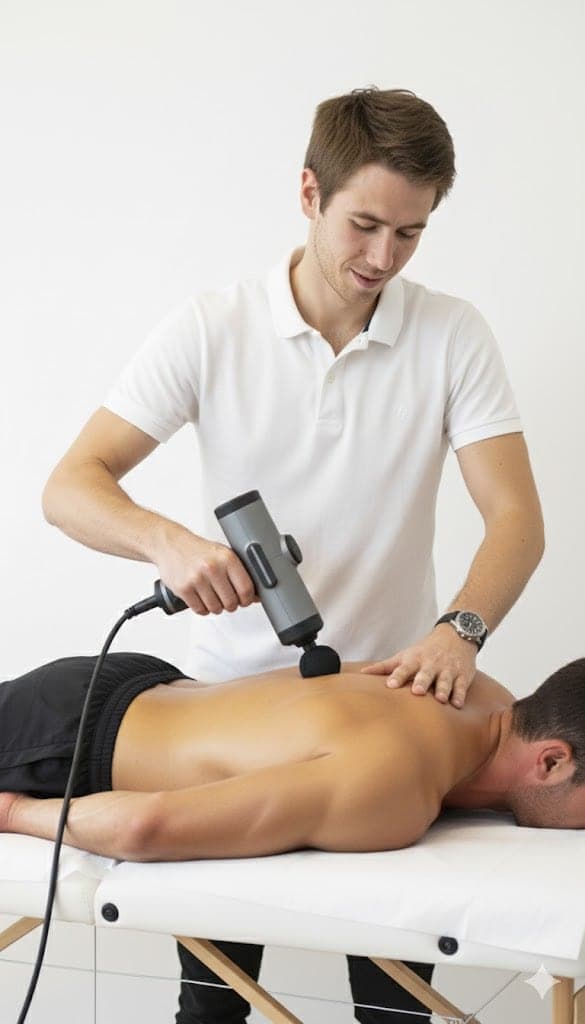
My specialized machine delivers these advantages definitively. The tool works deeper than hands can, releasing tension at its source rather than superficial layers. I maintain complete control, adjusting intensity from light to powerfully deep depending on tissue condition and client tolerance. Most critically, it eliminates “off days”—every treatment delivers equally effective results regardless of my physical state.
The Investment Required: Time, Money, and Commitment
Becoming a genuinely effective remedial massage therapist demands substantial investment. Prospective students should understand realistic cost and time commitments before beginning this pathway.
Financial Investment
| Educational Component | Typical Cost Range (USD) | Duration |
|---|---|---|
| Initial Certification Program | a wide range of costs | 6-18 months |
| Advanced Technique Workshops | a wide range of costs per course | 2-5 days each |
| Specialty Certifications | a wide range of costs | 3-12 months |
| Continuing Education (annual) | a wide range of costs | Ongoing |
| Professional Equipment | a wide range of costs | One-time investment |
These figures represent baseline investments. Practitioners pursuing genuine excellence typically exceed these amounts considerably through advanced training and specialized equipment acquisition.
Time Commitment
Initial certification: 6 to 24 months depending on program intensity and full-time versus part-time enrollment.
Clinical competence development: 2 to 5 years of supervised or independent practice treating diverse presentations.
Mastery level: 5 to 10 years combining extensive clinical hours with continued advanced education.
The ROI Equation
This investment yields returns only if you commit to genuine clinical excellence. The market distinguishes between practitioners who provide temporary symptom relief and those delivering lasting correction. Clients seeking real solutions will invest significantly in effective treatment while avoiding practitioners who simply “rub muscles” without strategic intent.
I position my service explicitly as an investment in long-term health, not an expense. That positioning is honest—clients who work with me experience lasting resolution of chronic issues that consumed years of their lives and thousands of dollars in unsuccessful treatments. That outcome justifies premium pricing because the value delivered far exceeds the monetary cost.
Choosing the Right Educational Pathway
Prospective remedial massage students face critical decisions shaping their entire professional trajectory. These guidelines help navigate program selection:
Accreditation and Recognition
Verify that programs hold accreditation from recognized bodies relevant to your practice location. Unaccredited training may not qualify for professional insurance or satisfy regulatory requirements.
Curriculum Depth and Clinical Hours
Examine detailed curriculum content. Programs emphasizing memorization of technique sequences without corresponding anatomical reasoning produce limited practitioners. Look for substantial supervised clinical hours—minimum 200, preferably 500 or more.
Faculty Expertise and Clinical Background
Instructors should maintain active clinical practices, not simply teach theory disconnected from real-world application. Faculty who regularly treat complex cases bring current, practical knowledge to education.
Philosophy and Approach Alignment
Different programs emphasize distinct philosophical approaches—energy-based theories, biomechanical models, or integrated methodologies. Ensure the program’s perspective aligns with your professional goals and evidence-based practice values.
Advanced Training Opportunities
The best foundational programs connect students to advanced training pathways rather than positioning initial certification as terminal education.
Beyond Certification: Building a Results-Driven Practice
The ultimate measure of remedial massage education and certification lies not in credentials accumulated but in client outcomes achieved. After ten years specializing in advanced mechanical deep-tissue work, I’ve learned that sustainable practice success requires several key elements.
Specialization Over Generalization
You cannot be expert in everything. I deliberately narrowed my focus to mechanical deep-tissue therapy using precision equipment because that specialization delivers superior results for chronic pain and performance optimization compared to generalist approaches. Clients don’t seek “massage therapists”—they seek specialists who solve their specific problems definitively.
Outcome Documentation and Communication
Track objective progress markers: range of motion measurements, pain scale ratings, functional capacity improvements. Data-driven practice builds client confidence and distinguishes your work from subjective “wellness” services.
Customized Treatment Protocols
Standardized massage sessions represent the opposite of remedial therapy. Every client presents unique dysfunction patterns requiring individualized assessment and tailored treatment strategies. I develop dedicated partnerships with customized plans, not one-off sessions, because meaningful correction demands progressive, strategic intervention.
Professional Infrastructure
Invest in proper equipment and create professional treatment environments. I travel to clients’ locations with a complete professional setup including specialized massage bench and advanced mechanical equipment. This mobile service eliminates barriers while maintaining clinical standards.
Common Misconceptions About Remedial Massage Credentials
Several persistent myths confuse prospective practitioners and clients alike:
Myth 1: More certifications equal better practitioners. Reality: Certificate accumulation without depth often signals shallow expertise. Mastery of core competencies outweighs collection of superficial credentials.
Myth 2: Remedial massage requires only manual techniques. Reality: Advanced mechanical tools significantly enhance treatment effectiveness for resistant conditions. Manual therapy has inherent limitations that technology can overcome.
Myth 3: Initial certification provides sufficient knowledge. Reality: Entry-level training establishes baseline competence. True expertise develops through years of clinical experience and continuous advanced education.
Myth 4: All remedial massage approaches deliver similar results. Reality: Methodology differences create dramatically divergent outcomes. Generic techniques produce generic results; precision approaches solve specific problems.
Myth 5: Formal education matters less than “natural talent.” Reality: Intuition without anatomical knowledge produces inconsistent, potentially harmful treatment. Comprehensive education provides the framework where skill can develop safely and effectively.
The Future of Remedial Massage Professional Development
The remedial massage field stands at an inflection point. Increasing recognition of massage therapy’s clinical value drives demand for genuinely effective practitioners, while simultaneously exposing the limitations of traditional training models.
Several trends will shape future remedial massage education and certification:
Integration with Mainstream Healthcare
Progressive healthcare systems increasingly incorporate remedial massage within multidisciplinary treatment teams. This integration demands higher educational standards, evidence-based practice models, and outcome documentation capabilities.
Technology-Enhanced Treatment Modalities
Advanced tools providing capabilities beyond manual therapy alone will become standard in progressive practices. Education must evolve to include proper application of percussion devices, instrument-assisted techniques, and other mechanical modalities.
Specialization and Credentialing Refinement
The generic “massage therapist” designation will fragment into specialized credentials reflecting distinct expertise areas. Just as medicine contains numerous specialties, remedial massage will develop clear distinction between general practitioners and advanced specialists.
Research-Informed Practice Standards
Growing research into fascial science, myofascial pain mechanisms, and manual therapy effectiveness will refine educational content and treatment protocols. Practitioners must engage with current literature rather than perpetuating outdated models.
Frequently Asked Questions About Remedial Massage Education and Certification
How long does it take to become a certified remedial massage therapist?
Initial certification typically requires 6 to 18 months of full-time study, or up to 24 months part-time. However, developing genuine clinical competence demands an additional 2 to 5 years of supervised or independent practice with diverse client presentations. Certification opens the door; experience builds expertise.
Can I practice remedial massage without formal certification?
Legal requirements vary by jurisdiction. Most regions require minimum certification for professional practice and insurance coverage. More importantly, attempting to practice without comprehensive training risks client harm and produces poor outcomes. Shortcuts in education inevitably manifest as limitations in treatment effectiveness.
What’s the difference between remedial massage and regular massage certification?
Remedial massage certification emphasizes clinical assessment, pathology recognition, and therapeutic intervention for specific musculoskeletal dysfunction. Regular massage certification often focuses on relaxation techniques and general wellness without the depth of anatomical knowledge and treatment specificity required for clinical practice. The distinction parallels the difference between a spa technician and a physical therapist.
Is a university degree necessary for remedial massage practice?
Most jurisdictions don’t require university-level education for basic remedial massage certification. However, my Bachelor’s degree in Physical Education and Nutrition provided invaluable foundation in biomechanics, exercise physiology, and nutritional factors affecting inflammation and tissue health. That broader context enables me to address dysfunction more comprehensively than practitioners with massage-only training. While not legally necessary, advanced education significantly enhances clinical effectiveness.
How much does remedial massage certification cost?
Initial certification programs typically vary widely depending on program length, location, and institution reputation. This covers foundational training only. Budget additional investment for advanced technique workshops (a wide range of costs per course), specialty certifications (a wide range of costs), annual continuing education (a wide range of costs), and professional equipment (a wide range of costs). Total investment over the first five years of practice commonly reaches a wide range of costs or more.
What specializations are available in remedial massage?
Common specialization pathways include sports massage and athletic performance, chronic pain management, postural and structural integration, pregnancy massage, lymphatic drainage, and instrument-assisted techniques. I specialize in advanced mechanical deep-tissue therapy using precision equipment—a relatively rare focus that addresses resistant chronic conditions other modalities cannot resolve effectively.
How do I choose between different remedial massage certification programs?
Evaluate programs based on accreditation status, curriculum depth (especially anatomy and clinical reasoning components), supervised clinical hours (minimum 200, preferably 500+), faculty clinical experience, and philosophical alignment with evidence-based practice. Avoid programs emphasizing esoteric theories over anatomical understanding or those offering unrealistically short completion timelines.
Can certified remedial massage therapists work internationally?
Certification typically isn’t internationally portable without additional credentialing. Each country maintains distinct regulatory frameworks. Research specific requirements for your target practice location. Some credentials facilitate reciprocal recognition, while others require substantial additional training or examination.
Making the Commitment to Excellence
Remedial massage education and certification represents the gateway to a profession capable of transforming lives—when practitioners commit to genuine excellence rather than minimum standards. The pathway demands substantial investment of time, money, and continuous effort. It requires intellectual curiosity, physical skill development, and unwavering dedication to client outcomes.
Over a decade in this field, I’ve witnessed the profound impact effective remedial therapy delivers. Clients who endured years of chronic pain find lasting relief. Athletes achieve performance levels previously limited by mechanical dysfunction. People reclaim quality of life they’d resigned themselves to losing.
These outcomes don’t result from basic certification alone. They emerge when practitioners combine comprehensive education with advanced specialization, sophisticated equipment, and relentless focus on measurable results. The credentials matter less than the commitment to solving problems other approaches cannot.
If you’re considering remedial massage as a profession, approach education with that commitment. Seek comprehensive training, pursue advanced specialization, invest in superior tools, and dedicate yourself to outcomes over techniques. The field needs specialists who deliver genuine solutions, not more practitioners offering temporary comfort while root dysfunction persists.
For those seeking remedial massage treatment, understand that certification alone doesn’t ensure effectiveness. Examine the practitioner’s specialization, methodology, equipment, and most critically, their demonstrated ability to achieve lasting results. Remedial massage is an investment in long-term health, not an expense for temporary relief—but only when delivered by professionals who have made the commitment to genuine mastery.
The human body possesses remarkable capacity for healing and optimization when addressed with precision, power, and consistency. That’s exactly what my specialized mechanical deep-tissue approach provides: treatment that reaches dysfunction at its source, delivers force impossible through manual therapy alone, and produces consistent results regardless of variables affecting manual treatment quality.
After ten years and a comprehensive educational foundation in exercise science and nutrition, I’ve refined an approach that doesn’t simply treat symptoms—it eliminates causes. That represents the ultimate validation of proper remedial massage education: the ability to deliver lasting solutions to problems others address only temporarily.
Written by
Chris
Massage therapist & body mechanics specialist
Norwegian-certified with a Bachelor’s in Physical Education and Nutrition and over ten years of clinical practice, working from a portable table in clients’ homes across the Paphos district.
This article is general information from clinical practice, not a medical diagnosis. If you have severe, worsening or unexplained pain, numbness, weakness, or pain after an accident, see a doctor first.