
Relaxation Techniques in Tsada: A Clinical Approach to Lasting Pain Relief
In short
Discover advanced relaxation techniques in Tsada that go beyond temporary relief. Expert mechanical deep-tissue treatment delivers lasting results where traditional methods fail.
When most people think about relaxation techniques in Tsada, they picture candlelit spa rooms, gentle music, and light-touch massages that feel pleasant in the moment but leave underlying problems untouched. I’ve spent a decade studying body mechanics, and my university training in Physical Education and Nutrition taught me something fundamental: true relaxation—the kind that transforms your quality of life—requires addressing the mechanical root causes of tension, not just masking symptoms with temporary comfort.
After treating hundreds of clients in Cyprus, I’ve seen the pattern repeatedly. Someone books a traditional massage, enjoys an hour of superficial relaxation, then returns to their chronic pain within days. This cycle wastes time and money while the underlying musculoskeletal dysfunction worsens. Relaxation techniques in Tsada should serve a higher purpose: lasting resolution of the mechanical issues causing your discomfort.
The distinction matters profoundly. When you understand the biomechanics of chronic tension—how fascial adhesions restrict movement, how trigger points refer pain to distant areas, how compensatory patterns create cascading dysfunction—you realize that gentle, feel-good treatments cannot access the depth required for lasting change. This is where advanced mechanical deep-tissue work separates itself from conventional approaches.
Understanding True Relaxation Versus Temporary Relief
Most discussions about relaxation techniques in Tsada conflate genuine therapeutic outcomes with momentary sensory pleasure. The neurophysiology of relaxation involves far more than activating parasympathetic responses through gentle touch. Real, sustainable relaxation occurs when the neuromuscular system no longer maintains chronic protective tension patterns.
I learned this principle during my years studying movement science in Norway. The human body develops tension as a protective mechanism—guarding injured tissue, compensating for postural imbalances, responding to repetitive strain. When you apply superficial pressure to these areas, you may trigger temporary endorphin release, but the underlying mechanical restriction remains completely intact.
The Biomechanical Reality of Chronic Tension
Consider what actually happens in chronically tense tissue. Collagen fibers in the fascia cross-link, creating adhesions that restrict the normal gliding motion between muscle layers. Sarcomeres—the contractile units within muscle fibers—become stuck in shortened positions, unable to fully lengthen. Trigger points form as localized contractures where the muscle cannot release.
Traditional relaxation techniques in Tsada rarely address these structural changes. Light Swedish massage, aromatherapy, and gentle stretching cannot generate sufficient mechanical force to reorganize densely adhered tissue. This explains why clients experience temporary symptomatic relief followed by rapid return of their original complaints.
Why Depth and Precision Matter Clinically
The tissues causing your chronic pain lie beneath superficial layers. Depending on the region and your body composition, therapeutic targets may sit 3-5 centimeters below the skin surface. Reaching these structures requires:
- Sufficient mechanical force to deform tissue at depth without causing surface trauma
- Precise targeting of specific fascial planes and muscle bellies
- Sustained pressure duration allowing viscoelastic tissue properties to yield
- Controlled application preventing compensatory bracing responses
Human hands, regardless of the therapist’s strength or skill, have inherent limitations. Finger and thumb joints cannot maintain the required force through extended sessions. Hand positioning restricts access to certain anatomical areas. Most significantly, manual pressure varies based on therapist fatigue, creating inconsistent treatment depth session to session.
Advanced Mechanical Deep-Tissue Treatment in Tsada
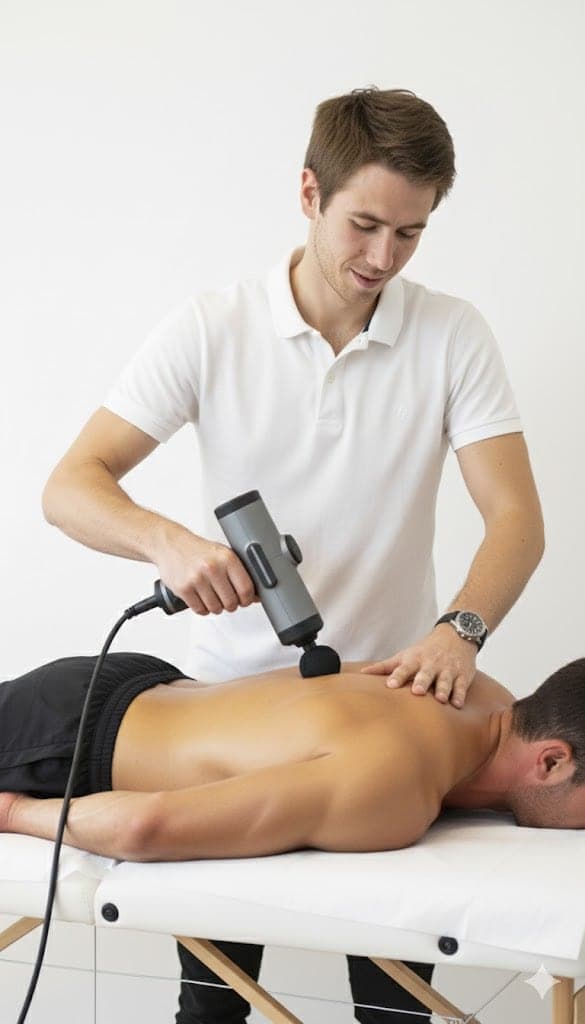
After recognizing these limitations early in my career, I dedicated myself to developing a superior methodology. The specialized mechanical system I employ addresses every shortcoming of traditional relaxation techniques in Tsada while delivering reproducible, measurable results.
This isn’t about replacing human expertise—my decade of anatomical study and clinical experience guides every treatment decision. Rather, the advanced tool serves as a precision instrument, extending my capabilities beyond what hands alone can achieve.
Precision: Targeting the Root Cause
The machine allows me to work with millimeter-level accuracy on specific anatomical structures. When I identify a fascial restriction in your thoracolumbar fascia contributing to lower back pain, I can maintain consistent pressure at exactly the required depth and angle for the duration needed to create lasting tissue change.
This precision eliminates the guesswork inherent in manual techniques. I’m not approximating pressure or hoping I’m reaching the target tissue—I know exactly where the tool is working and can feel the tissue response in real-time through proprioceptive feedback.
During a recent treatment with a competitive cyclist experiencing chronic hip flexor tightness, I used the mechanical system to access the deep psoas muscle—a structure nearly impossible to treat effectively with hands due to its position behind the abdominal organs. Within three sessions, his hip extension range increased by 15 degrees, directly translating to improved cycling efficiency.
Power: Going Deeper Than Hands Allow
The controlled mechanical force generated by my specialized equipment exceeds what any therapist can produce manually while maintaining safety and client comfort. This capability proves essential when treating:
| Tissue Type | Required Depth | Treatment Challenge |
|---|---|---|
| Deep gluteal muscles | 4-6 cm | Dense tissue requires sustained force |
| Thoracic paraspinals | 3-5 cm | Thick fascial layers restrict access |
| Quadratus lumborum | 5-7 cm | Protected position beneath other structures |
| Deep rotator cuff | 3-4 cm | Requires precise angle and sustained pressure |
The power isn’t about causing discomfort—quite the opposite. By working at the appropriate depth from the start, I address the problem tissue directly rather than traumatizing superficial layers trying to force pressure through them. This creates a paradox: deeper work often feels less painful than inadequate shallow pressure because it doesn’t trigger the protective responses that superficial trauma causes.
Consistency: Eliminating Variables for Reliable Results
One of the most frustrating aspects of traditional relaxation techniques in Tsada is their inherent variability. The same therapist may deliver markedly different treatments depending on their energy level, emotional state, or physical condition that day. This inconsistency makes it impossible to implement progressive treatment protocols effectively.
My mechanical approach eliminates this variable entirely. Session five delivers identical force, depth, and precision as session one. This consistency allows me to design systematic treatment progressions where each session builds on previous gains rather than attempting to recreate results from an unpredictable baseline.
I worked with a software developer who had tried numerous massage therapists for chronic neck tension. She described sessions ranging from “barely felt anything” to “so intense I couldn’t move the next day”—often with the same practitioner. When we established a consistent protocol using the mechanical system, she finally experienced the cumulative improvement that proper treatment progression creates.
Comprehensive Relaxation Techniques Available in Tsada
While my specialization focuses on advanced mechanical deep-tissue work, understanding the full spectrum of relaxation techniques in Tsada helps you make informed decisions about your treatment approach.
Traditional Massage Modalities
Swedish massage uses long, flowing strokes with light to moderate pressure. While pleasant, it primarily provides temporary stress relief without addressing structural dysfunction. The parasympathetic activation it creates lasts hours, not days or weeks.
Hot stone massage adds thermal elements to increase superficial blood flow. The heat feels relaxing but penetrates only 1-2 centimeters, leaving deeper tension untouched. Clients often report that problems return within 24-48 hours.
Aromatherapy massage combines essential oils with gentle touch. The olfactory and tactile stimulation activates relaxation responses, but again, this addresses psychological stress rather than biomechanical dysfunction. For chronic pain conditions, the results remain disappointingly temporary.
Stretching and Flexibility Work
Yoga and Pilates studios in Tsada offer valuable movement practices. However, stretching chronically shortened tissue without first releasing the fascial restrictions limiting its movement often proves ineffective or even counterproductive. The muscle cannot lengthen properly when adhesions anchor it in place.
I frequently see clients who’ve dedicated months to stretching programs with minimal improvement. Once we release the underlying restrictions with deep mechanical work, their stretching suddenly becomes effective—because now the tissue can actually move through the range we’re asking of it.
Meditation and Breathing Practices
Mental relaxation techniques provide important stress management tools. Reducing cortisol and activating parasympathetic responses supports overall health. However, these practices cannot directly address the structural tissue changes causing mechanical pain and dysfunction.
The most effective approach combines both elements: releasing physical restrictions through advanced bodywork while developing mental practices that prevent stress from creating new tension patterns. They serve complementary but distinct purposes.
Why Results-Driven Treatment Requires a Different Philosophy
The fundamental problem with viewing relaxation techniques in Tsada as isolated services is that it perpetuates a symptom-management mindset. Clients book a massage when stress builds, experience temporary relief, then repeat the cycle indefinitely without addressing underlying causes.
This approach makes sense for businesses maximizing appointment volume. It fails people seeking genuine solutions.
Treating Causes, Not Symptoms
My background in movement science taught me to think systematically about dysfunction. When someone presents with shoulder pain, I don’t simply massage their shoulder. I assess:
- Thoracic spine mobility and its influence on scapular positioning
- Anterior shoulder restrictions from prolonged sitting posture
- Compensatory patterns in the neck from altered shoulder mechanics
- Core stability deficits allowing excessive upper trapezius recruitment
The shoulder pain is a symptom—the endpoint of a complex chain of biomechanical compensations. Addressing only the symptomatic area provides temporary relief at best. Resolving the entire kinetic chain creates lasting improvement.
I recently worked with a tennis player experiencing elbow pain. Traditional treatment focused on his elbow delivered no lasting improvement. My assessment revealed restricted thoracic rotation forcing excessive compensation through his shoulder and elbow during his serve. After releasing thoracic restrictions and restoring proper scapular mechanics, his elbow pain resolved completely without ever directly treating the elbow itself.
The Partnership Model Versus Transaction-Based Treatment
Most relaxation techniques in Tsada operate on a transactional model: you pay for a session, receive a service, then repeat as desired. This structure doesn’t support systematic problem resolution.
I work differently. When we begin treatment, I conduct a comprehensive biomechanical assessment identifying all contributing factors to your condition. We then design a progressive treatment protocol addressing these elements in logical sequence.
This requires commitment from both parties. I’m investing my expertise in understanding your specific situation and engineering a solution. You’re investing time and resources in a systematic approach rather than hoping random sessions eventually help.
The typical progression involves:
- Initial assessment and treatment planning (90-120 minutes)
- Intensive phase addressing primary restrictions (4-6 sessions over 3-4 weeks)
- Refinement phase optimizing movement patterns (3-4 sessions over 4-6 weeks)
- Maintenance phase sustaining results (monthly sessions as needed)
This structure allows us to create real, measurable change rather than providing momentary comfort.
The Clinical Distinction: Investment Versus Expense
When comparing relaxation techniques in Tsada, price often becomes the primary decision factor. This fundamentally misframes the question. The relevant comparison isn’t cost per session—it’s cost per outcome.
If a traditional massage costs €50 and provides two days of relief, you need roughly 15 sessions monthly at €750 to maintain marginal symptom reduction. After a year, you’ve spent €9,000 and still have the original problem.
Advanced mechanical deep-tissue treatment typically costs more per session because it requires specialized equipment and extensive expertise. However, if we resolve your chronic condition in 8-12 sessions, the total investment might be €2,000-3,000—and the problem is solved durably, not temporarily managed.
Calculating True Cost of Dysfunction
Beyond direct treatment costs, chronic pain carries substantial hidden expenses:
| Category | Annual Impact | Long-term Consequence |
|---|---|---|
| Reduced work productivity | €2,000-5,000 | Career advancement limitations |
| Decreased physical activity | €1,500-3,000 | Declining health and fitness |
| Sleep disruption | €1,000-2,500 | Cumulative cognitive impairment |
| Medication and supplements | €500-1,500 | Side effects and dependency |
When viewed comprehensively, investing in treatment that actually resolves the problem becomes the obviously rational choice. Yet people hesitate because they’ve been conditioned to think of bodywork as a luxury rather than essential healthcare.
Performance Optimization for Athletes
For competitive athletes and serious fitness enthusiasts in Tsada, the calculation becomes even more compelling. Improved biomechanics directly translate to enhanced performance.
A runner with optimal hip mobility uses less energy per stride, reducing fatigue and improving race times. A cyclist with unrestricted thoracic rotation generates more power while reducing injury risk. A tennis player with balanced shoulder mechanics serves harder with less strain.
I worked with a triathlete preparing for an Ironman who had plateaued in training despite consistent effort. After releasing chronic restrictions in his hip flexors and thoracic spine, his run pace improved by 20 seconds per kilometer at the same perceived effort—a massive advantage over a marathon distance. The performance gain alone justified the treatment investment many times over.
The Mobile Treatment Advantage
One significant barrier to accessing effective relaxation techniques in Tsada is the logistics of traveling to a clinic, particularly when dealing with acute pain or mobility limitations. This is why I travel to your location with professional equipment.
This approach offers multiple advantages beyond convenience:
Optimal Treatment Environment
You receive treatment in your own space, where you feel most comfortable and can immediately rest afterward without driving. This eliminates the stress of post-treatment travel while your body integrates the tissue changes we’ve created.
After intensive deep-tissue work, your nervous system needs time to recalibrate. Forcing yourself to drive immediately afterward compromises this integration process and may recreate tension patterns we just released.
Consistency of Setup
I bring the same professional treatment bench and equipment to every session, ensuring complete consistency regardless of location. The equipment quality matches what you’d find in top physiotherapy clinics—this isn’t a portable massage table but a specialized mechanical treatment system.
Time Efficiency
For busy professionals and parents, eliminating travel time to and from appointments often makes the difference between maintaining a treatment protocol and abandoning it. When I travel to you, a 90-minute session requires 90 minutes of your time, not three hours when accounting for preparation and transit.
Frequently Asked Questions About Relaxation Techniques in Tsada
How does mechanical deep-tissue work differ from traditional massage?
Traditional massage uses hand pressure to manipulate superficial tissues, primarily activating relaxation responses and providing temporary symptom relief. Mechanical deep-tissue work uses specialized tools to access deeper structural restrictions, creating lasting tissue changes that resolve the underlying causes of chronic pain and dysfunction. The approaches serve fundamentally different purposes—one provides comfort, the other delivers solutions.
Is deeper pressure more painful?
Counterintuitively, properly applied deep pressure often feels less uncomfortable than inadequate shallow work. When we successfully reach and release the restricted tissue causing your problem, clients describe intense sensation but not painful trauma. Attempting to force shallow pressure through to deeper layers, conversely, traumatizes superficial tissue unnecessarily. My mechanical system allows precise depth control, working at exactly the required level without causing surface damage.
How many sessions will I need?
This depends entirely on your condition’s complexity and duration. Acute issues (present less than six weeks) may resolve in 2-4 sessions. Chronic conditions (present for months or years) typically require 8-12 sessions for complete resolution. During your initial assessment, I provide a realistic timeline based on your specific biomechanical situation. Unlike traditional massage where sessions continue indefinitely, my goal is completing a treatment protocol that solves your problem durably.
Can this help with stress-related tension?
Absolutely, though we approach it differently than conventional relaxation techniques. Stress creates real physical tension—elevated cortisol causes muscle guarding, shallow breathing restricts thoracic mobility, and anxiety triggers protective posturing. These responses become structural restrictions over time. By releasing the physical manifestations of stress, we break the cycle where tension creates more stress, which creates more tension. Combined with addressing the psychological stress sources, this provides comprehensive relief rather than temporary relaxation.
What conditions respond best to this approach?
I’ve achieved excellent results with chronic lower back pain, neck tension and headaches, shoulder restrictions and rotator cuff issues, hip mobility limitations, repetitive strain injuries, postural dysfunction, athletic performance optimization, and post-injury rehabilitation. Essentially, any condition involving musculoskeletal restriction or movement dysfunction responds well when we address the underlying biomechanical causes systematically.
Do you offer one-off relaxation sessions?
I focus exclusively on results-driven treatment protocols rather than traditional relaxation sessions. If you’re seeking a pleasant, stress-relieving massage experience, numerous excellent therapists in Tsada provide that service. My specialization serves clients committed to durably resolving chronic conditions or optimizing performance. This requires systematic treatment progression, not isolated sessions.
How quickly will I notice results?
Many clients experience significant improvement after the first session as we release primary restrictions. However, sustainable results require completing the treatment protocol. The tissue changes we create need integration time, and addressing compensatory patterns takes systematic progression. Expect noticeable improvement within 2-3 sessions, with continued enhancement throughout the protocol.
What makes your approach unique in Cyprus?
My combination of university-level education in movement science, ten years of specialized experience, and advanced mechanical treatment equipment creates capabilities unavailable elsewhere in the region. More fundamentally, my philosophy differs—I view treatment as engineering solutions to biomechanical problems, not providing temporary symptom relief. This clinical, results-focused approach serves clients frustrated with conventional options that haven’t delivered lasting improvement.
Making an Informed Decision About Your Treatment
The landscape of relaxation techniques in Tsada offers numerous options, each serving different needs and producing different outcomes. Understanding these distinctions allows you to make choices aligned with your actual goals rather than simply selecting the most convenient or affordable option.
If you seek pleasant, stress-relieving experiences and temporary symptom management, traditional massage modalities serve that purpose well. Many excellent practitioners provide these services affordably and conveniently.
If you want to durably resolve chronic pain, optimize athletic performance, or correct long-standing biomechanical dysfunction, you need a fundamentally different approach—one grounded in anatomical science, systematic treatment progression, and the precision that advanced mechanical tools enable.
The Starting Point
For clients ready to invest in genuine solutions, we begin with a comprehensive initial assessment. I evaluate your movement patterns, identify structural restrictions, and explain exactly what’s causing your condition in clear biomechanical terms. You’ll understand not just what we’re treating, but why these specific interventions will resolve your problem.
We then design a progressive treatment protocol tailored to your situation. This isn’t a generic approach applied uniformly—it’s an engineered solution addressing your unique biomechanical challenges systematically.
Throughout the process, I travel to your location with professional equipment, eliminating logistics barriers and allowing you to integrate treatment effects optimally.
Beyond Temporary Relief
After a decade studying body mechanics and treating hundreds of clients, I’ve learned that most people underestimate what’s possible. They’ve become accustomed to managing symptoms rather than expecting resolution. They view chronic pain as inevitable rather than correctable.
The reality is that most musculoskeletal dysfunction responds excellently to properly applied mechanical intervention. Your chronic lower back pain doesn’t have to be lasting. Your restricted shoulder mobility can improve dramatically. Your tension headaches can resolve completely. These outcomes require the right approach, systematically applied.
This is what separates genuine therapeutic treatment from temporary relaxation—one accepts your current state and provides momentary comfort, the other engineers a path to optimal function and lasting improvement.
When you’re ready to move beyond symptom management and invest in real solutions, the advanced mechanical deep-tissue approach I’ve developed delivers results that conventional relaxation techniques in Tsada simply cannot match. The question isn’t whether improvement is possible—it’s whether you’re ready to commit to the systematic process that creates it.
Written by
Chris
Massage therapist & body mechanics specialist
Norwegian-certified with a Bachelor’s in Physical Education and Nutrition and over ten years of clinical practice, working from a portable table in clients’ homes across the Paphos district.
This article is general information from clinical practice, not a medical diagnosis. If you have severe, worsening or unexplained pain, numbness, weakness, or pain after an accident, see a doctor first.