
Relaxation Techniques for Home Massage: A Clinical Approach to Lasting Results
In short
Discover evidence-based relaxation techniques for home massage that address the root causes of tension. Learn how advanced mechanical methods deliver deeper, more consistent results than traditional approaches.
Let me share something I’ve observed after a decade of working with hundreds of clients: most people fundamentally misunderstand what relaxation techniques for home massage should accomplish. They’re looking for temporary relief when they should be seeking lasting resolution. I’ve built my practice on challenging this misconception, and the results speak for themselves.
When someone contacts me for the first time, they often describe their goal as “just wanting to relax.” Within the first session, we shift that conversation entirely. Relaxation isn’t the endpoint—it’s a byproduct of properly addressing mechanical dysfunction in the body. This distinction matters because it determines whether you experience relief for a few hours or transform your physical capacity for years to come.
My background in Physical Education and Nutrition from Norway, combined with ten years of specialized practice in advanced mechanical deep-tissue techniques, has taught me that effective relaxation techniques for home massage require precision, consistency, and depth that traditional manual therapy simply cannot deliver. The human hand, no matter how skilled, has physiological limitations. I’ve learned to work beyond those limitations.
Understanding the Physiological Foundation of True Relaxation
Before we discuss specific relaxation techniques for home massage, we need to establish what’s actually happening in your body when you feel “tense.” The sensation you interpret as muscle tightness is typically the result of fascial restriction, myofascial trigger points, and compensation patterns developed over months or years of repetitive stress.
I remember working with a software developer who’d spent thousands on traditional massage therapy. He described the experience as “feeling great for about 36 hours, then right back where I started.” This pattern is predictable when treatment addresses symptoms rather than causes. His trapezius muscles weren’t tight because they needed to “relax”—they were tight because his thoracic spine had lost mobility, forcing his shoulder girdle into constant compensatory activation.
The Mechanical Reality of Muscular Tension
Your muscles exist in a constant state of communication with your nervous system. When tissue becomes restricted—through adhesions, scar tissue formation, or chronic inflammation—your body interprets this as a threat and maintains protective tension. Traditional relaxation techniques for home massage often attempt to override this protective response through superficial pressure or aromatherapy. This is like trying to silence a fire alarm without addressing the fire.
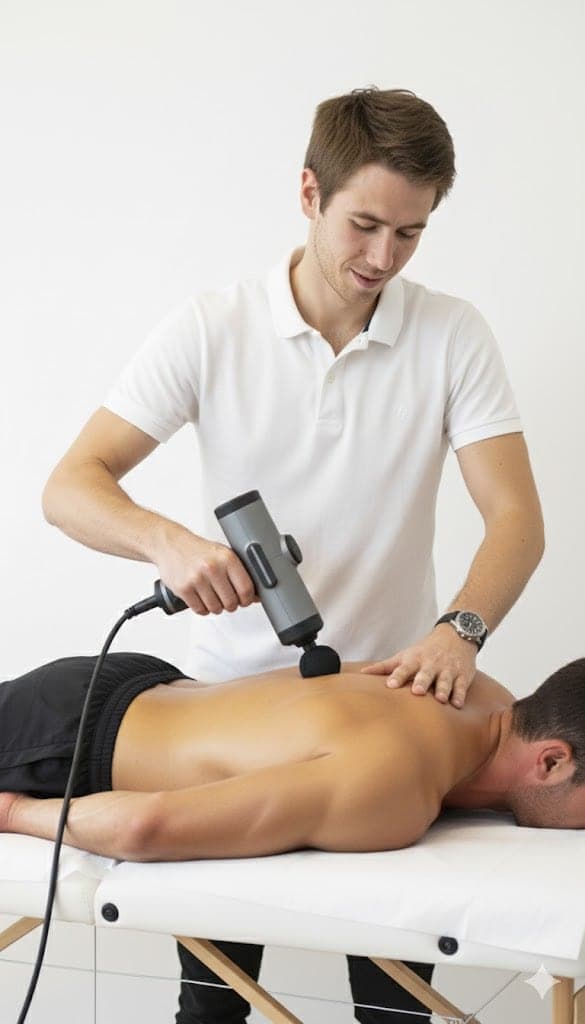
The approach I’ve developed works differently. Using specialized mechanical tools that deliver controlled, precise pressure far deeper than human hands can reach, we systematically release the actual restrictions causing your nervous system to maintain that protective state. The relaxation you experience isn’t forced—it’s the natural result of eliminating the mechanical dysfunction your body was responding to.
Advanced Relaxation Techniques for Home Massage: A Results-Driven Protocol
I travel to my clients’ locations with professional equipment specifically because the environment matters. You’re not adapting to a clinic setting—the treatment adapts to you. This is part of my commitment to a dedicated partnership, not transactional one-off sessions that leave you dependent on regular appointments.
Progressive Tissue Preparation
Every effective session begins with systematic tissue assessment and preparation. I’m evaluating range of motion, identifying compensation patterns, and mapping restriction zones before any deep work begins. This isn’t the generic “warm-up” you’d receive at a spa—it’s diagnostic.
The mechanical advantage of the specialized tools I use becomes immediately apparent in this phase. I can maintain consistent pressure across large muscle groups like the quadratus lumborum or latissimus dorsi for extended periods without the fatigue that limits manual therapists. This consistency is critical. Your tissue doesn’t respond to peak pressure—it responds to sustained, controlled pressure delivered at the precise depth required to access restricted fascia.
Targeted Myofascial Release Methodology
Here’s where most relaxation techniques for home massage fail: they apply pressure randomly or based on where you report pain. Pain is a poor indicator of dysfunction location. I’ve treated countless athletes whose primary complaint was knee pain, only to discover the actual mechanical restriction was in their hip flexor complex or even their thoracic spine.
My protocol involves systematic treatment of the kinetic chain relevant to your specific presentation. If you’re experiencing chronic shoulder tension, we’re addressing:
- Cervical spine mobility and the suboccipital triangle
- Scalene muscle complex and first rib positioning
- Pectoralis minor and subscapularis restrictions
- Thoracic spine extension capacity
- Scapular stabilizer function and coordination
This comprehensive approach is why clients report not just relief from their primary complaint, but improvements in seemingly unrelated areas. One client came to me for chronic low back pain and was shocked when her long-standing headaches also resolved. This isn’t surprising when you understand how compensation patterns cascade through the body’s mechanical systems.
The Machine Advantage: Precision, Power, and Consistency
Let me be direct about why I exclusively use advanced mechanical tools rather than manual techniques. After years of practice, I recognized that my hands—regardless of skill development—could never deliver the combination of depth, precision, and consistency that optimal tissue work requires.
Depth That Addresses Root Causes
The specialized machine I use can work substantially deeper than human hands while maintaining absolute control. We’re accessing tissue layers that manual therapy simply cannot reach effectively. This matters profoundly when treating chronic conditions.
I worked with a former Olympic athlete who had undergone years of conventional physical therapy and massage. His piriformis syndrome had become career-ending. Within three sessions using my mechanical protocol, we achieved measurable improvements in hip internal rotation and pain-free range of motion. By session eight, he was training again. The difference? We finally accessed and released the deep rotator cuff restrictions that had been the actual source of his compensatory piriformis tension.
Precise Intensity Control
One of the greatest advantages of mechanical application is the ability to modulate pressure with absolute precision. I can adjust from superficial lymphatic work to deep structural release within the same session, maintaining exact control throughout.
This precision is especially critical when working with acute injuries or sensitive populations. I’ve successfully treated clients ranging from professional powerlifters requiring extremely deep pressure to individuals with fibromyalgia who need careful, controlled progression. The machine allows me to meet each person’s needs exactly where they are, then systematically progress as their tissue tolerance improves.
Eliminating the “Off Day” Variable
Manual therapists have off days. They experience fatigue, illness, injury. The quality of treatment you receive depends significantly on variables beyond your control. This inconsistency undermines the systematic progression that optimal results require.
My mechanical approach eliminates this variable entirely. Every session delivers identical precision and power. Your progression depends solely on your body’s response and our strategic treatment plan, not on whether I’m having a good day or fighting off a cold.
Building an Effective Home Massage Relaxation Program
The relaxation techniques for home massage that I implement aren’t designed for dependency—they’re designed for liberation. My goal is lasting improvement in your mechanical function, not an endless cycle of appointments.
The Initial Assessment Phase
Our first session is extensive. I’m not just treating symptoms—I’m developing a comprehensive understanding of your movement patterns, injury history, and specific goals. This assessment includes:
| Assessment Component | Clinical Purpose | Treatment Implication |
|---|---|---|
| Postural Analysis | Identify compensation patterns | Determines primary treatment zones |
| Range of Motion Testing | Quantify mobility restrictions | Establishes baseline and progress metrics |
| Palpation and Tissue Quality | Locate specific adhesions and trigger points | Guides depth and duration of treatment |
| Functional Movement Screening | Reveal kinetic chain dysfunction | Identifies root causes versus symptoms |
| Client History and Goals | Understand context and expectations | Customizes treatment plan to individual needs |
This thorough approach is why clients often tell me they’ve learned more about their body in one session with me than in years of conventional treatment. Education is part of the service—you should understand what we’re doing and why it’s working.
Progressive Treatment Protocols
Effective relaxation techniques for home massage follow a strategic progression, not a standard routine. Each session builds on previous work, systematically addressing layers of restriction in a logical sequence.
In the early sessions, we’re often dealing with superficial and intermediate fascial restrictions, establishing tissue tolerance, and beginning to restore basic mobility. As your body adapts and restrictions release, we progress to deeper structural work, addressing chronic adhesions and longstanding compensation patterns.
I had a client—a competitive cyclist—who came to me with chronic IT band syndrome that had persisted for three years. The first four sessions focused entirely on hip flexor and glute medius restriction, areas he hadn’t even identified as problematic. His IT band received minimal direct treatment. By session five, his knee pain had resolved completely. We spent the next three sessions optimizing his mechanical efficiency for performance enhancement. He recently placed in his age group at a national event. That’s the difference between treating symptoms and addressing causes.
Integration of Breathing and Nervous System Regulation
No discussion of relaxation techniques for home massage is complete without addressing the autonomic nervous system’s role in tissue tension. Your breath pattern directly influences your muscular tension patterns, and most people breathe dysfunctionally without realizing it.
Diaphragmatic Function and Core Stability
I teach every client proper diaphragmatic breathing because it’s fundamental to maintaining the improvements we achieve. If you’re chronically chest breathing, you’re maintaining constant tension in your scalenes, upper trapezius, and pectoralis minor. No amount of tissue work will create lasting change if this pattern persists.
The mechanical treatment I provide creates the physical capacity for proper breathing by releasing restrictions in the thoracic spine, rib cage, and respiratory accessory muscles. Then we train the pattern itself. This integration is why clients report feeling “lighter” or “able to breathe deeply for the first time in years.”
Parasympathetic Activation Through Mechanical Release
When we successfully release chronic muscular restriction, your nervous system receives clear feedback that the threat has resolved. This triggers parasympathetic activation—the “rest and digest” state. This isn’t relaxation imposed from outside through aromatherapy or ambient music. It’s your body’s natural response to the removal of actual mechanical dysfunction.
I’ve observed this response hundreds of times. Clients often experience profound relaxation during treatment, sometimes falling asleep even during deep structural work that would typically be uncomfortable. This paradox resolves when you understand that their nervous system is finally receiving the message that it’s safe to release protective tension.
Common Mistakes in Home Massage Relaxation Approaches
After ten years of correcting the consequences of ineffective treatment, I’ve identified consistent patterns in how people misapply relaxation techniques for home massage.
Confusing Temporary Relief with Actual Resolution
The biggest mistake is accepting temporary symptom relief as success. If your tension returns within days, the treatment failed. Period. You haven’t addressed the underlying mechanical dysfunction causing your nervous system to maintain that tension pattern.
I had a client who’d been receiving weekly massage for five years. She considered this “maintenance” and accepted that skipping a week meant returning to significant discomfort. Within two months of starting my protocol, she no longer needed regular sessions. We transitioned to quarterly optimization sessions focused on performance enhancement rather than pain management. That’s the standard you should expect.
Applying Inadequate Depth and Duration
Gentle, superficial techniques have their place in specific clinical situations—acute inflammation, lymphatic drainage, certain neurological conditions. For chronic muscular tension and mechanical dysfunction, they’re inadequate. You cannot release deep fascial restrictions with light pressure, regardless of how long you apply it.
The mechanical tools I use can maintain therapeutic pressure at depths manual therapy cannot safely or effectively reach, for durations that would be impossible for human hands. This isn’t about causing pain—it’s about accessing the tissue layers where actual dysfunction exists.
Neglecting the Kinetic Chain
Your body functions as an integrated mechanical system. Treating isolated areas while ignoring the broader kinetic chain guarantees incomplete results. The relaxation techniques for home massage that deliver lasting outcomes must address the entire system relevant to your condition.
When someone contacts me about chronic neck tension, we don’t just work on their neck. We address thoracic mobility, shoulder mechanics, breathing patterns, and often hip function. This comprehensive approach is why results persist rather than requiring endless maintenance.
Specific Protocols for Different Client Presentations
The beauty of mechanical precision is the ability to customize treatment intensity and focus while maintaining consistent quality. Let me share how relaxation techniques for home massage adapt to different needs.
The Desk Worker Protocol
Individuals who spend extended periods in seated positions develop predictable patterns: forward head posture, rounded shoulders, thoracic kyphosis, and hip flexor shortening. The protocol for these clients focuses heavily on:
- Deep release of pectoralis minor and subscapularis to allow scapular positioning correction
- Comprehensive work on the cervical extensors and suboccipital muscles to address forward head posture
- Thoracic spine mobilization to restore extension capacity
- Hip flexor complex release to prevent compensatory lumbar hyperlordosis
- Strengthening cues for scapular stabilizers and deep neck flexors
I recently worked with a software engineer who had developed severe tension headaches occurring three to four times weekly. After eight sessions focusing on this protocol, his headaches reduced to once monthly, then disappeared entirely. Six months later, they haven’t returned. He now understands his body mechanics and maintains the improvements through awareness and occasional optimization sessions.
The Athletic Performance Protocol
Athletes require a different approach entirely. We’re not just eliminating pain—we’re optimizing mechanical efficiency for performance enhancement. These clients typically tolerate and require significantly deeper pressure to access restrictions in conditioned tissue.
The athletic protocol emphasizes:
- Sport-specific kinetic chain optimization
- Restoration of full range of motion in primary movement patterns
- Release of compensatory tension limiting power output
- Improvement of recovery capacity between training sessions
- Prevention of overuse injury through balanced mechanical function
I’ve worked with powerlifters who increased their squat depth and load capacity after we resolved chronic hip restriction they’d accepted as “normal tightness.” Their performance ceiling wasn’t limited by strength—it was limited by mechanical restriction preventing full range of motion under load.
The Chronic Pain Management Protocol
Clients with longstanding pain conditions require patience, precision, and a systematic approach. These individuals have often tried multiple treatments without success and may be skeptical. My results with this population are the most rewarding because the impact on quality of life is profound.
The chronic pain protocol involves:
- Extensive initial assessment to identify all contributing factors
- Conservative initial treatment to establish trust and tissue tolerance
- Systematic progression addressing restrictions in strategic sequence
- Education about pain science and mechanical dysfunction
- Development of self-management strategies for long-term success
I worked with a woman who’d experienced chronic low back pain for twelve years following a car accident. She’d accepted this as lasting and had organized her entire life around managing her pain. After our first session, she was skeptical of the improvement she felt, certain it would be temporary like every other treatment she’d tried.
By session six, she was doing activities she’d avoided for over a decade. By session twelve, she described herself as “pain-free for the first time since the accident.” A year later, she remains pain-free and contacted me recently to share that she’d started hiking again, something she thought she’d never do. That’s not symptom management—that’s life transformation through addressing mechanical causes.
The Role of Client Education in Sustained Results
Effective relaxation techniques for home massage include a significant educational component. You cannot maintain improvements you don’t understand. Part of my commitment to each client is ensuring they comprehend what we’re addressing and why it matters.
Understanding Your Body’s Mechanical Function
I explain the specific restrictions we’re treating, how they developed, and how they’re affecting your function. This isn’t simplified to the point of meaninglessness—I respect my clients’ intelligence and provide actual physiological explanation.
When someone understands that their shoulder pain stems from thoracic spine immobility forcing their shoulder girdle into compensatory elevation, they can make informed decisions about posture, ergonomics, and movement patterns. This knowledge prevents recurrence more effectively than any amount of passive treatment.
Recognizing Warning Signs and Compensatory Patterns
I teach clients to identify when they’re beginning to develop compensatory patterns before they become problematic. This early awareness allows for intervention—often through simple self-release techniques or movement modifications—before dysfunction progresses to pain.
This education transforms the relationship from dependency to partnership. You’re not waiting until pain becomes unbearable to schedule an appointment. You’re managing your mechanical health proactively, with me available for optimization and addressing issues beyond self-management capacity.
Why Traditional Approaches Fail: A Clinical Perspective
I need to address why most relaxation techniques for home massage deliver disappointing results. This isn’t about criticizing other practitioners—it’s about understanding the limitations of conventional approaches so you can make informed decisions.
The Limitation of Manual Pressure
Human hands are remarkable instruments, but they have physiological constraints. A therapist can only maintain deep pressure for limited duration before fatigue compromises technique. They cannot access certain tissue depths safely or effectively with manual pressure alone.
I spent years developing manual skills before transitioning to mechanical methods. I made this shift because I was honest about the results. My best manual work couldn’t achieve what mechanical precision delivers consistently. Clients deserve optimal outcomes, not my ego preservation.
The Flawed “Relaxation First” Paradigm
The spa industry has conditioned people to expect that massage should feel “relaxing” in a pleasant, superficial way throughout the entire session. This expectation undermines effective treatment because addressing actual mechanical dysfunction sometimes requires temporarily uncomfortable pressure.
I’m not suggesting treatment should be painful—excessive pain triggers protective tension that counteracts our goals. But the complete absence of discomfort during deep structural work usually indicates we’re not accessing the restricted tissue layers that need release.
The relaxation you should expect is the profound, lasting relief that comes after we’ve successfully addressed mechanical restrictions. Some of my most satisfied clients describe their sessions as “hard work that pays off” rather than “relaxing” in the conventional sense.
The Maintenance Trap
Perhaps the most significant failure of conventional approaches is creating dependency on regular sessions. If you require weekly or biweekly massage indefinitely to manage symptoms, the treatment is addressing effects rather than causes.
My approach is the opposite. The goal is independence. We work intensively for an initial period—typically six to twelve sessions depending on your presentation—to resolve the underlying mechanical dysfunctions. Then we transition to optimization sessions as needed for performance enhancement or addressing new challenges. Most clients eventually need me only occasionally, if at all.
This might seem like bad business practice, but it’s the foundation of my reputation. Clients who achieve lasting results refer others who want the same outcomes. I’ve never advertised my services—my entire practice is built on referrals from people whose lives improved dramatically through this work.
Measuring Progress: Objective Outcomes Over Subjective Feelings
Effective relaxation techniques for home massage should produce measurable improvements, not just temporary good feelings. I track specific metrics because what gets measured gets managed.
Quantifiable Mobility Improvements
We measure range of motion at initial assessment and track changes throughout treatment. These measurements are objective. Either your hip internal rotation increased by 15 degrees or it didn’t. Either your shoulder flexion improved from 145 to 175 degrees or it didn’t.
These measurements matter because they correlate directly with function and injury risk. Improved range of motion means better mechanical efficiency, reduced compensatory stress, and enhanced performance capacity.
Functional Capacity Enhancement
Beyond passive measurements, we assess functional changes. Can you now sit comfortably for extended periods without pain? Can you complete your sport-specific movements with better form and reduced effort? Can you sleep through the night without position changes to manage discomfort?
These functional improvements are what actually enhance quality of life. A five-degree increase in joint mobility is meaningless if it doesn’t translate to real-world benefit. My protocols are designed to deliver both measurable structural improvements and meaningful functional enhancement.
Long-Term Outcome Tracking
The true test of any treatment is durability. Do improvements persist months and years later, or do they vanish when regular sessions stop? I maintain contact with clients specifically to answer this question.
The data is clear: clients who complete a full treatment protocol addressing their specific mechanical dysfunctions maintain their improvements long-term. Those who achieve pain relief and then stop treatment prematurely often experience some regression, though typically not to their original baseline. This pattern reinforces the importance of completing a comprehensive protocol rather than stopping at initial symptom relief.
Frequently Asked Questions About Relaxation Techniques for Home Massage
How is your mechanical approach different from massage guns available to consumers?
Consumer percussion devices provide superficial stimulation to surface tissue. They’re useful for brief muscle activation or very superficial tension relief, but they cannot deliver the sustained, controlled pressure at therapeutic depths that professional-grade mechanical tools provide. The specialized equipment I use allows for precise pressure modulation from superficial to very deep, maintained for extended durations, targeting specific tissue layers based on clinical assessment. It’s the difference between a kitchen knife and a surgical scalpel—both cut, but precision and application differ fundamentally.
How many sessions will I need to see lasting results?
This depends entirely on your specific presentation, how long the dysfunction has existed, and your body’s response to treatment. Acute issues (weeks to months duration) typically require 4-6 sessions. Chronic conditions (years duration) usually need 8-12 sessions for complete resolution. Athletic performance optimization often requires 6-8 sessions initially, then occasional maintenance for peak performance. I provide a realistic estimate after the initial assessment, and we adjust based on your actual progress.
Is deep tissue work appropriate for everyone?
Not in the conventional sense of “deep tissue” as simply applying maximum pressure everywhere. What I provide is appropriate pressure applied to appropriate tissue depths based on individual assessment. Some clients require very deep work to address restrictions in conditioned muscle tissue. Others need more moderate pressure applied precisely to achieve optimal results. The mechanical advantage is that I can modulate pressure with absolute control to meet each person’s needs exactly.
What should I expect to feel during and after a session?
During treatment, you should expect to feel focused pressure that may range from comfortable to temporarily intense, depending on the restriction we’re addressing. After a session, most clients report feeling simultaneously worked and relieved—like you’ve completed a productive workout. Some areas may feel tender for 24-48 hours as tissue responds to release, similar to post-exercise soreness. This temporary discomfort, if present, should be mild and should resolve quickly as your body adapts.
Can this approach address chronic pain that hasn’t responded to other treatments?
In many cases, yes, specifically because we’re addressing mechanical causes that conventional treatment may have overlooked. I regularly work with clients who’ve tried physical therapy, chiropractic, conventional massage, and various other modalities without lasting success. The difference is the combination of depth, precision, and comprehensive kinetic chain approach. However, I’m clear about scope: I address mechanical dysfunction. If your pain has non-mechanical causes (certain diseases, systemic inflammation, neurological conditions), this approach may be insufficient as a standalone treatment, though it can still provide benefit as part of comprehensive care.
Why do you travel to clients rather than operating from a fixed location?
Convenience matters for consistency. If you have to drive across town, find parking, and build appointment travel time into your schedule, you’re less likely to complete a full treatment protocol. I eliminate those barriers by coming to you with professional equipment. This also allows you to rest immediately after treatment if needed, rather than driving home. The investment you’re making is in results, not in navigating logistics.
What’s the difference between your service and booking a mobile massage therapist?
Most mobile massage services provide conventional relaxation massage in your home for convenience. I provide advanced mechanical deep-tissue treatment using specialized equipment that most therapists—mobile or otherwise—don’t have access to or training with. The similarity ends at “comes to your location.” The actual service, methodology, and outcomes are completely different. This is clinical bodywork focused on lasting resolution of mechanical dysfunction, not a relaxation service.
How do I know if I need this type of work versus conventional massage?
If you’re satisfied with temporary relaxation and accept that regular ongoing sessions are necessary to manage your symptoms, conventional massage may meet your needs. If you want to actually resolve chronic tension, relieves pain at its source, improve mechanical function, and achieve independence from regular treatment, then this approach is what you need. The question is whether you’re looking for pleasant temporary relief or lasting functional improvement.
The Investment in Long-Term Physical Capacity
Let me address cost directly, because I position this as an investment, not an expense. Services that require ongoing regular sessions to maintain basic comfort are expenses—they’re recurring costs without endpoint. What I provide is an investment in your long-term physical capacity and quality of life.
Calculating True Cost of Symptom Management
Consider the actual financial impact of conventional approaches. If you’re receiving massage twice monthly at typical rates, you’re spending thousands annually for symptom management. Multiply that over years or decades, and you’ve invested tens of thousands of dollars without resolving the underlying problem.
My protocol requires a more concentrated initial investment over a shorter timeframe, but it’s designed to eliminate the need for ongoing regular treatment. When you calculate cost-per-year of being pain-free and functionally optimized, the investment is substantially lower than perpetual symptom management.
The Value of Reclaimed Capacity
Beyond direct financial comparison, consider what chronic pain and physical limitation cost you in life quality. Activities avoided, sleep quality compromised, productivity reduced, athletic goals abandoned, daily discomfort accepted as normal. What’s the value of reclaiming those capacities?
I’ve watched clients return to sports they’d quit, careers they’d considered leaving due to pain, and life activities they’d written off as impossible. One client told me that being able to play on the floor with his children without back pain was “worth more than any amount of money.” That’s the actual value proposition—not a pleasant hour of relaxation, but reclaimed life capacity.
Final Perspective: Results Over Rituals
The fitness and wellness industry is full of rituals—practices people engage in because they’re supposed to be beneficial, whether or not they actually produce meaningful results. Effective relaxation techniques for home massage should be evaluated solely on outcomes, not on how well they conform to conventional expectations.
I’ve built my practice on a simple premise: your body responds to mechanical input according to physiological principles, not according to what feels pleasant or what tradition suggests should work. When we apply precise, sustained pressure at appropriate depths to release actual restrictions in your fascia and musculature, your nervous system responds by releasing protective tension. This produces genuine, lasting relaxation—not because we’ve imposed it artificially, but because we’ve removed the mechanical dysfunction that was causing tension in the first place.
After ten years and hundreds of clients, the evidence is overwhelming: this approach delivers results that conventional relaxation techniques for home massage cannot match. Clients achieve lasting pain relief, enhanced performance capacity, and independence from ongoing treatment. These outcomes aren’t occasional success stories—they’re the expected standard.
If you’re reading this because you’re frustrated with temporary relief from conventional treatments, tired of accepting chronic discomfort as inevitable, or ready to actually resolve mechanical dysfunction rather than managing symptoms indefinitely, then you’re ready for this approach. The specialized mechanical methods I’ve developed deliver deeper pressure, more precise control, and more consistent results than any manual technique can provide.
Your body has enormous capacity for restoration and optimization when mechanical restrictions are properly addressed. The question isn’t whether lasting improvement is possible—it’s whether you’re ready to commit to the systematic approach required to achieve it. I provide the expertise, the technology, and the dedicated partnership. You provide the commitment to completing the protocol and implementing the insights you’ll gain about your own mechanical function.
The investment is in lasting capacity enhancement, not temporary symptom relief. The outcome is liberation from chronic dysfunction, not dependency on regular sessions. That’s the standard you should expect, and that’s exactly what this approach delivers.
Written by
Chris
Massage therapist & body mechanics specialist
Norwegian-certified with a Bachelor’s in Physical Education and Nutrition and over ten years of clinical practice, working from a portable table in clients’ homes across the Paphos district.
This article is general information from clinical practice, not a medical diagnosis. If you have severe, worsening or unexplained pain, numbness, weakness, or pain after an accident, see a doctor first.