
Physical Therapy for Posture Kissonerga: Advanced Mechanical Treatment for Lasting Results
In short
Discover how specialized physical therapy for posture in Kissonerga addresses the root causes of postural dysfunction through precision mechanical deep-tissue work, delivering lasting improvements rather than temporary relief.
Poor posture isn’t merely an aesthetic concern—it’s a mechanical failure that cascades throughout your entire kinetic chain. After a decade of treating postural dysfunction in clients across Cyprus, I’ve observed a recurring pattern: most people don’t understand that their rounded shoulders, forward head position, and chronic tension aren’t habits to correct through willpower. They’re biomechanical compensations locked into your fascial system, requiring precise mechanical intervention to resolve durably.
In Kissonerga, where residents and visitors alike spend considerable time at computers, driving, or engaged in repetitive activities, postural dysfunction has become endemic. What distinguishes effective physical therapy for posture from conventional approaches is this fundamental understanding: your body has adapted to dysfunction over years, sometimes decades. Superficial treatments that address symptoms rather than structural causes will never produce lasting change.
My approach to physical therapy for posture in Kissonerga differs fundamentally from traditional massage or generic physiotherapy. With my background in Physical Education and Nutrition from Norway and ten years specializing in advanced mechanical deep-tissue work, I’ve developed a methodology that treats posture as what it truly is: a complex interplay of fascial restrictions, muscular imbalances, and neuromuscular patterning that demands precision intervention.
Understanding the Biomechanics of Postural Dysfunction
When I assess a client’s posture, I’m not looking at how they stand in that moment. I’m analyzing the architectural collapse that has occurred throughout their myofascial system. Your posture reflects the accumulated tension patterns, compensatory mechanisms, and structural adaptations your body has developed in response to repetitive stress, injury, or biomechanical inefficiency.
The anterior shoulder roll that plagues office workers originates not in the shoulders themselves, but in the shortened pectoralis minor, restricted thoracic fascia, and inhibited lower trapezius. The forward head position—for every inch your head protrudes forward, it adds approximately 10 pounds of additional force on your cervical spine—stems from deep cervical flexor weakness and suboccipital tension that manual therapy alone cannot adequately address.
During my years treating postural cases, I’ve encountered clients who’ve spent thousands on ergonomic furniture, attended posture workshops, and diligently performed stretching routines, yet experienced minimal improvement. The reason is straightforward: you cannot stretch or strengthen your way out of deep fascial restriction. The tissue must first be mechanically released at the appropriate depth and with sufficient precision to restore optimal tissue quality.
The Fascial Component of Postural Patterns
Fascia—the connective tissue matrix enveloping every muscle, organ, and structure in your body—plays the dominant role in maintaining postural patterns. When fascia becomes densified through repetitive stress, dehydration, or compensation, it literally pulls your skeleton out of optimal alignment. This isn’t something you can consciously override or correct through postural awareness alone.
I’ve treated competitive athletes whose performance plateaued not from lack of strength or conditioning, but from fascial restrictions altering their movement patterns so subtly that they’d adapted without conscious awareness. Once we addressed the underlying fascial dysfunction through deep mechanical work, their performance metrics improved immediately—not because they became stronger, but because their body could finally access its existing capacity without fighting internal resistance.
Why Traditional Approaches to Posture Correction Fail
The conventional model of posture correction relies heavily on conscious awareness, stretching, and strengthening exercises. While these components have value, they fundamentally misunderstand the problem. Your poor posture isn’t a habit you can break—it’s a structural reality your nervous system has accepted as normal.
When someone with chronic forward head posture attempts to “sit up straight,” they’re fighting against years of shortened anterior cervical fascia, lengthened posterior musculature, and altered proprioceptive input. The moment their conscious attention shifts, their body returns to its structurally reinforced position because the underlying tissue restrictions haven’t changed.
| Approach | Treatment Focus | Duration of Results | Depth of Intervention |
|---|---|---|---|
| Traditional Massage | Superficial relaxation | Hours to days | Surface muscle tissue |
| Postural Exercises | Conscious correction | Requires constant attention | Does not address fascial restrictions |
| Standard Physiotherapy | General strengthening | Weeks with continued exercises | Moderate tissue depth |
| Mechanical Deep-Tissue | Fascial release and structural realignment | Lasting with proper treatment plan | Deep fascial and muscular layers |
I’ve witnessed countless clients who’ve undergone months of conventional physiotherapy with minimal postural improvement. The limitation isn’t the therapist’s knowledge—it’s the inherent constraint of manual techniques. Human hands, regardless of the practitioner’s skill, cannot consistently deliver the depth, precision, and sustained pressure required to release chronic fascial restriction throughout an entire postural chain.
The Depth Requirement for Structural Change
Effective treatment of postural dysfunction requires working at depths that manual therapy simply cannot reach consistently. The dense fascial adhesions maintaining your forward head position or rounded shoulders exist in tissue layers that manual pressure cannot adequately address without compromising precision or causing unnecessary discomfort.
This is where my specialized mechanical approach demonstrates its superiority. The advanced machinery I utilize delivers consistent, controllable pressure that reaches deep fascial planes while maintaining the precision necessary to target specific restrictions. This isn’t about applying more force—it’s about applying the optimal force at the exact location and depth required for structural change.
The Mechanical Advantage in Postural Physical Therapy
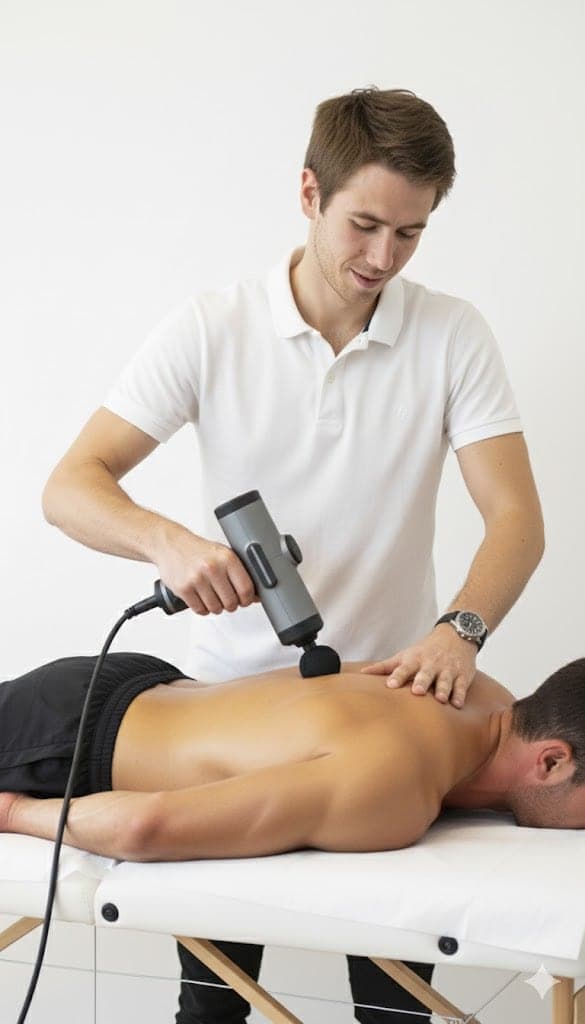
When I transitioned from purely manual techniques to incorporating specialized mechanical tools in my practice, the transformation in client outcomes was immediate and undeniable. The machine I employ isn’t a convenience or a shortcut—it’s a precision instrument that fundamentally changes what’s possible in postural correction.
This technology provides three critical advantages that manual therapy cannot match: precision, power, and consistency. Let me explain why each matters significantly in addressing postural dysfunction.
Precision: Targeting the Exact Source of Dysfunction
Postural problems originate from specific fascial restrictions and muscular imbalances. A forward head position, for instance, typically involves restrictions in the suboccipital triangle, shortened sternocleidomastoid, densified anterior scalenes, and compensation patterns throughout the thoracic spine. Each of these requires targeted intervention at different depths and angles.
The mechanical advantage allows me to address each restriction with millimeter precision, maintaining consistent contact and angle while adjusting depth based on real-time tissue response. When treating the levator scapulae attachment at C1-C4—a common restriction contributing to upper crossed syndrome—the precision required exceeds what manual palpation can consistently deliver, particularly in clients with significant adipose tissue or muscular development.
Power: Reaching Depths That Matter
I recently treated a construction foreman from Kissonerga whose occupation demanded forward flexion and repetitive overhead work for over fifteen years. His thoracic kyphosis and protracted shoulders had progressed to the point where sleeping comfortably required multiple pillows, and his shoulder range of motion was compromised by approximately thirty percent.
The fascial restrictions throughout his anterior chain—particularly in the pectoralis minor, coracobrachialis, and anterior deltoid—existed at depths that would require such intense manual pressure that treatment would be intolerable and tissue trauma likely. The mechanical approach allowed us to progressively reach those deep restrictions while maintaining client comfort and tissue integrity. After six sessions over three weeks, his shoulder mobility improved by over sixty percent, his sleep quality normalized, and the chronic tension headaches he’d experienced for years disappeared entirely.
This isn’t an exceptional case—it’s the expected outcome when you address dysfunction at the appropriate depth with sufficient precision.
Consistency: Eliminating Treatment Variables
Even the most skilled manual therapist experiences variations in pressure delivery, endurance, and precision throughout a session and across different days. When treating chronic postural dysfunction—which requires systematic progression through multiple sessions—this inconsistency undermines optimal results.
The mechanical system eliminates this variable entirely. Each session delivers identical precision and power, ensuring that your treatment plan progresses predictably. You’re not subject to whether I’ve already treated five clients that day or whether I’m experiencing fatigue. The machine delivers consistent results, session after session, which is essential for the systematic approach postural correction demands.
My Methodology for Postural Correction in Kissonerga
I don’t offer isolated massage sessions. Postural dysfunction didn’t develop in an hour, and it won’t resolve in an hour. My approach involves a dedicated partnership where we systematically address the structural causes of your postural problems through a customized treatment plan.
During the initial assessment, I conduct a comprehensive postural analysis that extends far beyond observing how you stand. I’m evaluating your movement patterns, identifying compensations, assessing tissue quality throughout your kinetic chain, and determining which restrictions are primary dysfunctions versus secondary compensations. This distinction is critical—treating compensatory patterns before addressing primary dysfunctions wastes time and produces suboptimal results.
The Treatment Progression
Effective postural correction follows a systematic progression. We begin by addressing the deepest, most significant restrictions—typically in the anterior fascial chain for most postural patterns common in office workers and drivers. As these primary restrictions release, your body naturally begins reorganizing toward more optimal alignment, at which point we address secondary compensations and begin integrating neuromuscular re-education.
Each session builds upon the previous one. The depth and intensity progress as your tissue quality improves and your nervous system adapts to the new positioning. This isn’t about pushing through pain—it’s about working at the edge of your tissue’s capacity for change, which shifts with each session as restrictions release and structural balance improves.
I travel to your location in Kissonerga with professional equipment, creating a clinical environment in the comfort of your home or office. This eliminates the travel burden for you while ensuring you receive treatment in a familiar, comfortable setting where you can immediately integrate the postural improvements into your daily environment.
Common Postural Dysfunctions I Address in Kissonerga
While each client presents unique patterns, certain postural dysfunctions appear consistently among the population in Kissonerga and throughout Cyprus. Understanding these patterns helps clarify whether my services align with your specific needs.
Upper Crossed Syndrome
This pattern—characterized by forward head position, rounded shoulders, and increased thoracic kyphosis—represents perhaps the most prevalent postural dysfunction in modern society. It originates from prolonged sitting, computer work, driving, and smartphone use. The anterior structures (pectoralis major and minor, anterior deltoid, sternocleidomastoid) become shortened and tight, while posterior structures (lower trapezius, serratus anterior, deep cervical flexors) become lengthened and inhibited.
I’ve treated dozens of cases of upper crossed syndrome, and the pattern is consistent: clients have typically tried stretching, strengthening programs, and ergonomic modifications with limited success. The missing element is always the same—they haven’t addressed the deep fascial restrictions maintaining the pattern. Once we systematically release the shortened anterior structures and restore optimal tissue quality throughout the shoulder girdle and cervical spine, the body naturally reorganizes toward better alignment.
Lower Crossed Syndrome
This pelvic and lumbar dysfunction presents as anterior pelvic tilt, increased lumbar lordosis, and often coincides with chronic low back pain. The hip flexors (particularly psoas and rectus femoris) become shortened, lumbar extensors become tight and overactive, while the gluteals and abdominals become lengthened and inhibited.
A client I treated last year—a professional driver spending six to eight hours daily behind the wheel—presented with severe lower crossed syndrome that had progressed to the point where standing upright felt unnatural and generated immediate low back discomfort. His previous attempts at core strengthening and hip flexor stretching provided no improvement because the deep psoas restrictions and anterior hip capsule tightness remained unchanged.
Through systematic mechanical release of his hip flexors, particularly the deep psoas attachment at the lumbar transverse processes, combined with thorough work throughout his anterior hip capsule and rectus femoris, his pelvic position normalized within four weeks. The chronic low back pain he’d experienced for over five years resolved completely, and his standing posture required no conscious effort to maintain.
Forward Head Position and Tech Neck
The ubiquity of smartphones and computers has created an epidemic of forward head position, particularly among younger populations. For every inch your head protrudes forward from optimal alignment, you add approximately ten pounds of additional stress to your cervical structures. A three-inch forward head position—extremely common—means your neck is supporting not the normal twelve pounds of your head’s weight, but rather forty-two pounds.
This chronic overload creates a cascade of dysfunction: suboccipital tension, cervicogenic headaches, reduced cervical range of motion, and eventually, structural changes to the cervical curve itself. The deep cervical structures—particularly the scalenes, sternocleidomastoid, and suboccipital muscles—develop dense fascial restrictions that manual therapy struggles to adequately address.
The mechanical approach I employ allows me to systematically release these deep restrictions while maintaining client comfort. The precision required to work effectively in the suboccipital triangle, for instance, exceeds what sustained manual pressure can consistently deliver. Yet this region is absolutely critical for resolving forward head position durably.
The Investment in Long-Term Postural Health
I position my service as an investment, not an expense, because that accurately reflects the reality of what you’re receiving. When you invest in comprehensive postural correction, you’re not purchasing temporary relief—you’re funding a lasting structural change that will improve your quality of life, performance capacity, and long-term health outcomes for decades.
Consider the alternative costs of chronic postural dysfunction: ongoing pain management, reduced work productivity, compromised athletic performance, increased injury risk, accelerated degenerative changes, and the cumulative impact on your daily quality of life. These aren’t abstract concerns—they’re the daily reality for millions living with unaddressed postural problems.
A client I worked with six months ago calculated that he’d spent over three thousand euros in the previous two years on various treatments for his chronic neck and shoulder pain—chiropractic adjustments, massage therapy, pain medications, and ergonomic equipment. None provided lasting improvement because none addressed the structural cause of his dysfunction. Our comprehensive treatment plan cost less than half what he’d already spent, and six months later, he remains pain-free with improved posture that requires no ongoing intervention.
The True Cost of Inadequate Treatment
Choosing less expensive, superficial treatments that fail to address structural dysfunction isn’t economy—it’s waste. Every session that provides temporary relief without creating lasting change is money spent with no lasting return. Every month you live with compromised posture is time experiencing reduced quality of life and allowing progressive structural deterioration.
I’ve encountered clients who spent years cycling through various practitioners, each providing modest temporary improvement before the dysfunction reasserted itself. The cumulative cost—financial, temporal, and in terms of decreased life quality—far exceeded what comprehensive treatment would have cost initially.
Why Location Matters: Physical Therapy in Kissonerga
Kissonerga presents unique considerations for physical therapy services. The community combines long-term residents with seasonal populations, professionals who work remotely or in nearby Paphos, and retirees who’ve chosen Cyprus for its lifestyle benefits. Each demographic presents distinct postural patterns based on their activities and life circumstances.
Remote workers and professionals spending significant time at computers develop the predictable forward head position and upper crossed syndrome. Retirees often present with years or decades of accumulated postural dysfunction that’s progressively worsened. Active individuals engaged in golf, tennis, swimming, or cycling develop sport-specific postural adaptations that, while different from desk work patterns, still compromise optimal alignment and performance.
By traveling to your location in Kissonerga, I eliminate the barrier of travel to a clinic while providing the same professional environment and clinical precision you’d receive in a traditional facility. The convenience isn’t a luxury—it’s a strategic decision that improves treatment outcomes by allowing you to immediately integrate postural improvements into your actual living and working environment.
The Science Behind Lasting Postural Change
Understanding why my methodology produces lasting results while other approaches offer only temporary improvement requires examining the neuromuscular and fascial mechanisms underlying postural patterns.
Your nervous system continuously receives proprioceptive input from mechanoreceptors throughout your fascial system, muscles, joints, and tendons. This input creates your body’s internal map of its position in space. When chronic fascial restriction and tissue densification alter this proprioceptive input, your nervous system adapts, accepting the dysfunctional position as normal.
Superficial treatments that don’t change the deep tissue quality don’t alter the proprioceptive input sufficiently to update your body’s internal map. Your nervous system continues receiving input consistent with the dysfunctional pattern, so it maintains that pattern even after temporary symptom relief.
Neuroplasticity and Structural Integration
Lasting postural change requires two simultaneous processes: mechanical release of fascial restrictions and neuromuscular re-education. As we systematically release deep tissue restrictions, we’re simultaneously changing the proprioceptive input your nervous system receives. Your body begins experiencing what optimal alignment feels like, and with proper progression, this new positioning becomes the default rather than requiring conscious maintenance.
This is why my treatment approach involves systematic progression rather than isolated sessions. We’re not just releasing tissue—we’re providing your nervous system the time and stimulus necessary to accept and integrate new positioning as normal. This integration process is what transforms temporary improvement into lasting change.
I recently completed treatment with an architect whose forward head position had become so pronounced that colleagues routinely commented on it. After our initial sessions released his deep anterior cervical restrictions, he noticed something remarkable: maintaining better head position no longer required conscious effort. His body had begun automatically adopting the improved alignment because the proprioceptive input from his newly released tissues was communicating a different postural reference to his nervous system.
Frequently Asked Questions About Physical Therapy for Posture in Kissonerga
How long does it take to correct poor posture durably?
The timeline varies based on how long you’ve had postural dysfunction, the severity of fascial restriction, and your compliance with any recommended supportive activities. Most clients experience noticeable improvement within three to four sessions, with significant structural change becoming evident by six to eight sessions. Complete resolution of chronic postural dysfunction typically requires eight to twelve sessions over two to three months. This isn’t quick—but it’s lasting, which distinguishes it from treatments offering immediate but temporary relief.
Is the mechanical deep-tissue approach painful?
Effective deep-tissue work exists at the edge of discomfort, not in the realm of pain. The sensation should be intense and might generate what we call “good pain”—discomfort that feels productive rather than damaging. The mechanical approach actually provides superior control over intensity compared to manual techniques, allowing precise modulation based on your real-time feedback. Clients consistently report that the mechanical method feels more comfortable than equivalent manual pressure while achieving better results.
How is this different from chiropractic treatment for posture?
Chiropractic focuses primarily on joint alignment and spinal manipulation. While this can provide value, it doesn’t address the fascial restrictions and soft tissue dysfunction that maintain postural patterns. You can adjust someone’s spine repeatedly, but if the fascial restrictions pulling them out of alignment remain, the dysfunction will reassert itself. My approach addresses the soft tissue component systematically, which often produces more stable, lasting postural improvement than joint manipulation alone.
Can postural problems return after successful treatment?
If we’ve addressed the structural restrictions comprehensively and your nervous system has integrated the improved positioning, the changes are lasting barring new injury or return to severely dysfunctional positioning for extended periods. However, I provide clients with awareness and occasionally simple maintenance practices to preserve their results. The key distinction is that you’re maintaining optimal function rather than managing chronic dysfunction.
Do I need ongoing treatments after my posture is corrected?
Unlike some treatment modalities that require indefinite ongoing sessions, my goal is to resolve your postural dysfunction comprehensively, after which you maintain results independently. Some clients choose periodic maintenance sessions quarterly or semi-annually, particularly if their occupation or activities create ongoing postural stress, but this is optimization rather than necessity. You’re not creating dependence on continued treatment—you’re investing in lasting structural improvement.
What should I expect during the initial assessment?
The initial assessment involves comprehensive postural analysis including observation of static posture from multiple angles, evaluation of movement patterns, palpation of tissue quality throughout relevant kinetic chains, and discussion of your history, symptoms, and goals. This typically requires sixty to ninety minutes and provides the foundation for your customized treatment plan. I’m gathering specific information about which restrictions are primary versus compensatory, which will determine our treatment progression.
Can you treat posture problems if I have existing injuries or conditions?
Most existing conditions don’t contraindicate postural treatment—in fact, many chronic conditions improve dramatically when underlying postural dysfunction is addressed. Previous injuries often create compensatory patterns that perpetuate dysfunction long after the injury has healed. However, certain acute conditions or medical situations require medical clearance before treatment. During our initial consultation, we’ll discuss your complete history to ensure treatment safety and appropriateness.
How does traveling to my location work logistically?
I bring all necessary professional equipment to your location in Kissonerga, including a specialized treatment bench and the mechanical tools required for optimal results. You need only provide a space large enough to accommodate the bench—typically a living room, bedroom, or office space works perfectly. This mobile setup provides the same professional environment and clinical precision as a traditional clinic while eliminating your travel requirement and allowing treatment in your familiar, comfortable environment.
The Long-Term Impact of Optimal Posture
Beyond the immediate benefits of pain relief and improved appearance, optimal posture influences virtually every aspect of your physical function and health outcomes. Your respiratory capacity improves—studies demonstrate that forward head position can reduce lung capacity by up to thirty percent. Digestive function optimizes when chronic thoracic compression resolves. Athletic performance improves across virtually all metrics when your body can move from optimal structural alignment rather than fighting internal compensation patterns.
The cognitive impact surprises many clients. Chronic postural dysfunction, particularly forward head position, creates sustained low-level stress on your nervous system that manifests as reduced mental clarity, increased fatigue, and compromised cognitive performance. Clients consistently report improved mental focus, reduced brain fog, and better energy levels after postural correction—benefits they didn’t anticipate but that fundamentally improve their daily quality of life.
A client I treated eight months ago was preparing to undergo shoulder surgery for what his orthopedist diagnosed as impingement syndrome. During our consultation, I identified that his shoulder pain was actually a symptom of severe upper crossed syndrome creating altered scapular mechanics. We postponed the surgical consultation and proceeded with comprehensive postural correction. Within six weeks, his shoulder pain had resolved completely, his range of motion normalized, and he avoided unnecessary surgery. His orthopedist confirmed at follow-up that the impingement had resolved—not through surgical intervention, but through restoration of optimal postural mechanics.
Taking Action: Your Next Steps Toward Lasting Postural Improvement
If you’re experiencing chronic postural dysfunction, tension, or the cascade of symptoms that accompany poor alignment—whether that’s headaches, reduced performance, compromised breathing, or simple awareness that your posture has deteriorated—the decision you face is straightforward: continue managing symptoms inadequately, or invest in comprehensive structural correction that produces lasting results.
I’ve dedicated ten years to developing expertise in mechanical deep-tissue therapy specifically because I recognized the limitations of conventional approaches. My background in Physical Education and Nutrition from Norway, combined with extensive clinical experience and ongoing professional development, has equipped me to address postural dysfunction at the structural level where lasting change occurs.
The specialized mechanical system I employ isn’t a gimmick or convenience—it’s a precision instrument that fundamentally changes what’s possible in postural correction. The combination of depth, precision, and consistency it provides allows me to deliver results that manual therapy alone cannot match, regardless of the practitioner’s skill.
Your posture affects everything: how you move, how you feel, how you perform, how you age. It influences your respiratory capacity, digestive function, cognitive performance, pain levels, injury risk, and overall quality of life. These aren’t minor considerations—they’re fundamental aspects of your daily existence that will continue degrading as long as the underlying structural dysfunction remains unaddressed.
I work with clients throughout Kissonerga and surrounding areas, traveling to your location with professional equipment to provide clinical-grade treatment in the comfort of your home or office. This isn’t about convenience alone—it’s about allowing you to immediately integrate postural improvements into your actual living environment, which supports the neuroplastic changes necessary for lasting results.
The investment in comprehensive postural correction delivers returns for the remainder of your life. Every day you live with optimal alignment rather than chronic dysfunction represents improvement in your performance, reduction in pain and tension, and enhancement of your overall quality of life. These benefits compound over time, making the initial investment increasingly valuable with each passing year.
If you’re ready to address your postural dysfunction at the structural level where lasting change occurs, rather than continuing to manage symptoms that will inevitably return, contact me to schedule your comprehensive postural assessment. We’ll evaluate your specific patterns, identify the primary dysfunctions driving your symptoms, and develop a customized treatment plan designed to produce the lasting results you deserve.
Physical therapy for posture in Kissonerga can mean many things—but when approached with the precision, depth, and systematic methodology I provide, it means lasting structural change that transforms your daily experience and long-term health outcomes. That’s not an exaggeration or marketing claim—it’s the consistent result I’ve delivered to clients over the past decade, and it’s what you should expect when you invest in your postural health.
Written by
Chris
Massage therapist & body mechanics specialist
Norwegian-certified with a Bachelor’s in Physical Education and Nutrition and over ten years of clinical practice, working from a portable table in clients’ homes across the Paphos district.
This article is general information from clinical practice, not a medical diagnosis. If you have severe, worsening or unexplained pain, numbness, weakness, or pain after an accident, see a doctor first.