Physical Recovery with Massage in Schools: A Scientific Approach to Student Athletic Performance
In short
Discover how advanced mechanical deep-tissue massage in schools revolutionizes physical recovery for student athletes, delivering measurable results that traditional methods cannot match.
I’ve spent the past decade working with athletes of all levels, and one truth has become undeniable: the youngest athletes are often the most overtrained and under-recovered. After completing my Bachelor’s degree in Physical Education and Nutrition in Norway, I witnessed firsthand how schools push students harder than ever—multiple training sessions weekly, competitive sports, physical education classes—yet provide virtually no structured recovery protocols. The result? A generation of young athletes accumulating muscular tension, developing compensatory movement patterns, and setting themselves up for chronic pain before they even reach adulthood.
Physical recovery with massage in schools isn’t just a luxury or a feel-good wellness initiative. It’s a critical intervention that addresses the biomechanical stress accumulating in young bodies day after day. When we examine the physiology of adolescent athletes, we see developing musculoskeletal systems subjected to repetitive strain without the recovery mechanisms that professional athletes take for granted. This article will explain exactly why traditional approaches fail these students, what effective recovery actually requires, and how my specialized method delivers results that manual techniques simply cannot achieve.
Understanding the Physical Demands Placed on Student Athletes
The modern school athlete faces a unique physiological challenge. Unlike professional athletes who have dedicated recovery time built into their training cycles, students move from morning PE classes to afternoon team practices, then to evening club sports—all while carrying heavy backpacks and sitting in poorly designed classroom furniture for hours.
I’ve treated fifteen-year-old swimmers whose shoulder mechanics resembled those of forty-year-old office workers. I’ve worked with high school football players who couldn’t achieve full hip extension because of accumulated tension in their hip flexors and quadriceps. These aren’t isolated cases; they represent a systemic failure to address recovery as a fundamental component of athletic development.
The adolescent body is remarkably resilient, but that resilience masks accumulating damage. Young athletes rarely report pain until dysfunction becomes severe. What we see instead are subtle compensations: a runner who starts favoring one leg, a basketball player whose jump height gradually decreases, a gymnast whose range of motion slowly diminishes. These are mechanical problems requiring mechanical solutions.
Why Traditional Massage Fails Student Athletes
Let me be direct about something the wellness industry doesn’t want to acknowledge: traditional massage, even when performed by well-intentioned therapists, is fundamentally inadequate for addressing the deep-seated tension patterns that develop in competitive student athletes.
Manual massage has three critical limitations:
Insufficient Depth: Human hands, regardless of the therapist’s strength, cannot consistently reach the deeper layers of fascia and muscle tissue where chronic tension accumulates. A therapist might achieve adequate depth for the first client of the day, but by the third or fourth session, fatigue compromises effectiveness. Student athletes need consistent, replicable depth that manual techniques cannot provide.
Inconsistent Pressure: The pressure applied during manual massage varies based on the therapist’s energy level, hand fatigue, and even mood. When you’re treating a high school athlete whose quadriceps have been subjected to three soccer practices and two games in a single week, you need precise, controlled pressure that doesn’t vary from session to session.
Limited Treatment Time: To achieve meaningful results with manual massage, therapists need to work slowly, spending extensive time on each muscle group. This makes treatment prohibitively time-consuming and expensive for most school programs. A therapist might spend twenty minutes on just the hamstrings, whereas my mechanical method can deliver superior results in half that time.
I don’t say this to disparage manual massage therapists—many are skilled practitioners. But we need to be honest about the mechanical realities of what hands can and cannot accomplish when treating athletic populations.
The Science Behind Effective Physical Recovery in Young Athletes
Effective physical recovery in student athletes requires understanding what’s actually happening at the tissue level. When muscles are repeatedly subjected to high-intensity contractions—whether from sprinting, jumping, or resistance training—the muscle fibers develop microscopic tears (this is normal and necessary for adaptation). However, the surrounding fascia, the connective tissue that encases muscles, can become adhered and restricted.
These fascial restrictions create several cascading problems:
| Physiological Impact | Performance Consequence | Long-Term Risk |
|---|---|---|
| Reduced blood flow to muscle tissue | Decreased power output and endurance | Chronic inflammation and early arthritis |
| Impaired muscle fiber recruitment patterns | Inefficient movement and energy waste | Development of compensatory movement patterns |
| Decreased proprioceptive feedback | Reduced coordination and balance | Increased injury risk across entire kinetic chain |
| Accumulated metabolic waste products | Prolonged recovery time between training sessions | Overtraining syndrome and burnout |
What student athletes need is treatment that addresses fascia at its root—not surface-level relaxation, but deep mechanical intervention that restores tissue quality and function. This is where my approach differs fundamentally from conventional methods.
Precision, Power, and Consistency: The Mechanical Advantage
After working with hundreds of athletes over ten years, I developed a specialized mechanical deep-tissue method that solves the limitations I consistently encountered with traditional approaches. The specialized machine I use delivers three critical advantages:
Precision That Human Hands Cannot Match
The tool I employ allows me to target specific fiber directions within individual muscles. When treating a student wrestler with chronic lower back tension, I can follow the exact fiber orientation of the quadratus lumborum, applying controlled pressure that releases restrictions without creating additional trauma to surrounding tissues. This level of precision is biomechanically impossible with manual techniques.
I remember treating a seventeen-year-old track athlete who had been dealing with persistent IT band syndrome for two seasons. Previous therapists had worked on her IT band directly—a common mistake that demonstrates fundamental misunderstanding of anatomy. The IT band is fascia, not muscle; it doesn’t respond to direct pressure. Using my mechanical method, I addressed the actual cause: severe tension in her tensor fasciae latae and gluteus medius that was creating excessive pull on the IT band. Within three sessions, she was pain-free. Two months later, she set a personal record in the 400-meter hurdles.
Power That Reaches the Root Cause
Deep tension doesn’t reside in the superficial muscle layers. It accumulates in the deeper myofascial structures, often at the bone-tendon interface where manual pressure simply cannot penetrate effectively. My mechanical approach delivers controlled force that reaches these deeper layers without requiring the therapist to sacrifice precision or exhaust themselves.
When I work with a high school football lineman who has developed chronic hip flexor tightness from his stance position, I need to reach the psoas major—a deep hip flexor that lies behind the abdominal organs. Manual massage might address the more superficial rectus femoris, but the psoas remains untreated. My method provides the necessary depth to release this critical muscle, restoring proper hip extension and preventing the compensatory lower back pain that inevitably develops when hip flexors remain restricted.
Consistency That Guarantees Results
Every session with my mechanical method delivers identical results. There are no “off days” where fatigue compromises treatment quality. When a school brings me in to work with their entire basketball team, the fifteenth athlete receives the same treatment quality as the first. This consistency is crucial for athletic populations where recovery needs to be predictable and replicable.
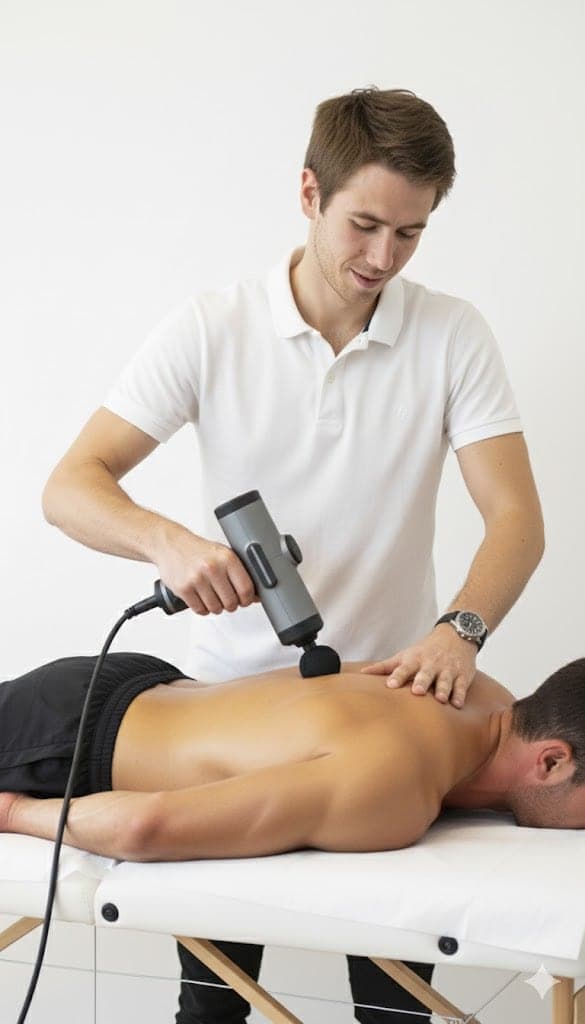
I travel to schools with a professional bench and all necessary equipment, creating a clinical treatment environment right on campus. This eliminates the logistical barriers that prevent most student athletes from accessing quality recovery services.
Implementing Physical Recovery Programs in Educational Settings
Based on my decade of experience, successful integration of physical recovery with massage in schools requires a systematic approach rather than ad-hoc treatment sessions.
Assessment-Based Treatment Planning
I don’t provide generic massage sessions. Every student athlete I work with receives an initial biomechanical assessment where I evaluate:
- Movement patterns and compensations during functional tests
- Range of motion limitations in key joints
- Palpable tension and adhesions in primary muscle groups
- Sport-specific biomechanical demands and common injury patterns
This assessment creates a baseline from which we build a customized treatment plan. A volleyball player needs entirely different focus than a cross-country runner. The assessment ensures we’re addressing each athlete’s specific biomechanical needs rather than applying a one-size-fits-all approach.
Structured Recovery Cycles
Physical recovery isn’t something you do once and forget. It needs to be integrated into the training cycle. For student athletes, I typically recommend treatment every two to three weeks during competitive seasons, with more intensive work during off-season periods when we can address accumulated tension without impacting performance.
I worked with a private school’s soccer program where we implemented bi-weekly recovery sessions throughout their season. The coaching staff reported a forty percent reduction in minor injuries and noticed that players maintained their sprint speed and agility much later into games compared to previous seasons. This wasn’t coincidence—it was the direct result of maintaining tissue quality throughout a demanding competitive schedule.
Education and Empowerment
Part of my role involves teaching young athletes to understand their own bodies. I explain what I’m feeling as I work, why certain areas are restricted, and how their training habits created these patterns. This education transforms passive treatment recipients into active participants in their own recovery.
One of my clients, a competitive swimmer who initially came to me for shoulder pain, eventually became so attuned to his own biomechanics that he started modifying his dryland training to avoid the movement patterns that were creating problems. He went from needing weekly treatment to maintaining himself with monthly sessions. That’s the goal—not dependence, but empowerment.
Addressing Common Misconceptions About Recovery Massage in Schools
Throughout my career, I’ve encountered numerous misconceptions about physical recovery massage, particularly in educational settings. Let me address the most common ones directly.
“Massage Is Relaxation, Not Treatment”
This is perhaps the most damaging misconception. Yes, some massage focuses primarily on relaxation and stress reduction—and there’s value in that. But what I provide is mechanical intervention designed to restore optimal tissue function. The confusion arises because both use similar terminology, but the goals, techniques, and outcomes are entirely different.
When I treat a student athlete’s chronically tight hamstrings, I’m not trying to make them feel relaxed. I’m breaking down fascial adhesions, restoring proper fiber alignment, and improving the muscle’s ability to contract and lengthen efficiently. The sensation during treatment is often intense—not painful, but definitely not “relaxing” in the spa sense. The relaxation comes afterward, when the athlete realizes their body is moving more efficiently than it has in months.
“Young Athletes Don’t Need Recovery Work”
This misconception is based on the observation that young people recover quickly from individual training sessions. While it’s true that adolescents have excellent acute recovery capabilities, they’re simultaneously developing movement patterns and tissue quality that will define their adult bodies.
A fourteen-year-old baseball pitcher might not feel any discomfort after throwing a hundred pitches, but if we examined his shoulder mechanics, we’d likely find developing restrictions in his posterior rotator cuff and limited external rotation. Address those issues now, and he develops healthy throwing mechanics. Ignore them, and by eighteen he’s dealing with chronic shoulder problems that will plague him for decades.
Prevention is always more effective than correction. The work I do with young athletes isn’t just about optimizing current performance—it’s about establishing healthy biomechanical patterns that serve them throughout their lives.
“Recovery Programs Are Too Expensive for Schools”
This objection reflects a fundamental misunderstanding of cost versus investment. Yes, implementing a professional recovery program requires financial resources. But compare that cost to the expenses associated with injuries, lost playing time, and reduced athletic performance.
I’ve worked with schools that calculated their return on investment and found that reduced injury rates alone justified the program costs. When you factor in improved performance, increased athlete satisfaction, and the recruitment advantages of offering professional recovery services, the economic case becomes overwhelming.
More importantly, we need to reframe how we think about student athlete welfare. If schools invest in coaching, facilities, and equipment, why wouldn’t they invest in the recovery systems that allow athletes to safely benefit from all that training?
Case Studies: Real Results in Educational Settings
Let me share specific examples from my work with student athletes, because results speak louder than theory.
The Distance Runner Who Regained Her Career
Sarah (name changed for privacy) was a promising high school distance runner who developed chronic shin splints that had sidelined her for six months. She’d tried ice, rest, orthotics, physical therapy—everything her school’s athletic trainer recommended. Nothing worked. When she came to me, I found severe tension throughout her entire posterior chain, from her calves through her hamstrings and glutes. Her shin pain was a symptom, not the cause.
Using my mechanical method, I systematically addressed the accumulated tension patterns that were forcing her lower legs to compensate for dysfunction higher in the kinetic chain. We didn’t focus primarily on her shins—we restored proper function to her entire lower body mechanics. Within four weeks, she was running pain-free. Three months later, she qualified for her state championships.
What made the difference? Treating the actual cause rather than chasing symptoms. My mechanical approach provided the depth and precision necessary to address root biomechanical problems that manual techniques had missed.
The Football Team That Transformed Their Season
I spent an entire season working with a high school football program that had struggled with an unusually high injury rate. The coaching staff was excellent, the strength and conditioning program was sound, but players kept developing minor injuries that accumulated into major problems.
I implemented a systematic recovery program where every player received assessment-based treatment every other week. We identified and addressed individual biomechanical issues before they became injuries. The tight-hipped linemen received focused work on their hip flexors and external rotators. The receivers with shoulder imbalances got precision treatment on their rotator cuffs and scapular stabilizers.
The results were measurable: they went from having an average of five players per game dealing with pain-related performance limitations to less than one. Their fourth-quarter performance improved dramatically because players maintained their biomechanical efficiency throughout games. The coaching staff attributed their successful playoff run directly to the recovery program we’d implemented.
The Gymnast Who Avoided Surgery
Emily was a competitive gymnast with chronic lower back pain that an orthopedist had recommended might require surgical intervention. At sixteen, she was facing the possibility that her athletic career might be over. Her parents brought her to me as a final attempt before scheduling surgery.
The assessment revealed exactly what I expected: years of extreme spinal extension and flexion had created severe tension patterns throughout her spinal erectors, quadratus lumborum, and psoas. These chronically tight muscles were pulling on her lumbar spine, creating mechanical stress that generated pain. No amount of core strengthening or flexibility work had resolved it because the deep fascial restrictions remained unaddressed.
Over eight weeks, using my mechanical method, we systematically released the tension patterns that had accumulated over years of training. The work was intensive and required Emily’s full commitment, but the results were undeniable. Her pain resolved completely, her spinal mechanics normalized, and she returned to competitive gymnastics. Two years later, she’s still training pain-free and recently earned a college scholarship.
This is what I mean when I talk about treating causes rather than symptoms. Surgery would have addressed a structural consequence of poor biomechanics without solving the underlying mechanical problem. My approach resolved the root cause, making surgery unnecessary.
The Long-Term Impact: Building Healthy Athletes for Life
The work I do with student athletes isn’t just about immediate performance gains or pain relief. It’s about establishing biomechanical health that serves them throughout their lives.
I’ve stayed in touch with many of the young athletes I’ve treated over the years. The ones who received regular, systematic recovery work during their school years consistently report better adult health outcomes. They move better, experience less chronic pain, and maintain higher activity levels as they age. This isn’t surprising—we helped them develop healthy movement patterns and tissue quality during their formative years.
Contrast this with the athletes who pushed through pain and accumulated tension without proper recovery. Many of them are dealing with chronic problems by their mid-twenties: persistent lower back pain, shoulder dysfunction, knee issues that limit their quality of life. These aren’t inevitable consequences of athletic participation—they’re the predictable results of accumulated biomechanical stress without proper intervention.
Physical recovery with massage in schools is an investment in long-term health, not just athletic performance. When schools implement systematic recovery programs, they’re not only helping students perform better today—they’re teaching them that body maintenance is a crucial life skill and giving them the biomechanical foundation for healthy adult lives.
Frequently Asked Questions About Physical Recovery Massage in Schools
How often should student athletes receive recovery massage?
The ideal frequency depends on training volume and intensity. During competitive seasons, I typically recommend treatment every two to three weeks for student athletes training five or more times weekly. During off-seasons, monthly maintenance sessions combined with more intensive work to address accumulated issues provides optimal results. The key is consistency—regular treatment prevents problems rather than constantly addressing crises.
Is deep-tissue massage painful for young athletes?
The sensation during treatment is intense but should never be genuinely painful. I adjust the pressure precisely to each athlete’s tolerance and tissue condition. What they experience is the discomfort of chronic tension being released—similar to the “good hurt” of productive stretching. Many athletes describe it as uncomfortable in the moment but immediately followed by dramatic improvement in how they feel and move. I maintain constant communication throughout treatment, ensuring the intensity remains productive rather than traumatic.
Can massage replace physical therapy or athletic training?
No, and that’s not the goal. Physical therapy, athletic training, and recovery massage serve complementary but distinct roles. Physical therapists diagnose and rehabilitate injuries, teaching corrective exercises and movement patterns. Athletic trainers manage acute injuries and provide immediate care. My work addresses the mechanical tissue quality that underlies healthy movement. The most effective approach integrates all three disciplines—each contributing their specific expertise to comprehensive athlete care.
How quickly will student athletes see results?
Most athletes notice immediate improvements in range of motion and movement quality after their first session. However, lasting changes in tissue quality and biomechanical patterns require consistent work over weeks to months, depending on how long the dysfunction has been developing. An athlete who’s been training for years with accumulated tension needs more extensive work than one who’s just starting to develop problems. This is why I emphasize partnership rather than one-off treatments—meaningful results come from systematic, progressive intervention.
What makes your mechanical method different from percussion massage devices?
Consumer percussion devices like massage guns provide superficial vibration that can temporarily reduce muscle tension and improve blood flow. They’re useful tools for daily maintenance, but they don’t address deeper fascial restrictions or provide the precision necessary for therapeutic work. My specialized method delivers controlled, sustained pressure that penetrates to the deeper myofascial layers where chronic tension accumulates. The difference is similar to comparing a kitchen knife to a surgical scalpel—both cut, but one provides the precision necessary for therapeutic outcomes.
Do schools need special facilities to implement recovery programs?
No specialized facilities are required. I travel to schools with a professional treatment bench and all necessary equipment. The only requirement is a private space with enough room for the bench—a classroom, athletic trainer’s office, or unused locker room works perfectly. This mobility eliminates the logistical barriers that often prevent student athletes from accessing recovery services. They don’t need transportation or appointments during limited free time; the treatment comes to them as part of their school day.
How do you handle parental consent and privacy concerns?
All treatment of minor athletes requires explicit parental consent with comprehensive explanation of the methods and goals. Parents receive detailed information about my approach, credentials, and philosophy. During treatment, I maintain strict professional boundaries—athletes remain fully clothed except for the specific area being treated, and a school staff member can be present if desired. Privacy and professionalism are non-negotiable aspects of working with student populations.
Can this approach help prevent overtraining syndrome?
Yes, though prevention of overtraining requires a multifaceted approach including proper periodization, adequate nutrition, and sufficient sleep. However, systematic recovery massage plays a crucial role by maintaining tissue quality and reducing the cumulative mechanical stress that contributes to overtraining. When athletes can efficiently recover between training sessions, they’re less likely to enter the downward spiral of accumulated fatigue that characterizes overtraining syndrome. I’ve worked with several student athletes who were developing early overtraining signs, and comprehensive recovery work was a critical component of their return to healthy training.
Moving Forward: Establishing a Recovery Culture in Schools
The future of student athletics requires fundamental changes in how we approach training and recovery. We’ve spent decades optimizing training methods, refining coaching techniques, and improving equipment. Now we need to apply that same systematic approach to recovery.
Physical recovery with massage in schools isn’t a luxury—it’s a logical extension of comprehensive athletic development. Schools that implement professional recovery programs aren’t coddling athletes; they’re applying evidence-based methods to optimize performance while protecting long-term health.
I challenge athletic directors, coaches, and school administrators to examine their current approach. Are you providing your student athletes with the recovery resources necessary to safely benefit from intensive training? Or are you hoping that youth and natural resilience will somehow prevent the biomechanical problems that inevitably develop when recovery is neglected?
My decade of experience, backed by my education in Physical Education and Nutrition, has taught me that the body follows mechanical principles. Accumulated stress without adequate recovery creates dysfunction. This isn’t debatable—it’s biomechanical reality. The only question is whether we’ll address it proactively or deal with the consequences reactively.
For schools ready to invest in their athletes’ long-term health and performance, I offer a dedicated partnership built on systematic assessment, customized treatment plans, and consistent results. This isn’t about selling massage sessions—it’s about fundamentally improving how we prepare young athletes for both immediate competition and lifelong health.
The students I’ve worked with over the years have shown me that when we provide proper recovery resources, young athletes thrive. They perform better, stay healthier, and develop the body awareness and maintenance habits that serve them throughout their lives. That’s the return on investment that matters most—not just championships won today, but healthy, capable adults tomorrow.
If you’re ready to establish a true culture of comprehensive athletic development at your school, where recovery receives the same attention and resources as training, I’m prepared to bring my specialized method, professional equipment, and decade of expertise directly to your athletes. The question isn’t whether systematic recovery works—my results speak for themselves. The question is whether you’re ready to invest in your students’ long-term success.
Written by
Chris
Massage therapist & body mechanics specialist
Norwegian-certified with a Bachelor’s in Physical Education and Nutrition and over ten years of clinical practice, working from a portable table in clients’ homes across the Paphos district.
This article is general information from clinical practice, not a medical diagnosis. If you have severe, worsening or unexplained pain, numbness, weakness, or pain after an accident, see a doctor first.