Massage for neck pain Paphos: how I treat a stiff, aching neck at home
In short
Most neck pain I see in Paphos is muscular: tight suboccipitals, levator scapulae and upper trapezius holding trigger points. Slow, deep, mechanical massage releases them, done at your home, €90 for 60 minutes.
I have spent more than ten years working on necks; most of the ones I see in Paphos hurt because of muscle, not bone. If you are looking for massage for neck pain Paphos, this is how I approach it: precise trigger-point massage in Paphos on the muscles that hold your head up, on my treatment table at your home.
I am not going to promise you a miracle. What I can offer is a clear explanation of what is usually going on, an honest account of what mechanical deep-tissue work does and does not do for it, and a session that is planned around your particular neck rather than a routine.
What is actually happening in a painful neck
The cervical spine is small, mobile and surrounded by layers of muscle that do a surprising amount of work. Your head weighs roughly the same as a bowling ball, and every centimetre it drifts forward of your shoulders adds load to the muscles at the back of the neck. Hours of screen work, phone use, driving the B7 into town, or sleeping on a pillow that is too high all push the head forward and keep those muscles switched on.
Muscle that never fully switches off does two things. It shortens, so the neck loses rotation and you notice it reversing the car. And it develops trigger points — small, irritable knots in the fibre that are tender to press and often refer pain somewhere else. Suboccipital trigger points at the base of the skull refer into the temple and behind the eye. Levator scapulae refers along the top of the shoulder blade. Upper trapezius refers up the side of the neck and into the jaw.
The muscles I assess in nearly every neck-pain session:
- Suboccipitals — four small muscles under the skull rim, the usual culprit in headache-type neck pain
- Levator scapulae — the "crick in the neck" muscle running from the upper neck to the shoulder blade
- Upper trapezius — the shelf between neck and shoulder that carries stress and desk posture
- Scalenes — at the side of the neck; when tight they can produce arm tingling
- Splenius and semispinalis — the deeper posterior layers that lose rotation first
The good news is that muscle responds to pressure. Bone, disc and nerve mostly do not, and I say more about that below.
Why I use trigger-point work rather than a general rub
A relaxing full-body massage feels pleasant on a sore neck for an hour, and I am happy to do that if it is what you want. But if the pain keeps returning, the general approach usually has not reached the tissue that is causing it. The suboccipitals sit under the trapezius and the semispinalis; the levator attachment hides under the upper edge of the shoulder blade. Getting there needs slow, sustained, precisely angled pressure held long enough for the fibre to let go — typically well over a minute on a stubborn point.
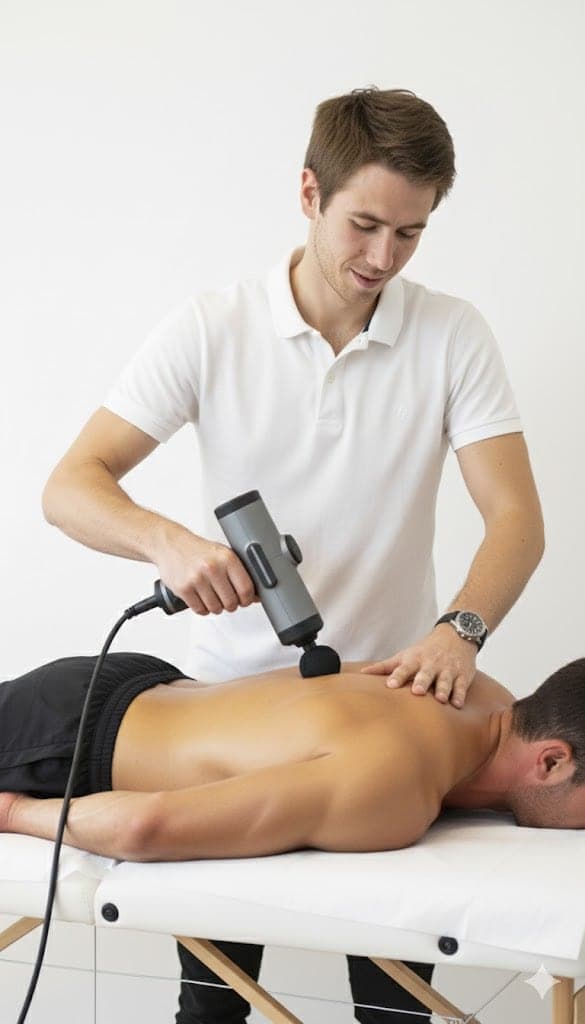
Hands tire quickly at that depth and angle. That is why my practice is built around mechanical deep-tissue tools: they let me hold a consistent, controlled load on a specific point for as long as it needs without my thumbs giving out or the pressure wandering. I still use my hands constantly, to find the point, to feel the change and to work the softer tissue around it. The tool does the sustained part.
Depth is not the same as force. Bracing against pain makes the neck guard harder, which is the opposite of what we want. I work at the level where you feel a strong, specific, "that's the one" ache and can still breathe normally, and I back off if you cannot.
How a session for neck pain runs at your home
I bring a professional folding treatment table, linen, and everything else, and I set up wherever there is roughly two metres by three of floor — a living room, a spare bedroom, a shaded terrace in the cooler months. You do not need to prepare anything except a little space and a glass of water afterwards.
| Stage | What happens | Roughly how long |
|---|---|---|
| Talk and check | Where it hurts, what makes it worse, red flags, how far you can turn and tilt | 5–10 minutes |
| Warm-up | Broad deep-tissue work through the upper back, shoulders and neck to prepare the tissue | 10–15 minutes |
| Trigger-point work | Sustained pressure on the specific points found in the assessment | 20–40 minutes |
| Recheck and advice | Range of motion again, one or two things to do at home | 5 minutes |
A 60-minute session (€90) is enough for the neck, shoulders and upper back. I suggest 90 minutes (€130) when the neck is part of a wider picture — a stiff mid-back, a tight chest pulling the shoulders forward, or lower back pain from the same desk. Every fifth session is free, and full details are on the pricing page.
Afterwards, expect the neck to feel looser and a bit heavy. Some people are tender for a day, similar to the ache after a hard gym session; that settles. What you should not feel is sharper pain or new arm symptoms, and if you do I want to hear about it.
The neck-pain patterns I see most often in Paphos
Almost everyone arrives with "my neck hurts", but the story underneath tends to fall into a small number of patterns, and each is treated slightly differently.
The presentation I see most often across Paphos town, Kato Paphos and the villages up towards Tala is the desk-and-phone neck: dull ache at the base of the skull, worse by late afternoon, sometimes a headache behind the eyes. The suboccipitals and upper trapezius are the target, and the advice about the screen matters as much as the massage.
Second is the sudden crick — you woke up unable to turn one way. That is nearly always levator scapulae or a splenius spasm, it responds well to careful work, and it wants gentler treatment in the first day or two rather than the deepest pressure.
Third is the stress neck, common among people running businesses and among visitors who arrive wound tight and only notice the neck once they stop. The whole shoulder girdle is up around the ears. Here I do more broad deep-tissue work through the shoulders and upper back before any specific point work.
- Desk-and-phone neck: skull-base ache, headaches, worse with hours at a screen
- Acute crick: one-sided, sudden, restricted rotation, recent
- Stress and guarding: both shoulders raised, jaw tight, sleep poor
- Old whiplash or long-term stiffness: global loss of range, deeper layers involved, slower to change
- Neck with arm symptoms: needs a careful look before I treat, see below
I do not give a fixed number of sessions in advance. A recent, simple neck often needs one or two. Something that has been building for years usually wants a short series and then occasional maintenance, and I will tell you frankly after the first session what I think is realistic.
What I can and can't help with
I can help with muscular neck pain, tension headaches that start at the base of the skull, loss of rotation from tight muscle, and the tightness that builds around an old injury once the acute phase is over. I cannot fix a disc, an arthritic joint or a trapped nerve, although easing the muscle around them often takes some of the pain away and I am glad to work alongside your doctor or physio on that.
See a doctor first if your neck pain followed a fall or crash, if you have numbness, weakness or pins and needles down an arm, if you have fever, unexplained weight loss or night pain that does not ease with rest, or if a headache came on suddenly and severely. Those are not massage problems until someone has ruled the serious causes out.
Frequently asked questions
How soon after a neck massage will I feel a difference?
Most people notice easier rotation and less of the dull skull-base ache before I have packed the table away. Trigger points that have been active for a long time can flare gently for a day and then settle to a better baseline. A recent, simple neck often improves clearly after one session; long-standing stiffness changes more gradually over a short series.
Is deep-tissue massage safe for neck pain?
Yes, when the pain is muscular and the person doing it knows the anatomy of the front and side of the neck, where the arteries and nerves run. I do not use force on the throat side, I check for red flags before starting, and I keep pressure at a level you can breathe through. If anything about your history suggests a non-muscular cause, I will ask you to see a doctor first.
Can massage help headaches that start in my neck?
Often, yes. Headaches that begin at the base of the skull and spread over the head or behind the eye are commonly driven by trigger points in the suboccipital and upper trapezius muscles. Releasing those points, and correcting the forward-head posture that keeps them irritated, tends to reduce how often and how hard those headaches arrive. Migraine and sudden severe headaches are different and need medical assessment.
How many sessions will my neck need?
I honestly do not know until I have felt it. A one-off crick or a fresh desk neck may need one or two sessions. A neck that has been stiff for years, or one that flares whenever work gets busy, generally does better with a short run of weekly sessions and then a top-up whenever it starts to creep back. I will give you my view after the first visit.
Do you treat neck pain everywhere in Paphos?
Yes. I am based in Chlorakas and travel across the Paphos district — Kato Paphos, the town, Geroskipou, Emba, Tala, Peyia and Coral Bay are all regular routes. You book by WhatsApp or phone, tell me the address, and I bring the table and everything else. Sessions are €90 for 60 minutes and €130 for 90.
Should I stretch or use heat before you arrive?
Neither is necessary. A warm shower beforehand is pleasant and softens the tissue a little, but I warm the area up myself as part of the session. Please avoid heavy exercise for the neck and shoulders in the hour before, and let me know if you have taken strong painkillers, because they blunt the feedback I rely on to judge pressure.
Written by
Chris
Massage therapist & body mechanics specialist
Norwegian-certified with a Bachelor’s in Physical Education and Nutrition and over ten years of clinical practice, working from a portable table in clients’ homes across the Paphos district.
- Norwegian-certified
- BSc Physical Education & Nutrition
- 10+ years clinical practice
- Based in Chlorakas · all of Paphos district
- No call-out fee anywhere in Paphos district
Last reviewed
This article is general information from clinical practice, not a medical diagnosis. If you have severe, worsening or unexplained pain, numbness, weakness, or pain after an accident, see a doctor first.