
IT Band Syndrome Pain Relief Tips: A Clinical Approach to Lasting Recovery
In short
Discover evidence-based IT band syndrome pain relief tips from a specialist with 10 years of experience. Learn how to address the root mechanical causes, not just symptoms, for lasting results.
I’ve worked with hundreds of athletes and active individuals suffering from iliotibial band syndrome over the past decade, and I can tell you with absolute certainty: most people are treating IT band pain completely wrong. They’re addressing symptoms while ignoring the biomechanical dysfunction that created the problem in the first place. After ten years of clinical practice and a Bachelor’s degree in Physical Education and Nutrition, I’ve developed a systematic approach that doesn’t just mask pain—it eliminates the mechanical restrictions causing it.
Let me share what actually works. Not generic stretching advice you’ll find on every fitness blog, but specific IT band syndrome pain relief tips based on understanding fascia, muscle compensation patterns, and the kinetic chain dysfunction that leads to this debilitating condition. If you’re currently sidelined from running, cycling, or simply walking without pain, you need to understand why traditional approaches fail and what it takes to achieve genuine recovery.
Understanding IT Band Syndrome Beyond Surface-Level Explanations
The iliotibial band isn’t a muscle—it’s a thick fascial structure that runs from your hip to your knee, acting as a stabilizer for your entire lower extremity during movement. When clients come to me complaining of lateral knee pain or hip discomfort, they’ve usually already tried foam rolling, rest, and basic stretching. These approaches provide temporary relief at best because they don’t address the fundamental issue: the IT band itself isn’t the problem.
I’ve examined this condition from every angle in my practice. The IT band becomes symptomatic when muscles that should be sharing the workload—particularly the tensor fasciae latae, gluteus medius, and vastus lateralis—develop adhesions, trigger points, and compensatory tension patterns. Your body is brilliant at adaptation, but these adaptations create mechanical inefficiency that eventually manifests as IT band pain.
The Biomechanical Chain Reaction
Here’s what happens in the body, explained with the clinical precision this condition demands. Your hip abductors and external rotators maintain pelvic stability during gait. When these muscles develop restrictions—from overtraining, prolonged sitting, previous injuries, or improper movement patterns—your body compensates. The tensor fasciae latae becomes hypertonic, pulling excessively on the IT band. Meanwhile, the gluteus medius fails to adequately stabilize your pelvis, forcing the IT band to work overtime as a stabilizer it was never designed to be.
This compensation creates friction where the IT band crosses the lateral femoral epicondyle during knee flexion and extension. That friction causes inflammation, and inflammation causes pain. But treating the inflammation without correcting the mechanical dysfunction is like bailing water from a sinking boat without plugging the hole.
IT Band Syndrome Pain Relief Tips: The Immediate Action Protocol
Let me give you a structured approach based on what I’ve observed works consistently in clinical practice. These aren’t random suggestions—this is a systematic protocol addressing the condition at multiple levels simultaneously.
1. Cease Aggravating Activities Without Complete Rest
I need to challenge the common advice to “just rest.” Complete cessation of all activity allows the acute inflammation to decrease, yes, but it also allows the compensatory patterns that caused the problem to solidify. Instead, implement activity modification. If running triggers pain at the 2-mile mark, reduce distance to 1 mile while we address the mechanical restrictions. If cycling aggravates symptoms after 30 minutes, cap sessions at 20 minutes. Maintain movement capacity while avoiding inflammatory triggers.
2. Target the True Source: Muscular Adhesions and Trigger Points
This is where conventional treatment fails spectacularly. People foam roll the IT band itself—a thick, resilient structure that doesn’t respond meaningfully to superficial pressure. What you actually need is deep mechanical release of the muscles creating tension on the IT band. The tensor fasciae latae, gluteus medius, gluteus minimus, vastus lateralis, and even the piriformis require treatment that reaches beyond superficial tissue layers.
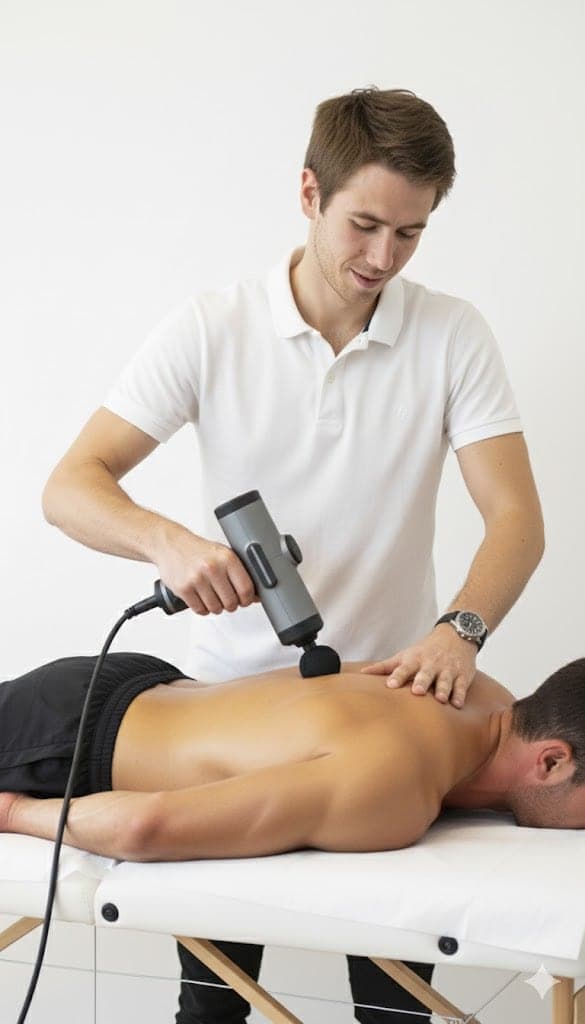
In my practice, I use specialized mechanical deep-tissue techniques that deliver precision, power, and consistency impossible to achieve with manual therapy or basic self-treatment tools. The equipment I employ works deeper than human hands can reach, with adjustable intensity that ranges from therapeutic to intensely powerful for conditioned athletes. This isn’t about comfort—it’s about accessing adhesions at their origin and restoring proper tissue mobility.
3. Address Hip Weakness Through Specific Activation
Gluteus medius weakness is present in approximately 80% of IT band syndrome cases I’ve treated. This muscle is your primary hip abductor and pelvic stabilizer during single-leg stance—which occurs with every running step. When it fails to fire properly, compensation patterns emerge immediately.
Implement these activation exercises with strict form:
- Side-lying hip abduction with external rotation: Lie on your side, bend the bottom leg, extend the top leg with the foot turned slightly upward, and raise it 30-40 degrees. Hold for 2 seconds at the top. The key is maintaining external rotation throughout the movement. Perform 3 sets of 15-20 repetitions.
- Single-leg stance with perturbation: Stand on one leg, maintain level hips, and have someone apply light pushes from various directions while you resist movement. This trains dynamic stabilization. Progress to eyes closed once you’ve mastered the basic version. 3 sets of 45-60 seconds per leg.
- Clamshells with resistance band: Yes, this is common advice, but most people perform them incorrectly. Lie on your side with knees bent 90 degrees, feet together, and a resistance band around your thighs just above the knees. Rotate the top knee upward while keeping the feet in contact and the pelvis absolutely stable. No rolling backward. 3 sets of 20 repetitions with a 2-second hold at maximum abduction.
4. Integrate Dynamic Stretching for Fascial Mobility
Static stretching of the IT band is biomechanically questionable—you cannot meaningfully lengthen this structure through conventional stretching. However, you can improve fascial glide and reduce tension in the muscles that attach to it through dynamic mobility work.
I recommend this sequence performed daily:
- Standing IT band mobilization: Stand with the affected leg crossed behind the other. Reach the same-side arm overhead and lean away from the affected side, creating a continuous line of tension from hip to fingertips. Hold for 30 seconds, repeat 3 times. This addresses the entire lateral fascial chain.
- Hip flexor mobilization in half-kneeling: Kneel on the affected side with the opposite foot forward. Drive your hips forward while maintaining upright posture until you feel a stretch in the front of the hip. Add a posterior pelvic tilt and feel the stretch intensify. This releases the tensor fasciae latae at its origin. Hold 45 seconds, repeat 3 times.
- Pigeon pose with rotation: From a pigeon pose position with the affected leg forward, rotate your torso toward the bent leg and hold. This creates multi-planar fascial release. 60 seconds per side, 2 repetitions.
The Clinical Treatment Approach That Delivers Lasting Results
Here’s a story that illustrates why superficial approaches fail. Six months ago, I worked with a competitive marathon runner who had been battling IT band syndrome for eight months. She had tried physical therapy, chiropractic care, acupuncture, and endless foam rolling. She could barely run three miles without severe lateral knee pain that would persist for days afterward. Her race season was essentially over.
When I evaluated her, I found extensive adhesions throughout her tensor fasciae latae, profound gluteus medius weakness, and trigger points in her vastus lateralis that referred pain directly to her lateral knee. Her IT band pain was the symptom, but these muscular dysfunctions were the cause.
I implemented my specialized mechanical deep-tissue protocol. Using precision equipment that works substantially deeper than manual techniques, I systematically released the adhesions restricting her hip musculature. The machine delivers consistent, controlled pressure that can be precisely calibrated from therapeutic to intensely powerful—critical for reaching restrictions in dense fascial layers. Within three sessions, her pain-free running distance increased from three miles to eight. After two months of dedicated treatment combined with the corrective exercises I prescribed, she completed a half-marathon with zero IT band symptoms.
Why Mechanical Precision Matters
I need to be direct about this: manual massage therapy, while valuable for relaxation and general wellness, lacks the mechanical advantage necessary to create lasting change in dense fascial restrictions. Human hands fatigue. Pressure becomes inconsistent. Depth is limited by finger and thumb strength. There are no “off days” with mechanical treatment—every session delivers identical precision and power.
The specialized equipment I use provides three critical advantages:
| Advantage | Clinical Benefit | Patient Outcome |
|---|---|---|
| Depth Beyond Manual Capacity | Accesses adhesions at fascial origins and insertions | Releases restriction at the source, not superficially |
| Adjustable, Consistent Intensity | Precisely calibrated from gentle to powerfully deep | Optimal treatment for each tissue layer and pain tolerance |
| Elimination of Therapist Fatigue | Every treatment session is equally effective | Predictable, reliable progression toward recovery |
This isn’t about convenience—it’s about mechanical superiority that produces superior results. When you’re investing in treatment, you deserve an approach that addresses causes, not symptoms.
The 30-Day IT Band Syndrome Recovery Protocol
Based on a decade of clinical experience, I’ve developed a four-week protocol that addresses IT band syndrome systematically. This assumes you’re implementing proper mechanical treatment alongside self-care measures. If you’re only doing self-treatment, expect this timeline to extend considerably.
Week 1: Acute Symptom Management
Reduce inflammation while beginning mechanical release of primary restriction sites. Ice application for 15 minutes post-activity. Implement hip abductor activation exercises daily at low resistance. Activity modification to stay below pain threshold. Initial deep-tissue treatment focusing on tensor fasciae latae and gluteus medius. Expect 30-40% reduction in symptom frequency.
Week 2: Progressive Tissue Remodeling
Increase mechanical treatment intensity as tissue tolerance improves. Add vastus lateralis and piriformis to treatment protocol. Progress hip strengthening exercises to moderate resistance. Begin graduated return to activity—if running was your primary aggravator, implement run-walk intervals at 1:2 ratio. Expect pain-free activity duration to increase by 50-70%.
Week 3: Functional Integration
Emphasize dynamic stability training and movement pattern correction. Single-leg exercises become primary strength focus. Mechanical treatment addresses remaining adhesions and begins maintenance protocol. Activity levels approach 70-80% of pre-injury capacity. Most clients report minimal to zero symptoms during normal daily activities by this point.
Week 4: Performance Optimization
Return to full activity with emphasis on movement quality over quantity. Continue strengthening protocol with progressive overload. Maintenance mechanical treatment every 7-10 days to prevent recurrence. Most clients are completely symptom-free and performing at or above previous levels by week four.
Advanced IT Band Syndrome Pain Relief Tips for Chronic Cases
Some individuals have been dealing with IT band syndrome for months or years. Chronic cases require a more aggressive approach because compensatory patterns have become deeply ingrained in their movement system.
Neural Tension Assessment
In chronic IT band syndrome, I frequently discover neural tension through the lateral femoral cutaneous nerve or even sciatic nerve involvement due to prolonged compensatory patterns. This manifests as burning pain, numbness, or tingling along the lateral thigh—symptoms people often attribute to the IT band itself. Neural gliding exercises become essential in these cases.
Proximal and Distal Chain Evaluation
Chronic IT band pain rarely exists in isolation. I examine the entire kinetic chain from foot mechanics through lumbar spine mobility. Ankle dorsiflexion restriction forces compensatory hip adduction during gait, increasing IT band stress. Lumbar spine stiffness prevents proper pelvic rotation, again overloading the IT band as a stabilizer. Addressing these distant restrictions often proves critical for resolving persistent symptoms.
Psychological Component of Chronic Pain
I need to address this openly. When pain persists beyond normal tissue healing timelines—generally 6-12 weeks—central nervous system sensitization begins. Your nervous system becomes hypervigilant, amplifying pain signals. This doesn’t mean the pain is “in your head”—it’s a legitimate neurophysiological response to chronic tissue irritation. But it does mean that mechanical treatment alone may be insufficient. You need movement confidence restoration through gradual, progressive loading that teaches your nervous system that movement is safe.
Frequently Asked Questions About IT Band Syndrome Pain Relief
How long does it take to recover from IT band syndrome?
With proper mechanical treatment and corrective exercise, most cases resolve within 4-6 weeks. However, this assumes you’re addressing the actual mechanical restrictions causing the condition, not just managing symptoms. Chronic cases with established compensatory patterns may require 8-12 weeks. Without appropriate treatment, IT band syndrome can persist indefinitely—I’ve worked with individuals suffering for years before implementing effective protocols.
Should I completely stop running if I have IT band syndrome?
Complete rest is rarely optimal. Activity modification that keeps you below the pain threshold while we address mechanical dysfunction is the superior approach. This maintains cardiovascular fitness, preserves movement patterns, and prevents the psychological frustration of complete cessation. If running triggers symptoms at 2 miles, reduce to 1.5 miles. If cycling causes pain after 45 minutes, limit sessions to 30 minutes. Continue moving intelligently while implementing treatment.
Is foam rolling effective for IT band syndrome?
Foam rolling the IT band itself provides minimal therapeutic benefit because the structure is too dense to be meaningfully affected by superficial pressure. However, foam rolling can be moderately useful for the muscles that attach to the IT band—tensor fasciae latae, vastus lateralis, and gluteus medius—if performed with sufficient duration and intensity. I consider it supplementary self-care, not primary treatment. It cannot replace mechanical treatment that reaches deep fascial restrictions.
What’s the difference between IT band syndrome and a meniscus tear?
This is a critical differential diagnosis question. IT band syndrome presents as lateral knee pain that worsens with repetitive knee flexion-extension, particularly during running downhill or descending stairs. Meniscus tears typically cause medial or lateral joint line pain with mechanical symptoms—catching, locking, or giving way. Pain from a meniscus tear often occurs with twisting movements and may be accompanied by swelling. If you have any mechanical symptoms or your pain doesn’t fit the classic IT band pattern, obtain proper medical evaluation before assuming the diagnosis.
Can IT band syndrome cause hip pain?
Absolutely. The IT band originates at the hip, and tension in the tensor fasciae latae frequently manifests as lateral hip pain, sometimes described as a deep ache or burning sensation. In my practice, approximately 40% of IT band syndrome cases present with hip symptoms as prominent as or more prominent than knee symptoms. This is actually encouraging from a treatment perspective—it confirms the problem is muscular and mechanical rather than structural knee damage.
Will surgery fix IT band syndrome?
Surgical intervention for IT band syndrome is rarely indicated and should be considered only after exhaustive conservative treatment has failed—and I mean truly comprehensive treatment addressing all mechanical factors, not just basic physical therapy. Surgery typically involves releasing or lengthening the IT band at the lateral femoral epicondyle. Success rates are inconsistent, and you still need to address the muscular imbalances that created excessive tension in the first place. I’ve never had a client require surgery when they committed to proper mechanical treatment and corrective exercise protocols.
What shoes should I wear if I have IT band syndrome?
Footwear matters, but it’s not the primary solution people hope it will be. Shoes that promote excessive pronation can increase hip adduction and internal rotation during stance phase, stressing the IT band. Conversely, overly rigid shoes that restrict natural foot motion can also create problems. I generally recommend neutral shoes with moderate cushioning and flexibility that allows natural foot mechanics. Get a proper gait analysis if you’re uncertain. But understand that changing shoes without addressing hip muscle dysfunction and movement patterns provides marginal benefit at best.
How often should I receive treatment for IT band syndrome?
Treatment frequency depends on condition severity and chronicity. For acute cases—symptoms present less than 4 weeks—I typically recommend twice-weekly sessions for 2-3 weeks, then weekly for 2-3 weeks, then maintenance every 2-3 weeks. Chronic cases may benefit from three sessions in the first week to aggressively address established restrictions, then twice weekly for several weeks. This isn’t a passive process where you receive treatment and hope for improvement. It’s a dedicated partnership where treatment sessions are integrated with daily corrective exercises you perform independently.
The Investment Approach to Lasting IT Band Pain Relief
I need to be completely transparent about something the wellness industry often obscures: achieving genuine, lasting resolution of IT band syndrome requires investment. Not expense—investment. There’s a critical distinction. An expense is money spent that disappears. An investment returns value that exceeds the initial cost.
When you invest in proper mechanical treatment that addresses causative factors rather than symptomatic massage that provides temporary relief, you’re investing in lasting pain elimination, unrestricted activity participation, and prevention of future episodes. You’re investing in being able to run, cycle, hike, or simply walk without pain limiting your life.
I’ve built my practice on this philosophy over ten years. I don’t offer one-off relaxation sessions. I provide dedicated partnerships with customized treatment plans designed to achieve specific outcomes. I travel to your location with professional equipment and everything necessary to deliver clinical-grade treatment. This isn’t a convenience service—it’s a results-driven approach that meets you where you are, literally and figuratively.
The Mechanical Advantage: Why Precision Equipment Creates Superior Outcomes
Let me share another case that demonstrates the mechanical advantage principle. Three months ago, I began working with a 52-year-old recreational cyclist who had undergone eight weeks of traditional physical therapy for IT band syndrome with minimal improvement. His lateral knee pain prevented rides longer than 15 miles and was beginning to limit his ability to climb stairs comfortably. His physical therapy had consisted of standard stretching, foam rolling, and basic hip strengthening exercises.
When I evaluated him, I found the typical pattern: extensive adhesions in the tensor fasciae latae, gluteus medius weakness, and particularly dense trigger points in the vastus lateralis that required significant pressure to release. I explained that while his previous treatment had addressed appropriate areas, it lacked the mechanical intensity necessary to create lasting change in his specific tissue restrictions.
Using specialized mechanical equipment that delivers controlled, powerful pressure impossible to achieve manually, I systematically worked through his lateral hip and thigh musculature over four sessions spanning two weeks. The machine’s precision allowed me to adjust intensity continuously based on his tissue response—lighter in acutely sensitive areas, significantly deeper in chronically restricted zones. By the third session, he reported pain-free cycling up to 30 miles. After six weeks of combined mechanical treatment and progressive strengthening, he completed a 75-mile century ride with zero IT band symptoms.
This outcome wasn’t luck. It was the predictable result of applying sufficient mechanical force to release adhesions at their source, combined with corrective exercise that addressed the motor control dysfunction maintaining those restrictions. Traditional manual therapy simply cannot generate this level of consistent, controlled depth.
Implementing Your Recovery: The Next Steps
If you’re serious about eliminating IT band pain durably rather than managing it indefinitely, you need to implement a comprehensive approach immediately. That means simultaneous attention to mechanical tissue release, hip strengthening and motor control, activity modification, and movement pattern correction. Addressing only one component produces incomplete results.
Start with the self-care protocols I’ve outlined—hip strengthening exercises, dynamic stretching sequences, and intelligent activity modification. These create the foundation. But understand their limitations. Without addressing deep fascial restrictions through mechanical treatment that reaches beyond superficial layers, your progress will be slower and potentially incomplete.
The specialized mechanical deep-tissue treatment I provide achieves what traditional approaches cannot: complete release of adhesions at their origin, restoration of proper tissue mobility, and elimination of the mechanical restrictions causing your symptoms. Combined with progressive corrective exercise tailored to your specific dysfunction pattern, this approach doesn’t just reduce pain—it eliminates the cause.
This is my area of expertise after ten years of dedicated practice. I’ve specialized exclusively in mechanical treatment of musculoskeletal conditions because I’ve witnessed firsthand the transformative outcomes it produces. I bring professional equipment to your location and deliver clinical-grade treatment designed for lasting resolution, not temporary relief.
If you’ve been tolerating IT band pain, limiting your activities, or cycling through ineffective treatments, it’s time to implement an approach based on mechanical principles and clinical evidence rather than hope and generic advice. Your body is capable of complete recovery when provided appropriate stimulus and progressive loading. The question is whether you’re ready to invest in the treatment and commitment required to achieve that outcome.
IT band syndrome isn’t a condition you need to manage for months or years. With proper mechanical treatment addressing causative factors and dedicated implementation of corrective protocols, most cases resolve completely within 4-8 weeks. That’s not an optimistic promise—it’s a predictable outcome I’ve observed repeatedly across hundreds of cases over a decade of clinical practice.
Your recovery begins with understanding that the IT band itself isn’t the problem—it’s the symptom of underlying mechanical dysfunction. Address that dysfunction with sufficient depth and precision, restore proper hip muscle function through targeted strengthening, and modify your activities intelligently during the recovery process. That’s the evidence-based pathway to lasting pain relief and unrestricted activity participation.
Written by
Chris
Massage therapist & body mechanics specialist
Norwegian-certified with a Bachelor’s in Physical Education and Nutrition and over ten years of clinical practice, working from a portable table in clients’ homes across the Paphos district.
This article is general information from clinical practice, not a medical diagnosis. If you have severe, worsening or unexplained pain, numbness, weakness, or pain after an accident, see a doctor first.