
Deep Tissue Sports Massage Tala: Advanced Mechanical Treatment for Athletes and Active Individuals
In short
Discover how precision deep tissue sports massage in Tala delivers lasting pain relief and performance optimization through advanced mechanical techniques. Expert treatment with a decade of proven results.
I remember my first session with a professional cyclist who had been seeing massage therapists for three years without lasting improvement. His hip flexors were restricting his power output, and despite countless treatments, the tension returned within days. After our first session using my specialized mechanical deep-tissue approach, he messaged me forty-eight hours later: “I can finally feel the difference in my pedal stroke.” That’s when I knew my method wasn’t just different—it was fundamentally superior to traditional massage techniques.
This distinction matters profoundly when we discuss deep tissue sports massage in Tala. The difference between temporary symptom relief and lasting biomechanical correction isn’t subtle—it’s measurable, observable, and transformative.
Why Traditional Sports Massage Falls Short for Serious Athletes
Let me be direct: most massage therapy fails athletes because it addresses symptoms rather than mechanical dysfunction. I’ve seen this pattern repeatedly over ten years of clinical practice. An athlete complains of lower back pain. A therapist works on the lower back. The pain returns. The cycle continues.
This approach fundamentally misunderstands how the human body functions as an integrated kinetic chain. Your lower back pain might originate from restricted hip mobility. Your shoulder discomfort could stem from thoracic spine rigidity. Your performance plateau might result from fascial adhesions limiting force transmission.
Traditional hands-only massage faces three critical limitations. First, human hands lack the consistent force generation necessary to reach deep fascial layers in well-developed athletes. Second, therapist fatigue introduces variability—your treatment quality depends on whether you’re the first or seventh client of the day. Third, manual techniques cannot deliver the sustained, targeted pressure required to remodel chronically shortened tissue.
My background in Physical Education and Nutrition from Norway taught me to view the body through a biomechanical lens. Muscles don’t exist in isolation. They function as part of integrated movement patterns, stabilization systems, and force transmission networks. Effective treatment requires understanding these relationships and addressing dysfunction at its mechanical origin.
The Mechanical Advantage: Precision Deep Tissue Technology
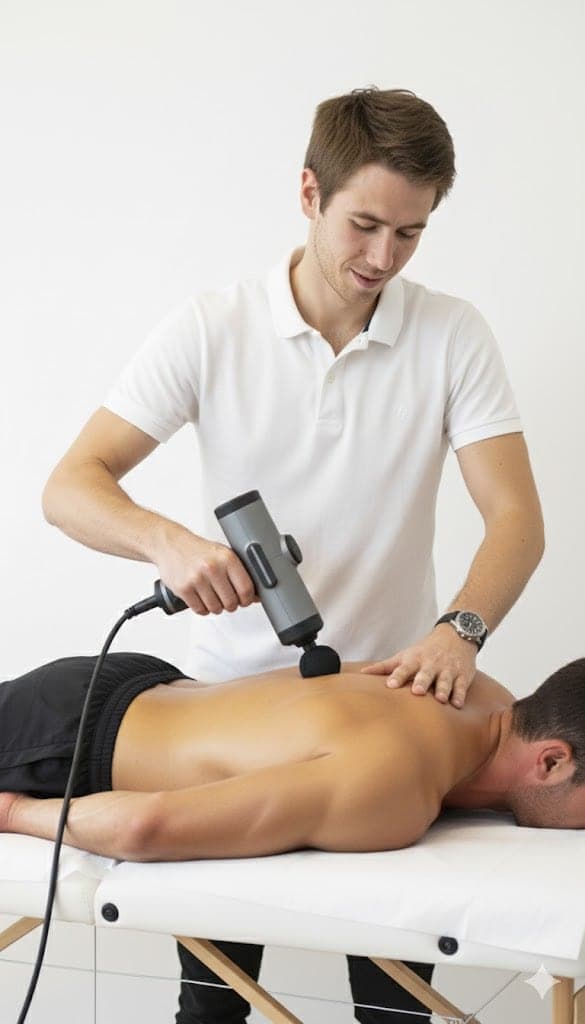
I transitioned to specialized mechanical deep-tissue treatment after recognizing the limitations of manual techniques. The machine I use isn’t a substitute for skill—it’s an amplification of expertise. It allows me to deliver treatment that would be physically impossible through hands alone.
This technology provides three distinct advantages that directly translate to superior athletic outcomes:
Depth and Penetration Beyond Manual Capacity
The specialized tool accesses tissue layers that hands simply cannot reach with therapeutic force. When I work on a runner’s iliotibial band or a tennis player’s rotator cuff, I’m not just pressing on surface muscle. I’m reaching the deep fascial layers where chronic restrictions develop. These adhesions form over months or years of repetitive movement, creating biomechanical compensations that limit performance and generate pain.
Athletes with significant muscle mass particularly benefit from this capability. A competitive weightlifter or rugby player has developed tissue density that requires substantial force to penetrate therapeutically. Manual pressure disperses across surface layers without reaching the dysfunction. Mechanical treatment delivers focused force precisely where it’s needed.
Calibrated Intensity for Individual Tolerance
Every athlete has different pain tolerance, tissue density, and treatment goals. The precision control in my method allows me to adjust intensity from gentle therapeutic pressure to powerfully deep athletic treatment. This isn’t just about comfort—it’s about optimal tissue response.
Too light, and we don’t trigger the mechanotransduction signals that remodel tissue. Too aggressive, and we create protective muscle guarding that defeats the purpose. The mechanical system allows me to find the exact threshold where tissue releases without reflexive bracing. I observe this in real-time through palpation and client feedback, adjusting continuously throughout the session.
This calibrated approach means I can treat a professional athlete and a weekend warrior in the same day, delivering equally effective treatment scaled to their individual needs. The consistency is impossible with manual techniques alone.
Elimination of Therapist Fatigue Variables
I provide the same treatment quality whether you’re my first client at eight in the morning or my last at seven in the evening. Manual therapists face an inconvenient truth: fatigue diminishes treatment effectiveness. Forearm strength wanes. Pressure consistency suffers. Treatment quality varies.
The mechanical system eliminates this variable entirely. Every session delivers identical force, pressure, and precision. You receive optimal treatment regardless of external factors. This consistency matters enormously when we’re pursuing long-term biomechanical change rather than temporary relief.
Deep Tissue Sports Massage Tala: Treatment Philosophy and Approach
My ten years of professional experience have taught me that effective treatment requires more than technical skill. It demands understanding the individual’s movement patterns, training demands, biomechanical limitations, and performance goals.
When an athlete contacts me for deep tissue sports massage in Tala, we’re not scheduling a single session. We’re beginning a partnership focused on lasting improvement. I travel directly to your location with professional equipment, eliminating the inconvenience of traveling to a clinic while ensuring complete privacy and comfort.
Assessment-Driven Treatment Planning
Before applying any technique, I conduct a comprehensive movement assessment. I observe how you move, identify compensatory patterns, and palpate areas of restriction. This assessment reveals the mechanical origins of your symptoms rather than just the symptomatic locations.
A runner might complain of knee pain. My assessment might reveal limited ankle dorsiflexion creating excessive knee valgus during foot strike. Treating the knee provides temporary relief. Addressing the ankle restriction and the resulting fascial adaptations creates lasting biomechanical improvement.
This diagnostic approach stems from my educational background in physical education. I don’t just feel tight muscles—I understand the kinesiological reasons they’ve become dysfunctional and the movement patterns we need to restore.
Progressive Treatment Protocols
Chronic dysfunction doesn’t develop overnight, and it doesn’t resolve in a single session. I design progressive treatment protocols that systematically address layers of adaptation.
Initial sessions focus on releasing superficial restrictions and establishing tissue tolerance for deeper work. Middle-phase sessions target deep fascial adhesions and chronic trigger points. Advanced sessions refine movement patterns and optimize performance capacity.
This progression isn’t arbitrary—it reflects how tissue remodels in response to mechanical stimulus. We’re not just pressing on muscles. We’re triggering biological adaptation processes: increased blood flow, fascial rehydration, neural reset, and tissue remodeling. These processes occur over time with consistent, progressive mechanical input.
Performance Benefits: Beyond Pain Management
Pain relief represents the minimum outcome I expect from treatment. Athletes don’t just want to hurt less—they want to perform better. Deep tissue sports massage in Tala, when delivered with mechanical precision and biomechanical understanding, directly enhances athletic performance through multiple mechanisms.
| Performance Parameter | Mechanical Mechanism | Observable Outcome |
|---|---|---|
| Range of Motion | Release of fascial restrictions and trigger points | Increased joint mobility, improved movement efficiency |
| Force Production | Optimization of muscle fiber recruitment patterns | Enhanced power output, reduced compensatory activation |
| Recovery Capacity | Improved circulation and waste product removal | Faster between-session recovery, reduced cumulative fatigue |
| Movement Economy | Elimination of biomechanical compensations | Reduced energy expenditure at given intensity |
| Injury Resilience | Balanced tissue tension across kinetic chains | Decreased injury risk from mechanical overload |
I worked with a competitive CrossFit athlete who had plateaued in overhead movements for eight months. Her shoulder mobility appeared adequate in isolation, but under load, she demonstrated excessive lumbar extension to compensate for restricted thoracic spine rotation. Traditional massage had focused on her shoulders—the symptomatic site.
My assessment identified the thoracic restriction as the mechanical origin. After four sessions targeting the deep paraspinal muscles, intercostals, and thoracic fascia, her overhead position transformed. She added twelve kilograms to her snatch within two weeks. The change wasn’t strength improvement—she had always possessed that strength. We simply removed the mechanical restriction preventing her from expressing it.
Neuromuscular Optimization
Deep tissue treatment affects more than just tissue structure. It fundamentally alters neuromuscular function through several mechanisms that directly impact athletic performance.
Chronic muscle tension creates elevated resting tone—your muscles never fully relax. This baseline activation wastes energy, limits range of motion, and interferes with skilled movement. Precise deep tissue work resets this resting tone, allowing muscles to function across their full contractile range.
Trigger points—hyperirritable spots within taut muscle bands—disrupt normal motor unit recruitment. They create pain referral patterns, alter movement strategies, and reduce maximum force production. Mechanical deep tissue treatment deactivates these trigger points more effectively than manual techniques because we can deliver sustained pressure directly to the dysfunction without therapist fatigue.
The specialized tool allows me to work along muscle fibers with consistent pressure, releasing adhesions between fascial layers. This improves the “sliding surface” function of fascia, allowing muscles to contract and relax through their full excursion without mechanical restriction.
Common Conditions Requiring Specialized Treatment
My practice in Tala serves athletes and active individuals dealing with specific biomechanical dysfunctions that haven’t responded adequately to conventional treatment. These conditions share common characteristics: they’re chronic, they limit performance, and they stem from mechanical dysfunction rather than acute injury.
Chronic Muscular Tension Patterns
Athletes develop characteristic tension patterns based on their sport demands. Cyclists accumulate restrictions in hip flexors and lower back extensors. Swimmers develop anterior shoulder tightness and thoracic rigidity. Runners create compensatory patterns from repetitive single-plane movement.
These aren’t simple “tight muscles” requiring relaxation. They’re adaptive responses to repetitive mechanical demands, reinforced over thousands of training hours. The tissue has literally remodeled—shortened, thickened, and developed adhesions. Reversing this adaptation requires sustained mechanical force that traditional massage cannot provide consistently.
I recently treated a triathlete who described her hip flexors as “concrete.” Three years of stretching and foam rolling had produced minimal change. After identifying the specific layers of restriction—from superficial rectus femoris through deep iliopsoas—we began progressive mechanical release. Within six sessions, she regained hip extension that had been limited for years. Her running stride lengthened, her power output improved, and her chronic lower back pain resolved entirely.
Sports-Specific Overuse Syndromes
Repetitive movement creates predictable dysfunction patterns. Tennis players develop service-side shoulder restrictions. Golfers accumulate thoracic rotation limitations. Weightlifters lose overhead mobility from chronic lat tightness.
These conditions require sport-specific understanding. I don’t just release tight tissue—I understand why it became dysfunctional based on movement mechanics. A tennis player’s shoulder restriction stems from the deceleration phase of serving. Treatment must address not just the posterior rotator cuff but the entire kinetic chain from foot plant through trunk rotation.
This comprehensive approach distinguishes advanced deep tissue sports massage from generic massage therapy. I’m not providing relaxation—I’m correcting mechanical dysfunction that limits athletic performance.
Postural Compensation Patterns
Modern life creates ubiquitous postural adaptations: forward head position, rounded shoulders, anterior pelvic tilt. Athletes superimpose sport-specific demands onto these existing dysfunctions, creating complex compensation patterns.
A desk worker who cycles on weekends faces compounded dysfunction. Sitting shortens hip flexors and weakens glutes. Cycling reinforces this pattern. Over months, the lumbar spine compensates with excessive extension. Eventually, pain develops—but the pain site isn’t the dysfunction origin.
Effective treatment requires systematic unwinding of these layered adaptations. We release superficial restrictions first, then address deeper fascial layers, finally targeting the primary dysfunction. This progression cannot be rushed. Tissue adaptation follows biological timelines that demand patience and progressive mechanical stimulus.
The Investment Framework: Cost Versus Value in Athletic Treatment
Athletes regularly invest thousands in equipment, coaching, and nutrition. Yet they often view bodywork as an expense to minimize rather than an investment to optimize. This perspective fundamentally misunderstands the role of tissue health in performance outcomes.
Consider the actual costs of untreated dysfunction. Chronic pain limits training quality and consistency. Biomechanical restrictions reduce force production and movement efficiency. Compensatory patterns increase injury risk. The cumulative impact on performance and longevity far exceeds the cost of proper treatment.
I position my service as an investment in three distinct returns: immediate pain relief, progressive performance enhancement, and long-term injury prevention. These aren’t abstract benefits—they’re measurable outcomes that directly impact your athletic career or active lifestyle.
Lasting Results Versus Temporary Relief
The distinction between my approach and traditional massage isn’t subtle—it’s foundational. Most massage therapy provides temporary symptom relief lasting days or perhaps weeks. My method targets lasting biomechanical correction through progressive tissue remodeling.
This difference stems from treatment depth and consistency. Superficial massage feels pleasant but doesn’t address deep fascial restrictions. Manual techniques lack the sustained force necessary to trigger tissue remodeling. The mechanical advantage I provide enables treatment that actually changes tissue structure rather than temporarily increasing blood flow.
I recently worked with a competitive powerlifter who had spent two years receiving weekly massage for chronic upper back tension. The relief lasted approximately three days after each session. He was spending over two thousand euros annually on temporary symptom management.
After our initial assessment, I identified severe restrictions in his deep erector spinae and multifidus muscles—layers that superficial massage couldn’t effectively reach. Using progressive mechanical deep tissue treatment, we systematically released these restrictions over eight sessions spanning three months. His tension patterns haven’t returned in over a year. He eliminated ongoing massage expenses while improving his training capacity.
Frequently Asked Questions About Deep Tissue Sports Massage in Tala
How does mechanical deep tissue treatment differ from regular sports massage?
The fundamental difference lies in depth, consistency, and precision. Traditional hands-only sports massage works primarily on superficial to intermediate tissue layers. The mechanical system I use penetrates significantly deeper, accessing fascial restrictions and trigger points that manual techniques cannot reach effectively. Additionally, the mechanical approach eliminates therapist fatigue as a variable, ensuring every treatment delivers identical force and precision. This consistency proves critical for progressive tissue remodeling rather than temporary symptom relief.
Is deep tissue massage painful, and should it be?
Effective deep tissue treatment operates at the threshold of therapeutic discomfort—what I describe as “good pain” versus “bad pain.” You should feel intense pressure and release sensation, but never sharp or unbearable pain that causes protective muscle guarding. The mechanical system’s precise control allows me to work at your individual tolerance threshold, maximizing tissue response without crossing into counterproductive intensity. Pain tolerance varies significantly between individuals, and treatment intensity adjusts accordingly. The goal isn’t to cause suffering—it’s to deliver mechanical stimulus sufficient to trigger tissue adaptation.
How many sessions are required to see lasting results?
This depends entirely on dysfunction chronicity, tissue condition, and performance goals. Acute issues often respond within three to five sessions. Chronic conditions developed over years typically require eight to twelve sessions for comprehensive resolution. I design progressive treatment protocols based on initial assessment findings and response to early sessions. Athletes maintaining high performance often transition to monthly maintenance treatment after resolving primary dysfunctions. The investment isn’t indefinite weekly sessions—it’s focused intensive treatment followed by strategic maintenance.
Can deep tissue massage improve athletic performance, or does it only address pain?
Performance enhancement represents the primary goal, with pain relief often occurring as a secondary benefit. Biomechanical restrictions limit force production, reduce movement efficiency, and create compensatory patterns that waste energy. By systematically releasing these restrictions and optimizing tissue function, we directly improve strength expression, range of motion, and movement economy. I’ve observed measurable performance improvements across various sports: increased power output in cyclists, enhanced overhead mobility in CrossFit athletes, improved running economy in endurance athletes. The mechanism isn’t mysterious—we’re removing mechanical limitations that previously prevented full athletic potential expression.
Why do you travel to clients rather than operating from a fixed clinic?
Convenience and consistency determine treatment adherence. Athletes maintain demanding schedules that often make clinic visits logistically challenging. By traveling to your location with professional equipment, I eliminate the barrier of travel time and scheduling complexity. You receive treatment in a comfortable, private environment without disrupting your daily routine. This model also allows me to maintain a selective client base focused on individuals committed to systematic improvement rather than running a high-volume practice with inconsistent results.
What should I expect during and after a deep tissue sports massage session?
Sessions typically last ninety minutes to two hours, beginning with movement assessment and specific area evaluation. Treatment itself involves systematic work through layers of restriction using the specialized mechanical tool. You’ll feel intense pressure and release sensations as we address dysfunctional tissue. I constantly adjust based on your feedback and observed tissue response. Post-session, most clients experience immediate mobility improvement and reduced pain. Some muscle soreness similar to training adaptation is normal for twenty-four to forty-eight hours as tissue remodels. I provide specific recommendations for movement, hydration, and activity modification between sessions to optimize results.
How does your educational background inform your treatment approach?
My Bachelor’s degree in Physical Education and Nutrition from Norway provided foundational understanding of biomechanics, kinesiology, and human performance that most massage therapists lack. I don’t just feel tight muscles—I understand the kinetic chain relationships, force transmission patterns, and movement compensations that created the dysfunction. This educational foundation allows me to assess movement patterns, identify mechanical origins of pain, and design treatment protocols that address root causes rather than symptoms. The decade of clinical experience has refined these skills, but the educational base remains essential to my analytical approach.
Is deep tissue sports massage suitable for non-athletes or recreational exercisers?
Absolutely. The principles of mechanical dysfunction apply equally to desk workers with chronic tension, weekend warriors with overuse injuries, and elderly individuals managing mobility limitations. The treatment intensity adjusts to individual needs and goals. A sedentary professional with shoulder pain from poor ergonomics benefits from the same mechanical approach as a competitive athlete—we’re addressing tissue restriction and biomechanical compensation regardless of activity level. My methods work because they target fundamental mechanical dysfunction, not because they’re specialized for elite performance alone.
Scientific Foundation: Understanding Tissue Mechanics and Adaptation
Effective treatment requires understanding not just where to apply pressure, but why mechanical stimulus triggers tissue change. My approach integrates current scientific understanding of fascial biology, neuromuscular physiology, and tissue adaptation mechanisms.
Fascia—the connective tissue network surrounding and interpenetrating all body structures—responds to mechanical loading through multiple pathways. Sustained pressure increases tissue hydration by stimulating hyaluronan production. This “lubricates” fascial layers, improving sliding surface function. Mechanical deformation triggers fibroblast activity, potentially remodeling dysfunctional collagen alignment over multiple sessions.
The nervous system plays an equally critical role. Muscle spindles and Golgi tendon organs respond to mechanical stimulus by modulating motor neuron output. Sustained pressure at appropriate intensity can reset elevated resting muscle tone—the baseline tension present even at rest. This neural reset often produces immediate range of motion improvements that purely structural explanations cannot account for.
Trigger points—palpable nodules within taut muscle bands—demonstrate both mechanical and neural characteristics. They exhibit local ischemia, altered metabolism, and sensitized nociceptors. Effective deactivation requires sustained mechanical pressure that increases local blood flow, flushes metabolic waste products, and resets sensitized neural structures. The mechanical tool I use delivers this sustained pressure more effectively than manual techniques.
These mechanisms aren’t theoretical abstractions—they’re observable phenomena with direct performance implications. When we release a chronically shortened muscle, we’re not just making it feel better. We’re restoring optimal length-tension relationships for force production, improving joint mechanics across the kinetic chain, and eliminating compensatory patterns that waste energy and increase injury risk.
Integration with Training: Optimizing Treatment Timing
Deep tissue sports massage delivers maximum benefit when strategically integrated with training periodization. Treatment timing relative to training cycles significantly impacts both recovery and adaptation.
During high-volume training phases, regular deep tissue work maintains tissue quality and prevents accumulation of restrictions that would otherwise limit training capacity. I typically recommend bi-weekly sessions during these periods, focusing on maintaining mobility and managing training-induced tension before it becomes dysfunctional.
During taper periods before competition, treatment shifts toward maintaining achieved improvements without introducing intensive stimulus that might temporarily reduce force production. Light to moderate sessions help preserve tissue quality without the deep work that can cause temporary soreness.
Off-season or base-building periods provide optimal timing for addressing chronic restrictions and implementing corrective protocols. Without immediate competition demands, we can work more aggressively on deep fascial restrictions, accepting temporary soreness in exchange for long-term biomechanical improvement.
I coordinate closely with athletes and their coaches to ensure treatment complements rather than compromises training. My background in physical education and nutrition allows meaningful dialogue about training periodization, recovery demands, and performance optimization strategies.
Client Selection and Partnership Approach
I maintain a selective practice focused on individuals genuinely committed to systematic improvement rather than seeking quick fixes. My method works exceptionally well for motivated athletes and active individuals willing to invest in progressive treatment protocols. It works poorly for those seeking occasional relaxation massage or unwilling to address lifestyle factors contributing to dysfunction.
The partnership approach means we’re working toward shared goals over time. Initial sessions establish baseline assessment and begin releasing superficial restrictions. Middle-phase treatment targets deep dysfunction and implements corrective strategies. Advanced sessions optimize performance capacity and establish maintenance protocols.
This progression requires commitment from both parties. You must maintain treatment consistency, implement recommendations between sessions, and communicate openly about response and progress. I provide expertise, technical skill, and systematic protocols, but results ultimately depend on collaborative effort.
Athletes who thrive with this approach share common characteristics: they’re analytical about their bodies, frustrated with previous treatment failures, motivated by performance improvement rather than just pain relief, and willing to invest in quality over convenience.
Long-Term Health Investment Beyond Immediate Performance
Athletic careers eventually end, but body function continues for decades. The biomechanical patterns you develop during competitive years profoundly impact quality of life after sport. Chronic restrictions that merely limit performance during athletic prime become debilitating pain conditions in middle age.
I view deep tissue treatment as investment in long-term musculoskeletal health, not just immediate performance optimization. By addressing mechanical dysfunction comprehensively rather than managing symptoms superficially, we’re preventing future degeneration and maintaining functional capacity across lifespan.
Former athletes frequently contact me years after retiring from competition, dealing with chronic pain from untreated dysfunction. The competitive swimmer develops frozen shoulder in his forties. The runner faces hip replacement in her fifties. Many of these conditions stem from compensatory patterns that could have been corrected with proper treatment during active years.
This preventive perspective changes how we think about bodywork investment. You’re not just paying for current pain relief—you’re investing in maintaining functional independence, recreational activity capacity, and pain-free movement decades into the future. The return on this investment becomes increasingly apparent with age.
Conclusion: Beyond Traditional Sports Massage in Tala
Deep tissue sports massage in Tala, when delivered with mechanical precision and biomechanical expertise, represents fundamentally different treatment than traditional massage therapy. The distinction isn’t subtle or promotional—it’s technical, observable, and outcome-driven.
My decade of professional experience and educational foundation in physical education allows me to deliver treatment that addresses mechanical dysfunction at its origin rather than merely managing symptomatic sites. The specialized mechanical system provides depth, consistency, and precision impossible through manual techniques alone.
For athletes and active individuals in Tala seeking lasting improvement rather than temporary relief, this approach offers measurable advantages: comprehensive assessment, progressive treatment protocols, mechanically superior technique, and outcome-focused partnership rather than transactional sessions.
The investment in proper treatment pays returns across immediate pain relief, progressive performance enhancement, and long-term functional preservation. These aren’t abstract promises—they’re observable outcomes I’ve delivered consistently across hundreds of clients over ten years.
If you’re frustrated with temporary relief from conventional massage, limited by chronic restrictions despite regular treatment, or seeking genuine performance optimization rather than symptom management, my approach offers a scientifically-grounded alternative. I travel to your location in Tala with professional equipment, eliminating inconvenience while ensuring privacy and comfort.
The question isn’t whether advanced mechanical deep tissue treatment works—the biomechanics and consistent client outcomes confirm effectiveness. The question is whether you’re ready to invest in systematic improvement rather than continuing patterns that haven’t produced lasting results.
Written by
Chris
Massage therapist & body mechanics specialist
Norwegian-certified with a Bachelor’s in Physical Education and Nutrition and over ten years of clinical practice, working from a portable table in clients’ homes across the Paphos district.
This article is general information from clinical practice, not a medical diagnosis. If you have severe, worsening or unexplained pain, numbness, weakness, or pain after an accident, see a doctor first.