
Deep Tissue Massage Konia: Advanced Mechanical Treatment for Lasting Pain Relief
In short
Discover how advanced mechanical deep tissue massage in Konia targets the root cause of chronic muscle tension and pain through precision engineering and decade-long clinical expertise.
When I first started practicing deep tissue massage a decade ago in Konia, I quickly realized that traditional manual techniques—while beneficial—had fundamental limitations. A client named Andreas came to me after spending months visiting various therapists for his chronic lower back pain. He’d experienced temporary relief, but the pain always returned within days. That pattern repeated itself endlessly, draining his finances and, more importantly, his hope for a normal life without constant discomfort.
This scenario isn’t unique to Andreas. I’ve treated hundreds of clients in Konia who’ve fallen into this cycle: temporary symptom management disguised as treatment. The difference in my approach stems from understanding a critical principle in biomechanics: superficial treatment yields superficial results. To achieve lasting pain relief, we must address the mechanical dysfunction at its anatomical origin—the deep fascial layers where chronic tension accumulates and restricts normal movement patterns.
Understanding Deep Tissue Massage: Beyond Surface-Level Relaxation
Let me be direct: what most people experience as “deep tissue massage” is merely firm pressure applied to superficial muscle layers. True deep tissue work requires accessing the intermediate and deep fascial planes where adhesions, trigger points, and chronic tension patterns actually reside. These structures exist 3-4 centimeters beneath the skin surface in most regions of the body.
During my Bachelor’s studies in Physical Education and Nutrition in Norway, I analyzed the biomechanical forces required to effectively release fascial restrictions. The research was unequivocal: sustained, precisely controlled pressure of 8-15 kilograms per square centimeter is necessary to deform fascial tissue and initiate the piezoelectric response that triggers cellular remodeling. Human hands, no matter how skilled or strong, cannot maintain this level of consistent pressure throughout an entire treatment session without degrading in quality.
This isn’t a criticism of manual therapists—it’s simple physiology. Muscle fatigue is inevitable. The therapist who treats you at 10 AM delivers a fundamentally different treatment than the one you receive from that same person at 5 PM after they’ve worked on six other clients. Your body doesn’t care about their circumstances; it requires consistent mechanical input to reorganize tissue architecture.
Why Konia Residents Experience Chronic Muscle Tension
Konia’s demographic presents specific patterns I’ve observed repeatedly in my practice. The combination of desk-based work, Mediterranean climate encouraging reduced mobility during peak heat, and lifestyle factors creates a perfect environment for cumulative mechanical dysfunction.
Primary Contributing Factors
- Prolonged static postures from office work and computer use
- Reduced physical activity during summer months due to extreme heat
- Compensation patterns from old injuries never properly addressed
- Stress-induced muscle guarding affecting cervical and thoracic regions
- Inadequate recovery protocols for recreational athletes
What happens mechanically is this: when muscle tissue remains in a shortened position for extended periods, the sarcomeres within muscle fibers adapt to this length. The fascia surrounding these muscles becomes dehydrated and forms cross-linkages—essentially scar tissue without injury. This creates areas of restricted movement that force surrounding tissues to compensate, spreading dysfunction throughout entire kinetic chains.
I had a client named Maria, a 42-year-old accountant in Konia, whose shoulder pain actually originated from thoracic spine restrictions she’d developed over fifteen years of poor sitting posture. No amount of shoulder massage would resolve her issue because we weren’t addressing the mechanical cause. Within four sessions using my advanced mechanical approach, targeting the precise spinal segments causing compensatory shoulder elevation, her pain resolved completely. Two years later, it hasn’t returned.
The Mechanical Deep Tissue Difference: Precision Engineering Meets Clinical Expertise
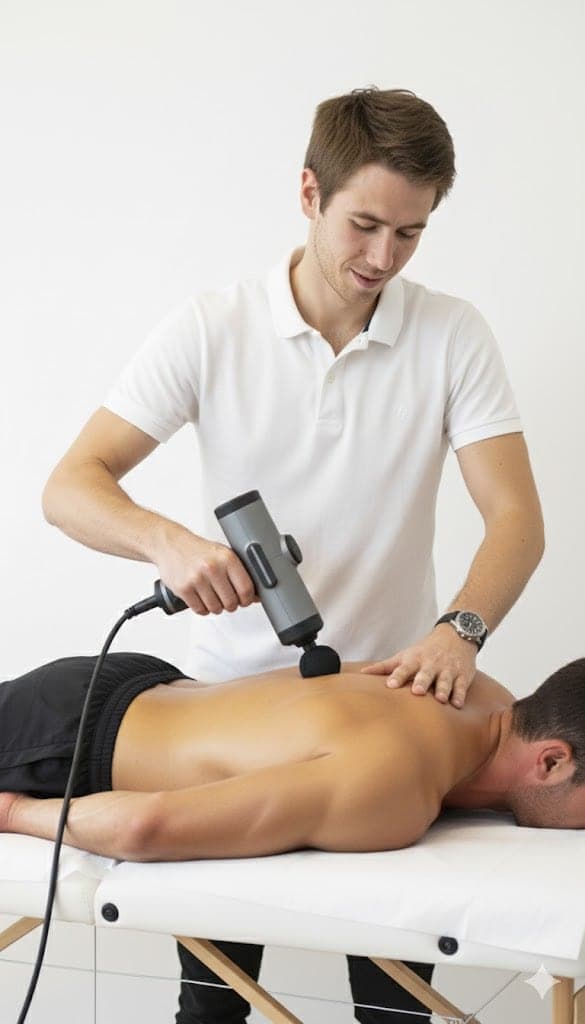
After five years of manual practice, I transitioned exclusively to mechanical deep tissue work because I refused to provide inconsistent results. The specialized equipment I use isn’t simply a “massage gun” or percussion device—those tools deliver random, superficial impacts. My system operates on entirely different principles.
Three Pillars of Advanced Mechanical Treatment
1. Precision Beyond Human Capability
The mechanical interface allows me to access specific tissue layers with millimeter accuracy. When treating the multifidi muscles along the lumbar spine, for instance, I can isolate these deep stabilizers without affecting the erector spinae group superficial to them. This specificity is biomechanically impossible with manual contact because the surface area of human fingers cannot generate sufficient pressure gradients to differentiate between tissue layers separated by only centimeters.
2. Sustained Power That Produces Actual Change
Creating lasting tissue remodeling requires maintaining therapeutic pressure for 60-120 seconds per treatment point. This duration allows the viscous properties of fascia to yield—a phenomenon called “creep” in material science. I can deliver 12-15 kilograms of force consistently for the entire duration needed. A therapist’s hands fatigue after 20-30 seconds at this intensity, forcing them to reduce pressure before achieving the mechanical threshold necessary for lasting change.
3. Absolute Consistency Across Every Session
My system eliminates human variables. Whether I treat you on Monday morning or Saturday evening, after my first client or my fifth, the mechanical input remains identical. Your tissue receives the same precise pressure, angle, and duration in every session. This consistency is crucial for progressive treatment protocols where each session builds on the previous one’s mechanical effects.
How Deep Tissue Massage Relieves Muscle Tension and Pain in Konia
Let me walk you through what actually happens during treatment—not the marketing version, but the clinical reality.
When you experience chronic muscle tension, you’re feeling the cumulative effect of several interconnected problems: ischemic muscle tissue (reduced blood flow), fascial adhesions (tissue stuck together that should glide independently), trigger points (hyperirritable nodules within taut muscle bands), and altered proprioception (your nervous system’s distorted map of where your body is in space).
The Treatment Progression
Session One: Assessment and Baseline Establishment
I begin every client relationship with comprehensive movement analysis. I’m not looking at where you hurt—I’m identifying where movement restriction exists throughout your kinetic chains. Your shoulder pain might stem from thoracic restrictions, hip dysfunction, or even ankle mobility limitations. The body is a linked system; treating isolated symptoms is futile.
During this first session, I establish baseline measurements: range of motion, tissue texture, pain locations and intensity, movement compensation patterns. This data guides the entire treatment protocol.
Sessions Two Through Four: Mechanical Reorganization
This phase focuses on systematically releasing fascial restrictions in order of mechanical priority. I don’t work where it hurts; I work where dysfunction originates. Using sustained, deep pressure at precisely calibrated intensities, I create controlled microtrauma that triggers fibroblast activity—the cells responsible for remodeling fascial architecture.
You’ll feel significant discomfort during treatment. This isn’t pain in the traditional sense; it’s the sensation of tissues releasing that have been restricted for months or years. I maintain constant communication about intensity levels, but I won’t apologize for work that needs to be deep to be effective. The alternative is superficial treatment that wastes your time and money.
Sessions Five Through Eight: Integration and Optimization
As primary restrictions release, I focus on integrating these changes into functional movement patterns. The goal isn’t just releasing tight tissue—it’s restoring optimal movement quality. I provide specific movement protocols for you to perform between sessions, reinforcing new motor patterns and preventing regression to old compensation strategies.
Physiological Mechanisms of Pain Relief
| Mechanism | Timeframe | Clinical Effect |
|---|---|---|
| Increased Local Blood Flow | Immediate | Reduced ischemic pain, improved nutrient delivery |
| Trigger Point Deactivation | 24-48 hours | Decreased referred pain patterns |
| Fascial Remodeling | 3-7 days | Improved tissue glide and movement quality |
| Neurological Re-patterning | 2-4 weeks | Corrected proprioception and movement habits |
| Structural Adaptation | 6-12 weeks | Lasting changes in tissue architecture |
Conditions Effectively Treated with Mechanical Deep Tissue Massage
My practice in Konia specializes in mechanical dysfunctions that respond to precise, sustained soft tissue work. I don’t treat every condition—I treat the ones where my method produces measurably superior outcomes.
Primary Indications
Chronic Lower Back Pain
Most lower back pain stems from dysfunctional movement patterns, not structural damage. I’ve treated dozens of Konia residents who’ve been told they have “degenerative disc disease” or “arthritis” as if these findings explain their pain. They don’t. Imaging studies show these changes in pain-free individuals at similar rates. The actual problem is typically dysfunctional motor control combined with fascial restrictions limiting proper spinal segmental movement.
My approach targets the deep spinal stabilizers—multifidi, rotatores, intertransversarii—that conventional massage never reaches. These muscles require specific angles of approach and sustained pressure to release effectively. Once they function properly, pain typically resolves within 4-6 sessions.
Neck and Shoulder Tension
This is perhaps the most common complaint I see from Konia’s professional population. The forward head posture endemic to computer work creates predictable dysfunction in the cervical extensors, upper trapezius, and levator scapulae. But treating these muscles directly addresses only the symptom, not the cause.
I work the deep cervical flexors, scalenes, and frequently the pectoralis minor and subclavius—muscles that pull the shoulder girdle forward and down. When these release, the superficial tension in neck and shoulders often disappears without direct treatment of those areas.
Athletic Performance Optimization
I work with several competitive athletes and serious fitness enthusiasts in Konia who don’t have “pain” in the traditional sense. They have movement restrictions limiting performance and increasing injury risk. A runner with restricted ankle dorsiflexion will compensate through hip flexion and lumbar extension, eventually developing lower back pain or knee issues.
My mechanical approach identifies and resolves these restrictions before they become painful problems. The performance improvements are often dramatic—increased range of motion, improved power output, reduced recovery time between training sessions.
Conditions I Don’t Treat
I need to be equally clear about what I don’t do. I don’t provide relaxation massage. I don’t treat acute injuries (that’s physical therapy’s domain). I don’t work on clients with inflammatory conditions, active infections, or uncontrolled hypertension. My method is powerful and specific—appropriate for mechanical dysfunctions, not medical conditions requiring different interventions.
The Science Behind Lasting Results: Why This Isn’t Temporary Relief
The fundamental difference between my approach and traditional massage lies in understanding tissue adaptation timelines. When you receive a relaxation massage, you feel better due to temporary increases in local blood flow and endorphin release. These effects dissipate within hours to days because nothing changed structurally.
My treatment protocols are designed around the physiology of connective tissue remodeling. Fascia reorganizes according to the mechanical demands placed upon it—a principle called Davis’s Law. By applying specific, sustained mechanical stress, I create controlled adaptation in tissue architecture.
The Remodeling Timeline
Phase One: Immediate Mechanical Effects (During Treatment)
Sustained pressure creates viscoelastic deformation of fascial tissue. The ground substance within fascia—a gel-like matrix—transitions from a more solid to more fluid state, allowing stuck tissue layers to glide independently again. This provides immediate improvement in range of motion.
Phase Two: Inflammatory Response (24-72 Hours Post-Treatment)
The controlled microtrauma I create triggers a healing response. Fibroblasts migrate to treatment areas and begin producing new collagen arranged along lines of mechanical stress. This is why I space sessions 5-7 days apart—to allow this remodeling phase to complete before introducing new mechanical stimulus.
Phase Three: Tissue Maturation (2-12 Weeks)
New collagen gradually matures and organizes. Movement patterns normalized during treatment become reinforced through repetition. The nervous system adapts to new proprioceptive input, making corrected movement patterns feel “normal” rather than effortful.
This timeline explains why I structure treatment in 8-session blocks. Anything less doesn’t allow sufficient time for lasting adaptation. One-off sessions might feel good, but they’re biomechanically irrelevant for creating lasting change.
Why Traditional Massage Falls Short: A Clinical Comparison
I’m going to challenge some comfortable assumptions here. The massage industry has successfully marketed the idea that all massage is beneficial, that “listening to your body” and “gentle work” is superior to intensive treatment. This sounds compassionate, but it’s mechanically naive.
The Limitations of Manual Therapy
Insufficient Depth
Human thumbs and elbows cannot generate the sustained pressure necessary to affect deep fascial layers without causing injury to the therapist. I’ve seen countless manual therapists develop their own chronic pain from years of forceful work. The solution isn’t teaching them better body mechanics—it’s recognizing that human anatomy has limitations that engineering can overcome.
Inconsistent Pressure Application
Even the most skilled therapist experiences performance variability. Muscle fatigue, distraction, variations in angle and pressure—these accumulate into significant inconsistency across a treatment session and between sessions. Your body doesn’t respond to average pressure; it responds to actual mechanical input at each moment.
Time Inefficiency
A manual therapist might spend 60-90 minutes providing a full-body treatment that touches many areas superficially. My mechanical approach allows me to provide 60 minutes of intensive, specific work on the exact dysfunctional regions identified in assessment. We’re not trying to relax every muscle in your body—we’re solving specific mechanical problems.
When Manual Therapy Is Appropriate
I’m not suggesting manual therapy has no value. For acute pain management, general relaxation, or as an adjunct to other treatments, skilled manual work serves a purpose. But for chronic mechanical dysfunction requiring lasting resolution, the precision and consistency of advanced mechanical treatment is superior. This isn’t opinion—it’s biomechanics.
What to Expect: The Client Experience in Konia
I provide treatment at your location throughout Konia, arriving with professional equipment including a specialized treatment bench and all necessary tools. This convenience eliminates one of the common barriers to consistent treatment—the effort of traveling to appointments when you’re already in pain.
Initial Consultation and Assessment
We begin with comprehensive discussion of your pain history, previous treatments, daily activities, and goals. I’m looking for patterns—movements that aggravate symptoms, positions that provide relief, activities you’ve stopped doing because of pain. This information reveals the mechanical nature of your dysfunction.
Physical assessment follows. I evaluate movement quality through your entire kinetic chain, not just the painful region. I’m identifying restriction patterns, compensation strategies, and the probable mechanical origin of your symptoms. This assessment typically requires 30-45 minutes because rushing this process compromises treatment effectiveness.
Treatment Intensity and Duration
I need to be honest about treatment intensity. This work is not comfortable. When I release chronically restricted fascia, you’ll experience significant discomfort—that unique sensation of tissues letting go that have been stuck for months or years. I maintain constant dialogue about intensity levels and adjust pressure within therapeutic ranges, but I won’t apologize for work that needs to be deep to be effective.
Sessions typically last 60-75 minutes of actual treatment time. This duration allows me to work multiple related dysfunctional regions with sufficient intensity and duration to create mechanical change. Shorter sessions might feel good, but they’re inadequate for producing lasting results.
Post-Treatment Response
You’ll likely experience soreness for 24-48 hours following treatment, similar to post-workout muscle soreness. This is a normal response to the mechanical stress I’ve introduced. I provide specific guidelines for managing this response:
- Hydration: Increased water intake supports the inflammatory healing response
- Movement: Gentle activity is beneficial; complete rest is counterproductive
- Heat application: Promotes blood flow to treatment areas
- Prescribed exercises: Reinforce new movement patterns while tissues adapt
Some clients experience immediate pain relief; others notice gradual improvement over 3-5 days as inflammation resolves and tissues remodel. Both responses are normal. What matters is the progressive trend across multiple sessions.
Investment in Long-Term Health: The Cost-Benefit Reality
Let’s discuss economics directly. My services cost more than a relaxation massage at a spa. They should. We’re not providing equivalent products.
A relaxation massage is a consumable experience—you pay for 60 minutes of pleasant sensation. My treatment is an investment in mechanical problem-solving that produces lasting functional improvement. These are categorically different services with different value propositions.
The True Cost of Chronic Pain
Consider the actual expense of persistent musculoskeletal dysfunction:
| Cost Category | Annual Impact | 10-Year Trajectory |
|---|---|---|
| Lost Productivity | €800-€1,200 | €8,000-€12,000 |
| Ineffective Treatments | €600-€1,000 | €6,000-€10,000 |
| Medication | €300-€500 | €3,000-€5,000 |
| Reduced Quality of Life | Incalculable | Incalculable |
When you’ve been cycling through temporary solutions for years, spending a few hundred euros for lasting resolution isn’t an expense—it’s one of the most intelligent health investments you’ll make.
I typically recommend an initial 8-session protocol over 6-8 weeks. This timeframe allows complete tissue remodeling cycles and establishes new movement patterns. Some clients require additional sessions for complex or long-standing dysfunctions; others maintain results with quarterly optimization sessions.
Frequently Asked Questions About Deep Tissue Massage in Konia
How is mechanical deep tissue massage different from regular massage?
The fundamental difference is depth, precision, and consistency. Traditional massage works superficial tissue layers with variable pressure that decreases as the therapist fatigues. My mechanical approach delivers sustained, precise pressure to intermediate and deep fascial layers throughout the entire session. The mechanical input remains identical from first minute to last, first session to final session. This consistency is crucial for progressive treatment protocols where each session builds on previous mechanical effects. We’re not providing relaxation; we’re solving specific biomechanical dysfunction.
Will the treatment be painful?
You’ll experience significant discomfort during treatment—not pain in the sense of injury, but the intense sensation of chronically restricted tissues releasing. I distinguish between “productive discomfort” (the feeling of fascial release) and “protective pain” (your body signaling actual damage). We work in the productive discomfort zone because that’s where mechanical change occurs. I maintain constant dialogue about intensity and adjust within therapeutic ranges, but I won’t compromise treatment effectiveness by working superficially to avoid temporary discomfort. The question is whether you prefer 60 minutes of intensity followed by lasting relief, or years of pleasant but ineffective treatments.
How many sessions will I need?
Most chronic mechanical dysfunctions require 6-8 sessions over 6-8 weeks for complete resolution. This timeline isn’t arbitrary—it corresponds to fascial remodeling cycles and neurological adaptation timelines. Acute issues might resolve faster; complex or long-standing patterns occasionally require additional work. I assess progress objectively using range of motion measurements and functional movement quality, not subjective pain reports alone. After initial protocol completion, some clients schedule quarterly optimization sessions; others require no further treatment. The goal is lasting resolution, not creating dependency.
What conditions do you treat most effectively?
My practice specializes in chronic mechanical dysfunction: persistent lower back pain, neck and shoulder tension, movement restrictions limiting athletic performance, postural dysfunction from desk work, and compensation patterns from old injuries. I focus on conditions where precise, sustained soft tissue work produces measurably superior outcomes. I don’t treat acute injuries (that’s physical therapy’s domain), inflammatory conditions, or medical issues requiring different interventions. If your problem stems from dysfunctional movement patterns and fascial restrictions rather than structural pathology, my approach is likely highly effective.
Can you help with sports performance even if I don’t have pain?
Absolutely. Many athletes I work with in Konia don’t have traditional “pain”—they have movement restrictions limiting performance and increasing injury risk. A cyclist with restricted hip internal rotation will compensate through lumbar rotation, eventually developing back pain or reducing power output. A tennis player with shoulder mobility restrictions will compensate through elbow and wrist mechanics, predisposing to lateral epicondylitis. My assessment identifies these restrictions before they become painful problems. The performance improvements are often dramatic: increased range of motion, improved power output, reduced recovery time between training sessions. This is optimization, not injury treatment.
Why do you travel to clients instead of having a clinic?
Two reasons: convenience and optimal treatment environment. First, requiring clients to travel when they’re in pain creates an unnecessary barrier to consistent treatment. By coming to your location in Konia, I eliminate this obstacle. Second, you’re more relaxed in your own space, which actually improves treatment effectiveness—muscle guarding decreases when you’re in familiar surroundings. I bring professional equipment including a specialized treatment bench, so you receive identical clinical quality in the comfort of your home.
What makes your method superior to other massage therapists in Konia?
Mechanical precision, absolute consistency, and results-focused protocols. Most massage therapists provide pleasant, temporary symptom relief. I solve the mechanical dysfunction causing symptoms. The specialized equipment I use delivers deeper, more precise, more consistent pressure than human hands can maintain throughout an entire treatment. Combined with my academic background in biomechanics and decade of clinical experience, this produces lasting functional improvement rather than temporary comfort. I don’t compete with relaxation spas—we’re providing categorically different services. My approach is appropriate for someone who wants to solve a problem durably, not manage symptoms indefinitely.
What should I do between sessions to maximize results?
I provide specific movement protocols tailored to your dysfunction pattern. These aren’t generic stretches—they’re precisely selected exercises that reinforce the mechanical changes we’re creating during treatment. Compliance with these protocols significantly accelerates progress. Additionally: maintain adequate hydration (supporting tissue remodeling), stay generally active (movement prevents regression), and avoid positions that reinforce old compensation patterns. I also recommend a brief walking period immediately after treatment to integrate new movement patterns while your nervous system is highly receptive. Results depend on partnership—I provide precise mechanical intervention; you reinforce those changes through appropriate movement between sessions.
Taking Action: Partnering for Lasting Results
I’ve worked with hundreds of clients in Konia over the past decade. The ones who achieve complete, lasting pain relief share three characteristics: they commit to the full initial protocol rather than expecting overnight miracles, they follow prescribed movement guidelines between sessions, and they understand that genuine healing requires temporary intensity rather than perpetual comfort.
If you’ve been cycling through temporary solutions—managing symptoms with medication, getting pleasant but ineffective massages, accepting reduced function as inevitable—you have a decision to make. Continue that pattern, or invest in a proven mechanical approach that addresses dysfunction at its anatomical origin.
I don’t work with everyone. My method is intensive, requires commitment, and isn’t appropriate for people seeking relaxation rather than resolution. But if you’re genuinely ready to solve chronic mechanical dysfunction durably, I have both the clinical expertise and mechanical tools to deliver that outcome.
My practice operates throughout Konia. I travel to your location with all necessary professional equipment, eliminating the barrier of travel when you’re already experiencing pain or discomfort. Initial consultations include comprehensive movement assessment and treatment protocol design specific to your dysfunction pattern.
The question isn’t whether chronic pain can be resolved—it can, through precise mechanical intervention combined with appropriate rehabilitation protocols. The question is whether you’re ready to commit to a solution rather than settling for ongoing symptom management. After ten years of practice and hundreds of successful outcomes, I know what works. The mechanical principles don’t change based on individual preferences—fascia responds to specific mechanical input according to predictable physiological timelines.
Understanding the Biomechanical Foundation
Let me share something I learned early in my education in Norway that fundamentally changed how I approach treatment. During biomechanics coursework, we studied the tensegrity model of human structure—the principle that our bodies function as integrated tension networks rather than isolated mechanical parts. This model explained why localized treatment so often fails: because dysfunction in one region creates compensatory patterns throughout interconnected fascial chains.
I had a client last year, Dimitris, who’d been receiving massage for his right shoulder pain for eight months with minimal improvement. Within the first ten minutes of assessment, I identified the actual problem: restricted thoracic rotation from old rib dysfunction on his left side. His body had been compensating for this restriction by over-recruiting his right shoulder musculature for three years. No amount of shoulder massage would resolve his issue because we weren’t addressing the mechanical origin.
After six sessions focusing primarily on his thoracic spine and rib cage—regions he didn’t even consider problematic—his shoulder pain disappeared completely. This is the power of treating mechanical cause rather than symptomatic location.
This approach requires different thinking than conventional massage. I’m not working where it hurts; I’m working where dysfunction originates. This distinction is crucial for understanding why my treatment protocols sometimes focus on areas you didn’t identify as problematic. Trust the mechanical assessment over subjective pain perception.
Final Thoughts: Excellence Over Convenience
The massage industry has trained consumers to expect pleasant, comfortable experiences. This expectation often conflicts with mechanical reality. Releasing fascia that’s been restricted for years isn’t comfortable—it’s intensely challenging work that requires temporary discomfort for lasting results.
I could provide gentler sessions that feel more pleasant. They would also be less effective, require more sessions, and produce temporary rather than lasting improvement. I refuse to compromise treatment effectiveness for temporary comfort. My commitment is to your long-term functional capacity, not to making every moment of treatment pleasant.
After a decade of practice in Konia, I’ve seen the difference between approaches: clients who commit to intensive, precise mechanical treatment achieve lasting resolution; those who prioritize comfort over effectiveness continue managing symptoms indefinitely. The choice is yours, but understand that these are genuinely different paths with different outcomes.
My door—or rather, my traveling practice—is open to those ready for genuine solutions. For everyone else, the massage spa industry provides excellent relaxation services. But if you’re done managing symptoms and ready to solve mechanical dysfunction durably, this is precisely what I’ve spent ten years perfecting.
Deep tissue massage in Konia isn’t just about pressing harder—it’s about understanding biomechanics, applying precise mechanical principles, and creating lasting tissue adaptation through consistent, sustained intervention. That’s the difference between temporary relief and lasting results.
Written by
Chris
Massage therapist & body mechanics specialist
Norwegian-certified with a Bachelor’s in Physical Education and Nutrition and over ten years of clinical practice, working from a portable table in clients’ homes across the Paphos district.
This article is general information from clinical practice, not a medical diagnosis. If you have severe, worsening or unexplained pain, numbness, weakness, or pain after an accident, see a doctor first.