Deep tissue massage Paphos: what actually changes and why
In short
Deep tissue massage helps most when the problem is a stiff, overloaded muscle rather than a joint or nerve. Done slowly, at your home in Paphos, it can reduce pain and restore movement over a short series of sessions.
Most people who ask me about deep tissue massage Paphos have already tried a gentler massage, felt better for two days and watched the ache return. This article explains what mechanical deep-tissue massage in Paphos actually changes in the tissue, who it helps, and where its limits are.
What deep tissue work actually does
Deep tissue is a term that gets used loosely. In practice it means slow, sustained pressure applied to specific muscles and their surrounding connective tissue rather than broad, gliding strokes over the whole back. The aim is not to hurt you. The aim is to reach the layer of tissue that is holding the tension and give it a reason to let go.
Muscle that has been overloaded for months — from sitting, from a repetitive sport, from guarding an old injury — becomes stiff and poorly hydrated. The fascia around it loses some of its ability to glide. Nerve endings in the area become more sensitive, so the same load feels worse over time. Slow, deep pressure changes this in a few ways:
- it stretches and mobilises the fascia so adjacent layers slide more freely
- it increases blood flow to tissue that has been chronically tight
- it gives the nervous system a strong, safe signal that lets it reduce protective guarding
- it lets me find and treat the actual source, which is often not where you feel the pain
That last point matters most. Lower back pain in the people I treat is very often driven by tight hip flexors and weak, stiff glutes. Neck tension is often a chest and upper-back problem. I treat the chain, not the spot.
Why I work mechanically rather than by hand alone
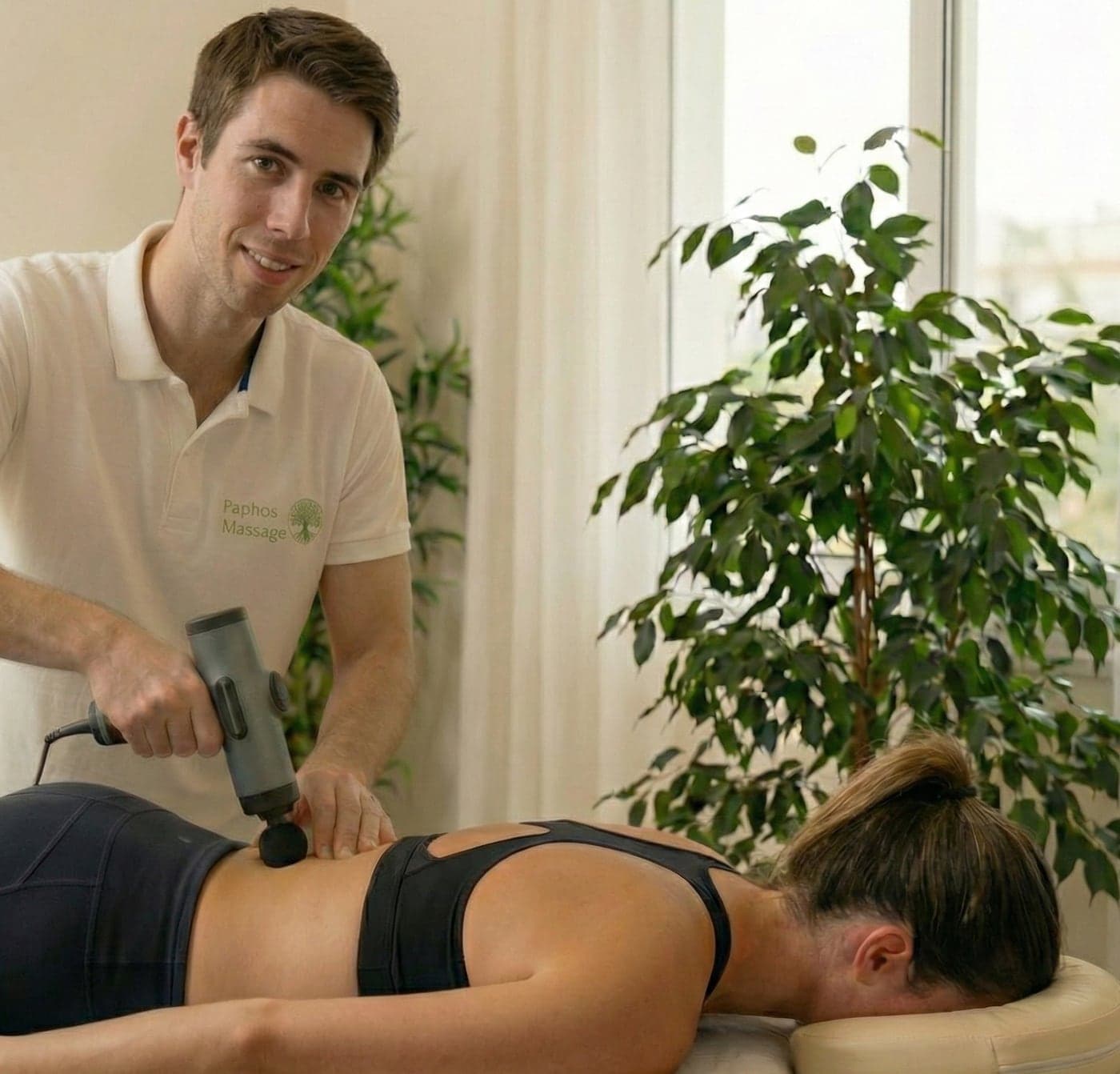
Hands are good at assessment and at finishing work. What they are not good at is holding a precise, consistent depth for a full hour, session after session. Even a strong therapist tires, and pressure drifts. For a client whose problem sits deep in the gluteal or thoracic tissue, that drift is the difference between reaching it and not.
For that reason I use a mechanical deep-tissue device alongside my hands. My training was in physical education and nutrition, and I have spent more than ten years refining how the two work together.
I still use my hands to assess, to warm tissue and to work around joints and bony edges. The device does the sustained work that hands do inconsistently.
Deep tissue massage Paphos — the benefits I see most often
I am careful about promising outcomes. Tissue takes time to change and every body responds differently. What I can describe honestly are the patterns I see repeatedly across the Paphos district.
| Presentation | What I usually find | What tends to change |
|---|---|---|
| Persistent lower back ache | Short hip flexors, stiff glutes, tight lumbar erectors | Easier standing from sitting, less morning stiffness |
| Neck and shoulder tension | Tight upper traps, levator scapulae, pectorals | Freer rotation, fewer tension headaches |
| Stiff or restricted shoulder | Guarding in rotator cuff and subscapularis | Gradual gain in reach and rotation |
| Lateral thigh and knee irritation | Tight TFL, gluteus medius, lateral quad | Less pain on stairs and downhill walking |
| Calf and heel pain | Tight calf complex, restricted ankle | Easier first steps in the morning |
None of these happen in one visit. What usually happens after the first session is a clear, measurable change — you can turn your head further, or the back feels less braced when you stand — and that tells both of us we are working in the right place. Real change generally builds over a short series, then holds if the underlying habits are also addressed.
For people who train, the benefits are more about function than pain: better range of motion, faster recovery between sessions, and fewer of the small compensations that turn into injuries. That is the same reason many of my clients book sports massage in Paphos alongside deep-tissue work.
Who it suits and who it does not
Deep tissue work is not the right answer for everyone, and I would rather say so early than let you spend money on the wrong thing.
It suits you if:
- your pain is dull, aching and predictable — worse after sitting, better after moving
- you can point to muscles that feel tight or knotted
- you have had lighter massage and it helped briefly
- you are willing to attend two to five sessions and change something in your routine between them
It is less useful, or should wait, if:
- the pain is sharp, shooting or accompanied by numbness or tingling down a limb
- there has been recent trauma, surgery, or unexplained swelling
- you have a clotting condition, take blood thinners, or have an active infection or fever
- you mainly want to relax — in that case a lighter treatment is a better fit
What a session looks like at your home
I come to you with a treatment table, the device, linens and everything else needed. Sixty minutes is €90 and ninety minutes is €130, with every fifth session free; the full breakdown is on the pricing page. Booking is by WhatsApp or phone.
The first visit starts with a short conversation and a few movement tests. I want to see how you bend, rotate and reach before I touch anything, because that tells me where the restriction actually lives. Then:
- I warm the area by hand and settle you into the pressure.
- I work the primary restriction slowly with the device, adjusting depth as the tissue reacts.
- I follow the chain — hips for a back, chest and upper back for a neck.
- I finish by hand and retest the movement so we can both see what changed.
You should feel strong pressure and a sense of release, not pain that makes you hold your breath. Tell me if it crosses that line and I will back off. Some soreness for a day afterwards is normal; sharp pain is not.
I can help with muscular tightness, movement restriction and the recurring aches that come from posture, training or long hours seated. I cannot treat joint disease, nerve compression, fractures or anything that needs imaging or medication — see a doctor first if you have numbness, weakness, night pain that does not ease with position, or pain following a fall or accident. Once those are ruled out, I am glad to work alongside whatever else you are doing.
Frequently asked questions
Does deep tissue massage have to hurt to work?
No. Useful pressure sits at the edge of discomfort, where you feel the muscle giving rather than fighting. If you are bracing, holding your breath or clenching your fists, the pressure is too high and the tissue will guard rather than release. I check in throughout and adjust. Most people describe the sensation as strong but tolerable, and the soreness the next day as similar to a solid workout.
How many sessions will I need?
Most muscular problems I see in Paphos respond within two to five sessions, usually spaced a week or two apart. You should feel a measurable change after the first — better rotation, easier standing — even if the pain returns partly. If nothing has shifted after two or three visits, the cause is probably not muscular and I will say so rather than keep booking you in.
Is deep tissue massage the same as sports massage?
They overlap. Deep tissue is about slow, sustained pressure into specific chronically tight tissue. Sports massage tends to be quicker and more varied, aimed at preparing for or recovering from training. In practice I combine techniques based on what your body needs on the day. If you are unsure which to book, describe the problem when you message and I will recommend one.
What should I do after the session?
Drink water, keep moving gently and avoid a hard training session that same day. Mild soreness for twenty-four to forty-eight hours is common and fades. If I have found a clear pattern — tight hip flexors, for example — I will give you one or two simple things to do between sessions, because the change holds far better when the habit that caused it is addressed too.
Can you treat me if I have a medical condition?
Often, yes, but tell me first. Blood thinners, recent surgery, active infection, unexplained swelling or a diagnosed disc or nerve problem all change what I will and will not do. In some cases I will ask you to see a doctor before we start. Deep tissue work is safe for most people when it is applied thoughtfully, and I would rather ask questions than assume.
Written by
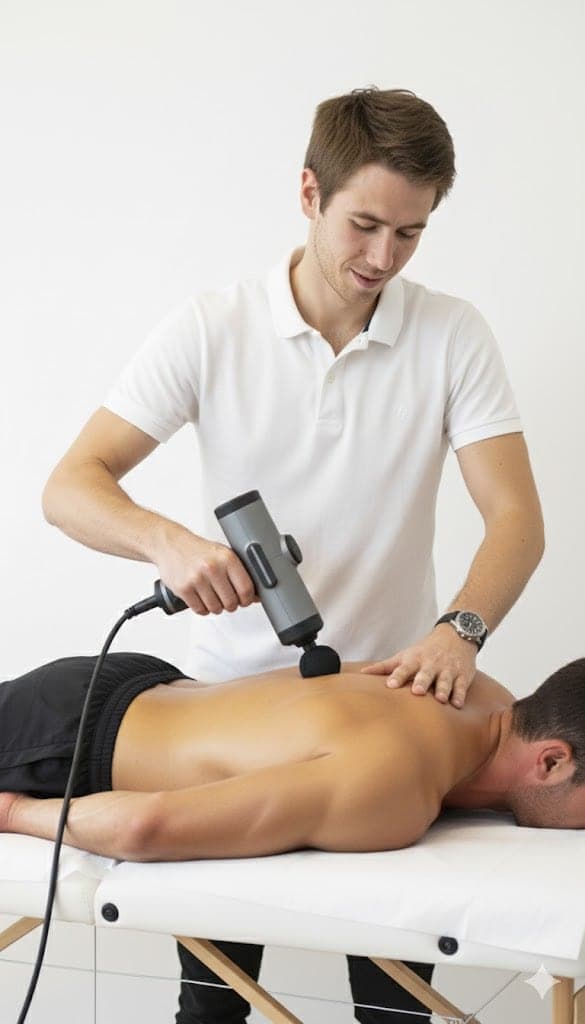
Chris
Massage therapist & body mechanics specialist
Norwegian-certified with a Bachelor’s in Physical Education and Nutrition and over ten years of clinical practice, working from a portable table in clients’ homes across the Paphos district.
- Norwegian-certified
- BSc Physical Education & Nutrition
- 10+ years clinical practice
- Based in Chlorakas · all of Paphos district
- No call-out fee anywhere in Paphos district
Last reviewed
This article is general information from clinical practice, not a medical diagnosis. If you have severe, worsening or unexplained pain, numbness, weakness, or pain after an accident, see a doctor first.