
Clinical Massage vs Physical Therapy for Injury: Which Delivers Real Results?
In short
Discover the critical differences between clinical massage and physical therapy for injury treatment. Learn which approach addresses root causes and which method delivers lasting recovery for your specific condition.
I’ve spent the last decade watching clients navigate the confusing landscape of injury treatment, often bouncing between practitioners without ever addressing the fundamental mechanical failures in their bodies. With my background in Physical Education and Nutrition from Norway and ten years of specialized experience in advanced mechanical deep-tissue treatment, I’ve witnessed firsthand how the choice between clinical massage and physical therapy can mean the difference between temporary relief and lasting resolution.
The question isn’t really which modality is “better” in an abstract sense. The real question is: which approach actually resolves the mechanical dysfunction causing your injury? After treating hundreds of cases—from chronic shoulder impingements to debilitating lower back pain—I can tell you that the answer depends entirely on understanding what each discipline actually does to your body’s structure.
Let me be direct: most people choose their treatment based on misconceptions, convenience, or what their insurance covers. That’s backward thinking. Your body doesn’t care about administrative convenience. It responds to mechanical intervention that addresses tissue restriction, fascial adhesion, and neuromuscular dysfunction at the depth where the problem actually exists.
Understanding the Fundamental Difference in Treatment Philosophy
Physical therapy and clinical massage operate from entirely different philosophical frameworks, and this distinction determines everything about your recovery trajectory.
Physical therapists approach injury through movement correction and strengthening protocols. Their primary tool is exercise prescription—teaching your body to move differently, building strength around weakened areas, and improving range of motion through guided movement patterns. This approach assumes that your movement dysfunction is the primary problem and that teaching better movement will resolve the injury.
Clinical massage, particularly advanced mechanical deep-tissue work like what I provide, addresses the tissue restriction itself. We work from the premise that movement dysfunction is usually a symptom of deeper mechanical failure—restricted fascia, adhered muscle fibers, and compressed neural pathways that physically prevent optimal movement regardless of how well you understand proper form.
Here’s what I’ve observed repeatedly in my practice: A client comes to me after six months of physical therapy for a frozen shoulder. They’ve done all the exercises, followed every protocol, yet their shoulder remains restricted and painful. Within three sessions of deep mechanical treatment, we release the subscapularis adhesion that was physically preventing their shoulder from achieving full range of motion. Suddenly, all those strengthening exercises they struggled through become effortless because the mechanical restriction is gone.
This isn’t to diminish physical therapy—it’s to clarify the distinction. Physical therapy excels at teaching your body new patterns once the mechanical restrictions are removed. Clinical massage excels at removing those restrictions in the first place.
The Depth Problem: Why Surface-Level Intervention Fails
The single most critical factor in injury resolution is treatment depth, and this is where most therapeutic approaches fail catastrophically.
Your chronic hamstring strain isn’t in the superficial muscle belly that a standard massage therapist rubs for sixty minutes. It’s in the deep tendinous junction where repetitive stress has created fibrous adhesion that shortens the entire muscle-tendon unit. Your persistent neck pain isn’t in the trapezius muscle you can palpate with your fingers—it’s in the deep cervical rotators and scalene attachments that sit beneath multiple tissue layers.
Physical therapy rarely addresses tissue at this depth. The modalities they employ—ultrasound, electrical stimulation, heat therapy—penetrate superficially. Their manual therapy techniques, while valuable, are constrained by the physical limitations of human hands. A physical therapist might spend five minutes on manual therapy before moving to exercises, and those five minutes simply cannot generate the pressure and precision required to release deeply embedded fascial restriction.
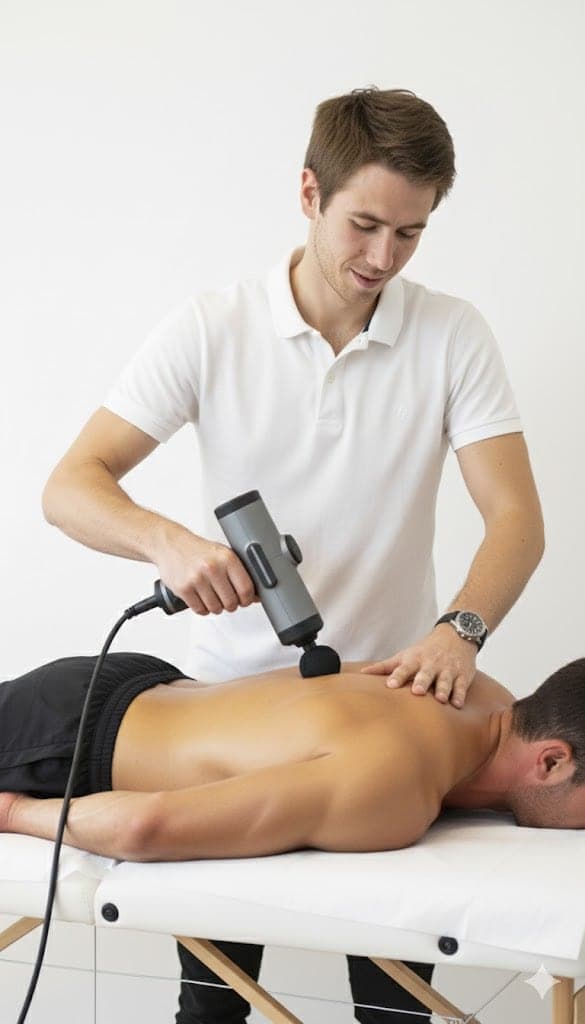
I use a specialized mechanical tool specifically because human hands cannot achieve the depth required for lasting tissue change. This isn’t about working “harder”—it’s about working at the precise depth where the pathology exists. My machine delivers pressure that reaches the deepest muscle layers, the fascial planes between muscles, and the tendon-bone junctions where chronic injury actually lives.
When I treat a runner’s chronic IT band syndrome, I’m not rubbing the lateral thigh. I’m applying sustained, precisely controlled pressure to the vastus lateralis-IT band interface, the tensor fasciae latae insertion, and the gluteus medius attachment points—structures buried beneath centimeters of tissue that are completely inaccessible to standard treatment methods.
Precision vs Generalization: The Treatment Specificity Factor
Physical therapy follows standardized protocols. Your rotator cuff injury receives the same basic exercise progression as every other rotator cuff injury because PT operates on evidence-based protocols designed for population-level effectiveness.
My approach is the opposite of standardized. Every treatment is customized to the specific mechanical failure present in your body at that moment.
| Treatment Aspect | Physical Therapy Approach | Advanced Clinical Massage |
|---|---|---|
| Assessment Method | Movement screening and strength testing | Deep palpation of specific tissue structures |
| Primary Tool | Exercise prescription | Mechanical deep-tissue release |
| Treatment Depth | Superficial to moderate tissue layers | Deep fascial planes and tendon junctions |
| Session Duration | 30-60 minutes including exercises | Full session dedicated to hands-on treatment |
| Intensity Control | Patient-controlled through exercise | Precisely calibrated mechanical pressure |
| Outcome Focus | Improved movement patterns and strength | Lasting tissue restriction release |
Here’s what precision means in practice: When treating a client’s chronic lower back pain, I don’t follow a generic “lower back protocol.” I palpate the erector spinae, quadratus lumborum, psoas major, and multifidus individually. I identify which specific muscle belly has developed trigger points, which fascial plane has restricted glide, which vertebral level shows compressed tissue density. Then I apply treatment to that exact location at the exact depth and intensity required to create tissue change.
The machine I use provides complete control over treatment intensity—from therapeutic light work for acute inflammation to powerfully deep intervention for dense scar tissue in athletes. This variability isn’t possible with standardized physical therapy equipment or with human hands that fatigue and vary in pressure delivery.
The Consistency Advantage
Every massage therapist has off days—times when their hands are tired, their focus wavers, or they simply can’t generate the pressure a particular adhesion requires. I eliminated this variable entirely by adopting mechanical treatment.
My machine doesn’t have off days. Every session delivers identical precision, power, and consistency. When I tell a client we’ll need three sessions to resolve their chronic tension headaches originating from suboccipital muscle restriction, I know exactly what force and frequency I’ll deliver in each session. The only variable is how their tissue responds—the treatment itself is perfectly reproducible.
This consistency extends to results. Physical therapy outcomes vary dramatically based on patient compliance with home exercises, the skill of the individual therapist, and the patient’s ability to execute movement patterns correctly. My outcomes depend on one thing: whether the mechanical restriction is released. That’s within my complete control during our sessions.
Timeline to Results: Managing Expectations Realistically
Let’s address the timeline question directly because this is where most treatment decisions go wrong.
Physical therapy typically operates on a 6-12 week protocol for most injuries. You’ll attend 2-3 sessions per week, performing exercises both in the clinic and at home. Improvement is gradual, incremental, and heavily dependent on your compliance with the home program.
Advanced clinical massage delivers faster mechanical change because we’re directly altering the tissue restriction rather than teaching your body to work around it. I typically see significant improvement within 3-5 sessions for most chronic conditions—but this doesn’t mean the problem is completely resolved in three weeks.
The difference is that my clients feel immediate change. After the first session targeting a frozen shoulder, you’ll have measurably improved range of motion because we’ve mechanically released restricted tissue. After physical therapy’s first session, you’ve learned some exercises but the restriction itself hasn’t changed.
However—and this is critical—tissue remodeling takes time. The immediate improvement you feel after mechanical release must be followed by continued treatment to ensure the tissue heals in its lengthened state rather than re-adhering. This is where my partnership-based approach becomes essential.
I’ve had clients with ten years of chronic neck tension achieve pain-free status after eight sessions, but we continue maintenance treatment monthly because their occupational stress patterns will recreate the same tension without ongoing intervention. Physical therapy might “discharge” you after twelve sessions regardless of whether the underlying mechanical dysfunction is truly resolved.
The Active vs Passive Treatment Paradox
Physical therapists often criticize massage as “passive treatment,” arguing that patients need to actively participate in their recovery through exercise. This criticism reveals a fundamental misunderstanding of what mechanical tissue work actually accomplishes.
Yes, massage is passive in the sense that you lie on my bench while I perform the treatment. But the mechanical changes I create in your tissue are anything but passive. I’m actively breaking down fascial adhesions, releasing trigger points, decompressing neural pathways, and restoring tissue glide that has been mechanically impossible for months or years.
Once that mechanical restriction is removed, active exercise becomes infinitely more effective. I’ve watched clients struggle through physical therapy strengthening exercises for their rotator cuff, making minimal progress because their subscapularis was adhered to their rib cage. After I release that adhesion mechanically, their strengthening exercises suddenly work because the muscle can actually contract through its full range.
The optimal approach isn’t either/or—it’s sequential. First, remove the mechanical restriction through deep tissue work. Then, if needed, strengthen and stabilize through targeted exercise. Trying to strengthen around a mechanical restriction is like trying to inflate a tire that has a nail in it. Address the mechanical failure first.
When Physical Therapy Is the Right Choice
I’m not here to dismiss physical therapy entirely. There are specific scenarios where PT is clearly the appropriate intervention:
- Post-surgical rehabilitation requiring guided movement progression and scar tissue management
- Neurological conditions requiring movement pattern retraining
- Significant muscle atrophy requiring progressive strengthening protocols
- Balance and proprioception deficits following injury
- Gait abnormalities requiring video analysis and correction
Physical therapy excels when the primary problem is movement dysfunction, weakness, or neurological impairment rather than mechanical tissue restriction.
But here’s what I’ve learned after a decade of treating clients who’ve exhausted physical therapy without resolution: the vast majority of chronic musculoskeletal pain is mechanical restriction masquerading as movement dysfunction. Treating the symptom (poor movement) without addressing the cause (restricted tissue) generates temporary improvement at best.
The Insurance Trap: Why Coverage Shouldn’t Determine Your Treatment
Most people choose physical therapy because their insurance covers it. This is the most expensive decision you can make.
Insurance coverage creates the illusion of affordability. You pay your copay, attend twelve sessions, and feel like you’ve received “free” treatment. But if those twelve sessions don’t resolve your mechanical dysfunction—if you’re still compensating, still in pain, still unable to perform at your optimal level—what did that coverage actually buy you?
My service is an investment, not an expense. I don’t accept insurance because insurance companies dictate treatment protocols designed for cost containment, not mechanical resolution. They authorize a specific number of sessions regardless of whether your tissue restriction is actually released.
When you work with me, you’re paying for a dedicated partnership focused entirely on lasting resolution. I travel to your location with professional equipment. I customize every session to your specific mechanical needs. I adjust intensity based on real-time tissue response, not predetermined protocols. And I continue treatment until we achieve actual resolution, not until your insurance authorization expires.
I’ve had clients spend thousands of dollars over years on covered physical therapy, acupuncture, and chiropractic care without lasting improvement. They finally invest in my service and resolve the problem in a fraction of that timeframe. The upfront cost is higher, but the total cost—both financial and in terms of continued pain and dysfunction—is dramatically lower.
The Mechanical Reality of Common Injuries
Let me walk you through how physical therapy and clinical massage address specific injuries differently, because the theoretical differences become crystal clear when applied to actual pathology.
Chronic Lower Back Pain
Physical therapy approach: Core strengthening exercises, hip flexor stretches, lumbar stabilization drills, postural education.
My approach: Deep palpation reveals that your quadratus lumborum has developed dense trigger points from years of asymmetric sitting. Your psoas major is shortened from prolonged hip flexion. Your erector spinae has fascial adhesion restricting segmental motion. I spend sixty minutes releasing these specific restrictions at the depth where they exist. Your back pain resolves because we’ve addressed the mechanical cause, not because you’ve learned to brace your core better.
Frozen Shoulder
Physical therapy approach: Pendulum exercises, wall walks, pulley systems for assisted range of motion, progressive strengthening as mobility improves.
My approach: Your shoulder capsule has developed adhesive capsulitis with significant restriction in the inferior capsule and subscapularis. I apply sustained pressure to the subscapularis insertion, the inferior glenohumeral ligament, and the posterior capsule specifically. We achieve 30 degrees of additional range of motion in the first session because we’ve mechanically released the adhesed tissue. The exercises physical therapy prescribed suddenly become possible because the mechanical barrier is gone.
Plantar Fasciitis
Physical therapy approach: Calf stretching, arch strengthening, gait analysis, orthotics recommendation.
My approach: Your plantar fascia has developed thickening and restriction at the calcaneal insertion, but the actual problem is shortened gastrocnemius and soleus muscle bellies pulling excessively on your Achilles tendon, which then pulls on the calcaneal insertion where the plantar fascia attaches. I release the deep compartments of your calf muscles, address the Achilles tendon structure, and work the plantar fascia directly. The inflammation resolves because the mechanical tension creating it has been eliminated.
Advanced Applications: Athletic Performance and Injury Prevention
Beyond injury treatment, there’s an entire dimension of body optimization that neither traditional massage nor standard physical therapy adequately addresses.
Athletes don’t just need injury treatment—they need mechanical optimization. A runner might not have “pain,” but they have fascial restriction in their IT band limiting hip extension by 5 degrees. That restriction costs them seconds per mile and increases injury risk. Physical therapy won’t identify this as a problem because there’s no pain and no movement dysfunction obvious enough to flag in screening.
I identify mechanical inefficiencies before they become injuries. With the precision my machine provides, I can detect tissue density changes, fascial adhesions, and trigger point formation in their earliest stages. Addressing these restrictions enhances performance and prevents the progression to actual injury.
I’ve worked with competitive cyclists whose power output increased measurably after we released chronic quadriceps restriction they didn’t even know they had. I’ve treated CrossFit athletes whose overhead mobility improved dramatically once we addressed latissimus dorsi and teres major adhesions limiting shoulder flexion.
This proactive optimization is completely outside physical therapy’s scope because insurance doesn’t cover “make me better at my sport.” But for athletes serious about performance, it’s the difference between competing at your genetic potential and competing with mechanical handicaps you don’t even recognize.
The Partnership Model: Why Continuity Matters
Physical therapy operates on an episode-of-care model. You have an injury, you complete a treatment protocol, you’re discharged. If the problem recurs, you start over with a new episode of care.
I operate on a partnership model because your body isn’t a machine that gets “fixed” and then requires no further maintenance. You have occupational stress patterns, athletic demands, postural habits, and biomechanical tendencies that continuously create tissue restriction.
My clients understand that optimal function requires ongoing maintenance. We resolve the acute injury first, then we prevent recurrence through regular sessions that address restriction before it progresses to pain and dysfunction.
A dedicated client I’ve worked with for three years used to have debilitating migraines three times per week from chronic suboccipital tension. After our initial intensive treatment phase, we moved to bi-weekly maintenance. She hasn’t had a migraine in over two years, her posture has fundamentally changed, and her athletic performance has reached levels she never achieved before.
This partnership approach is impossible in the physical therapy model because insurance authorization doesn’t support ongoing maintenance care. But it’s the only approach that actually aligns with how your body functions in reality.
The Science of Mechanical Tissue Change
Let me address the mechanisms behind why deep mechanical work creates lasting tissue change while superficial intervention doesn’t.
Fascia responds to mechanical stress through a process called mechanotransduction. When you apply sufficient pressure to restricted fascial tissue, you trigger cellular-level changes in the fibroblasts that produce collagen. These cells literally remodel the tissue architecture in response to mechanical load.
But this remodeling only occurs when the mechanical stress exceeds a specific threshold. Gentle, superficial pressure doesn’t reach this threshold. Standard massage, even when labeled “deep tissue,” rarely generates sufficient force. Physical therapy modalities like ultrasound and electrical stimulation don’t apply direct mechanical stress at all.
My machine delivers the precise pressure intensity required to trigger mechanotransduction in the deepest fascial layers. We’re not just “breaking up” adhesions—we’re creating an adaptive response that causes the tissue to remodel into a lengthened, more mobile state.
Similarly, trigger point release requires sustained pressure that exceeds the muscle fiber’s tolerance for compression. This triggers a protective reflex that releases the contracted sarcomeres maintaining the trigger point. But if your pressure is too light or too brief, you merely irritate the trigger point without releasing it.
The scientific literature on manual therapy effectiveness is mixed precisely because most manual therapy doesn’t achieve the depth and intensity required for actual mechanical change. Studies showing “no significant difference” between massage and placebo are typically studying Swedish massage or light pressure techniques that were never designed to create structural change.
Practical Considerations: What to Expect
If you’re deciding between physical therapy and advanced clinical massage for your injury, here are the practical realities you should understand:
Treatment Intensity
Physical therapy is generally comfortable. Exercises might challenge you, but the treatment itself isn’t painful.
My treatment works at the edge of your tolerance because that’s where tissue change occurs. We’re applying significant pressure to restricted, often painful tissue. I calibrate intensity based on your real-time feedback, but this isn’t relaxing spa treatment—it’s mechanical intervention.
Most clients describe the sensation as “good pain”—intense pressure that clearly feels therapeutic. Others find it challenging initially but develop tolerance as their tissue releases. I’ve never had a client quit because the treatment was too intense, but I’ve had many express surprise that effective bodywork requires this level of intervention.
Treatment Environment
Physical therapy occurs in a clinic setting with multiple patients receiving treatment simultaneously. You’re one of several people your therapist is managing during your appointment time.
I travel to your location with a professional treatment bench and all required equipment. You receive my complete, undivided attention for the entire session. This isn’t just about convenience—it’s about creating an environment where I can focus entirely on the mechanical changes occurring in your tissue without distraction or time pressure.
Treatment Frequency
Physical therapy typically requires 2-3 sessions per week during the acute phase.
I generally recommend weekly sessions initially for most conditions, with frequency adjusted based on tissue response. Acute injuries might benefit from twice-weekly treatment during the first two weeks. Chronic conditions often resolve with weekly treatment for 4-6 weeks, then transition to bi-weekly or monthly maintenance.
The key difference is that each of my sessions creates substantial mechanical change. You’re not coming back three times per week to do exercises—you’re coming back once per week because that’s how long your tissue needs to integrate the changes we created.
Making the Decision: A Framework
Choose physical therapy if:
- You’ve had surgery and require supervised rehabilitation
- Your primary problem is weakness or poor movement patterns without significant tissue restriction
- You have neurological involvement requiring movement retraining
- You prefer working with insurance coverage and don’t mind the limitations that imposes
- You respond well to exercise-based intervention and have time for daily home programs
Choose advanced clinical massage if:
- You have chronic pain that hasn’t responded to standard treatment
- You can feel mechanical restriction (tightness, limited range of motion) that seems to be the root problem
- You’ve completed physical therapy without achieving lasting resolution
- You’re an athlete seeking performance optimization, not just injury treatment
- You want treatment that addresses the mechanical cause, not exercises that work around it
- You value lasting results over upfront cost savings
Or—and this is often the optimal path—do both sequentially. Let me release the mechanical restrictions first, then work with a physical therapist to strengthen and stabilize if needed.
Frequently Asked Questions
How is clinical massage different from regular massage?
Regular massage focuses on relaxation and stress relief through lighter pressure applied to superficial tissue layers. Clinical massage, specifically the advanced mechanical deep-tissue work I provide, targets specific mechanical dysfunctions in deep tissue structures using sustained, precisely calibrated pressure. The goal isn’t relaxation—it’s lasting resolution of tissue restriction causing pain and movement limitation.
Why use a machine instead of hands?
Human hands have physical limitations in terms of sustained pressure, depth of penetration, and consistency across sessions. My specialized machine delivers pressure deeper than hands can reach, maintains perfectly consistent force without fatigue, and allows me to precisely calibrate intensity from light therapeutic work to powerfully deep intervention for dense scar tissue. This isn’t about replacing the human element—I’m still performing the treatment, making all clinical decisions, and adjusting based on tissue response. The machine simply eliminates the physical constraints of manual therapy.
How many sessions will I need?
This depends entirely on the chronicity and complexity of your condition. Acute injuries (less than three months) typically respond within 3-5 sessions. Chronic conditions (more than six months) generally require 6-10 sessions for significant resolution, then maintenance to prevent recurrence. I provide honest assessment after the first session based on how your tissue responds to treatment.
Is the treatment painful?
The treatment works at the intensity required to create mechanical tissue change, which means working at the edge of your tolerance. Most clients describe it as intense but clearly therapeutic—”good pain” that feels productive. I constantly adjust pressure based on your feedback and tissue response. The discomfort during treatment is temporary; the relief that follows is lasting.
Can I combine this with physical therapy?
Absolutely, and this is often the optimal approach. My treatment excels at releasing mechanical restrictions in tissue. Physical therapy excels at strengthening and movement pattern correction. When combined strategically—mechanical release first, then strengthening and stabilization—you get comprehensive treatment addressing both tissue structure and movement function.
Do you treat acute injuries or only chronic conditions?
I treat both, but the approach differs significantly. Acute injuries require lighter pressure and modified technique to avoid aggravating inflammation. Chronic conditions benefit from deeper, more aggressive intervention. My machine allows me to precisely calibrate treatment intensity to match your tissue’s current state, whether that’s acute inflammation requiring gentle work or dense scar tissue requiring maximum pressure.
Why don’t you accept insurance?
Insurance companies dictate treatment protocols based on cost containment rather than optimal mechanical resolution. They authorize a predetermined number of sessions regardless of whether your specific tissue restriction is actually released. By working outside the insurance model, I can focus entirely on what your body needs—continuing treatment until we achieve real resolution, not until your authorization expires. This approach costs more upfront but dramatically less over time because we’re creating lasting change, not temporary symptom management.
What should I do after a treatment session?
Hydrate extensively—tissue release creates metabolic waste that your body needs to flush. Avoid intense training for 24 hours while your tissue integrates the changes we created. Gentle movement is beneficial; complete rest isn’t necessary. Many clients feel immediate improvement, but the full effect of treatment typically manifests over 48-72 hours as inflammation subsides and tissue remodels.
The Investment in Long-Term Function
Every day you live with mechanical restriction is a day you’re not functioning at your potential. You’re compensating, adapting, working around the problem—and creating secondary dysfunctions that will eventually require their own treatment.
Physical therapy might be covered by insurance, but if it doesn’t resolve the mechanical restriction causing your pain, what have you actually received? You’ve spent time, energy, and copays on temporary improvement at best.
My service represents a different philosophy entirely. We’re not managing your condition—we’re resolving the mechanical dysfunction at its source. This requires depth of treatment that most modalities simply cannot achieve. It requires precision that eliminates the variability of manual therapy. And it requires a partnership approach that continues beyond initial symptom relief to ensure lasting change.
I’ve built my practice on results, not on what insurance companies reimburse. After ten years and hundreds of clients, I’ve seen what actually creates lasting resolution versus what creates temporary relief. The difference is mechanical depth, treatment precision, and unwavering commitment to addressing root cause rather than symptoms.
Your body is the most important physical asset you own. Every decision you make about its care either moves you toward optimal function or keeps you trapped in compensation patterns that progressively worsen. Choose based on what will actually resolve your mechanical dysfunction, not on what administrative systems make convenient.
The path to lasting resolution isn’t always the easiest or the cheapest upfront. But it’s the only path that actually delivers freedom from chronic pain and mechanical limitation. That freedom is what I provide, session by session, through precision, power, and consistency that creates lasting change.
Written by
Chris
Massage therapist & body mechanics specialist
Norwegian-certified with a Bachelor’s in Physical Education and Nutrition and over ten years of clinical practice, working from a portable table in clients’ homes across the Paphos district.
This article is general information from clinical practice, not a medical diagnosis. If you have severe, worsening or unexplained pain, numbness, weakness, or pain after an accident, see a doctor first.