
Clinical Massage for Sports Injuries: A Mechanical Approach to Rehabilitation and Performance
In short
Clinical massage for sports injuries goes beyond symptom relief—it addresses root mechanical dysfunction. Learn how advanced deep-tissue techniques accelerate recovery and optimize athletic performance.
I’ve spent a decade watching athletes make the same critical mistake: treating their injuries as temporary setbacks rather than mechanical problems requiring precise intervention. After working with hundreds of athletes—from weekend warriors to competitive professionals—I can tell you that the difference between those who return stronger and those who develop chronic issues comes down to one factor: how they address the underlying biomechanical dysfunction causing their injury.
Clinical massage for sports injuries isn’t about relaxation. It’s about restoring optimal tissue function, resolving adhesions, and reestablishing movement patterns that prevent re-injury. My background in Physical Education and Nutrition taught me the theory; ten years of clinical practice taught me that traditional methods often fall short when treating the mechanical realities of sports injuries.
Why Sports Injuries Demand a Different Approach
When an athlete suffers a hamstring strain, rotator cuff impingement, or IT band syndrome, the visible injury represents only the final expression of a longer mechanical breakdown. I’ve observed this pattern repeatedly: compensation patterns develop weeks or months before the acute injury, creating tension imbalances that eventually exceed tissue tolerance.
The problem with conventional treatment protocols is their focus on the injury site rather than the mechanical chain that produced it. A runner with plantar fasciitis typically has dysfunction originating in the posterior chain—tight calves, restricted hamstrings, and compensatory patterns in the lower back. Treating only the foot provides temporary relief but guarantees recurrence.
This is where clinical massage for sports injuries becomes essential. We’re not simply reducing inflammation or promoting blood flow—we’re systematically addressing the mechanical restrictions that created the injury environment in the first place.
The Mechanical Reality of Athletic Tissue
Athletic tissue operates under different demands than sedentary tissue. The repetitive loading patterns, eccentric contractions, and rapid force generation required in sports create specific types of dysfunction that recreational massage techniques cannot effectively address.
I’ve treated tennis players whose shoulder pain stemmed from fascial restrictions in their thoracic spine, cyclists whose knee issues originated in hip capsule tightness, and runners whose Achilles tendinopathy traced back to dysfunctional ankle dorsiflexion patterns. Each case required deep, precise work that penetrated beyond superficial layers to reach the structures actually limiting movement.
The Limitations of Traditional Hands-On Treatment
Let me be direct about something the massage industry doesn’t like to acknowledge: human hands have physiological limitations that compromise treatment effectiveness for serious sports injuries. I say this as someone who spent years perfecting manual techniques before recognizing their constraints.
The human thumb can generate approximately 20-40 pounds of pressure for short durations before fatigue compromises precision. For superficial work, this suffices. For releasing dense fascial adhesions in an athlete’s quadriceps or addressing chronic tension in the erector spinae, it’s inadequate.
More importantly, manual pressure varies throughout a session. The therapist’s energy level, hand positioning, and physical condition on any given day affect treatment consistency. An athlete receiving clinical massage for sports injuries needs predictable, reproducible results—not variable outcomes dependent on the practitioner’s physical state.
Why I Transitioned to Mechanical-Assisted Treatment
Five years into my practice, I treated a competitive cyclist with chronic IT band syndrome. He’d seen multiple therapists, tried foam rolling, received traditional sports massage, and followed stretching protocols. Nothing provided lasting relief.
During our assessment, I identified severe adhesions along his vastus lateralis and tensor fasciae latae—restrictions so deep and dense that manual pressure couldn’t effectively release them without exhausting both of us. I needed a tool that could deliver sustained, precise pressure at depths my hands couldn’t reach.
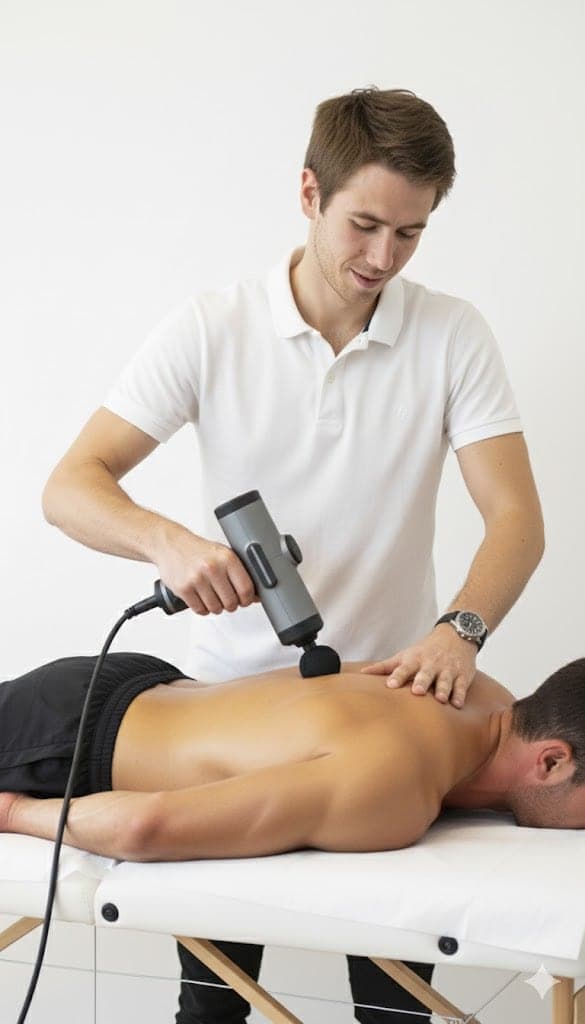
That realization led me to specialized mechanical deep-tissue equipment. The difference was immediate and undeniable. Where my hands could work effectively for 15-20 minutes before fatigue compromised precision, the machine maintained consistent pressure and depth for entire sessions. More critically, it reached layers of tissue that had remained inaccessible with manual techniques.
The cyclist’s chronic pain resolved after three sessions. Two years later, he remains pain-free and recently set a personal best in his age category. That outcome wouldn’t have been possible with traditional methods.
Clinical Massage for Sports Injuries: The Mechanical Advantage
My current approach combines anatomical knowledge, biomechanical assessment, and precision mechanical treatment to address sports injuries at their source. This isn’t about applying more pressure—it’s about applying the right pressure, to the right tissues, with the right consistency.
Depth and Precision
Athletic injuries often involve structures several centimeters below the skin surface. A hamstring tear creates scar tissue within the muscle belly. Shoulder impingement involves restrictions in the subscapularis and infraspinatus—muscles buried beneath the deltoid and trapezius.
Accessing these structures requires sustained, focused pressure that penetrates progressively deeper without damaging superficial tissues. The mechanical tool I use delivers this precisely, allowing me to work through layers methodically while monitoring tissue response in real-time.
I can identify the exact depth where restriction exists, apply targeted pressure to that specific layer, and hold that pressure long enough for the tissue to release—something impossible to achieve consistently with manual techniques.
Controlled Intensity
Different injuries and different athletes require different treatment intensities. A fresh muscle strain demands gentler work than chronic fascial restrictions. A recreational athlete may need moderate pressure, while a professional competitor with high pain tolerance can benefit from deeper intervention.
The mechanical system provides infinitely adjustable intensity, allowing me to customize each treatment to the client’s current condition and tolerance. I can start superficially to warm tissues, progress to deeper layers as restrictions release, and modulate intensity throughout the session based on tissue response.
This level of control eliminates the guesswork inherent in manual treatment and ensures every session delivers optimal therapeutic effect without exceeding tissue tolerance.
Consistency Across Sessions
Recovery from sports injuries requires progressive treatment. Each session should build on the previous one, systematically addressing restrictions in a logical sequence. This demands consistency—something human hands struggle to provide.
With mechanical-assisted treatment, I eliminate the variability factor. Whether it’s the first session of the week or the last, whether I’m fresh or tired, the treatment quality remains identical. My clients know exactly what to expect, and their tissues receive the consistent stimulus necessary for optimal adaptation.
My Treatment Methodology for Common Sports Injuries
After ten years of specialization, I’ve developed protocols for the most common athletic injuries I encounter. Each follows the same principle: identify the mechanical dysfunction creating the injury, address restrictions systematically from distal to proximal, and restore optimal movement patterns.
| Injury Type | Primary Restriction Sites | Treatment Focus | Typical Session Protocol |
|---|---|---|---|
| Hamstring Strain | Hamstring belly, ischial tuberosity, lumbar fascia | Release scar tissue, restore eccentric capacity | 4-6 sessions over 3-4 weeks |
| Rotator Cuff Issues | Subscapularis, infraspinatus, thoracic spine | Restore scapular mechanics, decompress joint | 6-8 sessions over 4-6 weeks |
| IT Band Syndrome | TFL, vastus lateralis, gluteus medius | Address hip mechanics, release lateral line | 5-7 sessions over 4 weeks |
| Plantar Fasciitis | Posterior chain, calf complex, plantar fascia | Restore ankle dorsiflexion, release fascia | 4-6 sessions over 3-4 weeks |
| Tennis/Golfer’s Elbow | Forearm extensors/flexors, biceps, pectorals | Address kinetic chain dysfunction | 5-7 sessions over 4-6 weeks |
Case Study: Resolving Chronic Achilles Tendinopathy
Last year, I worked with a 42-year-old runner who’d been dealing with Achilles pain for eight months. He’d tried rest, eccentric exercises, and multiple rounds of physical therapy without lasting improvement. By the time he contacted me, he’d resigned himself to quitting running.
My assessment revealed the expected findings: significant restrictions in his gastrocnemius and soleus, adhesions around the Achilles insertion, and limited ankle dorsiflexion. But the critical discovery came when I examined his posterior chain. His hamstrings were severely restricted, his glutes weren’t firing properly, and his lower back showed chronic tension patterns.
His Achilles wasn’t the problem—it was the victim of mechanical dysfunction originating much higher in the kinetic chain.
We started proximally, addressing his lower back and hamstring restrictions first. This alone reduced his pain by 40% within two sessions. Then we systematically worked through his calf complex, spending three sessions releasing dense adhesions that had developed over months of compensatory loading.
Finally, we addressed the Achilles itself—not just the insertion point where he felt pain, but the entire tendon and its fascial connections. By this point, with proper mechanics restored throughout his posterior chain, the Achilles could actually heal instead of being continuously re-traumatized by dysfunctional movement patterns.
After eight sessions over six weeks, he returned to running. Eighteen months later, he’s training for his first marathon. That outcome required deep, precise work that simply isn’t possible with traditional massage techniques.
Beyond Injury Treatment: Performance Optimization
Clinical massage for sports injuries extends beyond rehabilitation. Once we’ve resolved the acute injury and addressed underlying mechanical dysfunction, we can optimize tissue quality and movement efficiency to enhance performance.
I work with several athletes who no longer have injuries but continue treatment because they recognize the performance benefits. When your tissues move optimally, without hidden restrictions or compensation patterns, your body functions more efficiently. Less energy wasted on overcoming internal resistance means more power available for athletic performance.
The Competitive Advantage of Optimal Tissue Function
Consider what happens when a sprinter’s hip flexors are completely unrestricted. Their stride length increases without additional effort. Recovery between repetitions improves because there’s less internal friction to overcome. The risk of strain decreases because tissues aren’t operating near their tolerance threshold.
These aren’t marginal gains—they’re fundamental improvements in how the body produces and controls force. I’ve watched athletes drop their 5K times, increase their cycling power output, and improve their vertical jump simply by eliminating restrictions they didn’t know existed.
This represents clinical massage for sports injuries at its highest application: not just fixing what’s broken, but optimizing what’s functional to achieve peak performance.
Why Athletes Need Specialized Treatment
The athletic body presents unique challenges that general massage therapy isn’t equipped to handle. Athletes operate at tissue tolerance limits that sedentary individuals never approach. They require treatment that matches the intensity and specificity of their training.
I’ve had clients tell me about previous massage experiences where the therapist seemed afraid to apply real pressure, or worked so generally that nothing changed, or provided relaxation that felt good but did nothing for their chronic hamstring issue. Those experiences represent a fundamental mismatch between the treatment approach and the client’s needs.
The Investment Perspective
When I discuss clinical massage for sports injuries with potential clients, some initially react to the cost. I understand—specialized treatment isn’t cheap. But I ask them to consider what they’re actually investing in.
Chronic injury costs accumulate: missed training, compromised performance, ongoing pain that affects daily life, eventual medical interventions, lost opportunities in competition. The athlete who spends months trying cheaper alternatives while their condition worsens pays far more in the long run—not just financially, but in quality of life and athletic potential.
My approach represents front-loaded investment for long-term return. We address the problem comprehensively, resolve it durably, and establish tissue quality that prevents recurrence. The athletes I work with don’t need endless maintenance sessions—they need a focused treatment block that produces lasting change.
One professional cyclist I treated put it perfectly: “I spent two years and thousands on treatments that barely helped. Six sessions with you solved the problem completely. I should have started here.”
The Clinical Assessment Process
Effective clinical massage for sports injuries begins with comprehensive assessment. I need to understand not just where you hurt, but why you hurt there. This requires examining your entire movement system, identifying compensation patterns, and tracing the mechanical chain that led to your injury.
Initial Consultation
Our first session starts with detailed history. I want to know:
When did the pain begin, and what were you doing at the time? How has it progressed since onset? What makes it better or worse? What treatments have you already tried? What are your athletic goals and training schedule?
This information helps me construct a mechanical model of your injury. A runner whose knee pain worsens during downhill sections likely has different underlying issues than one whose pain appears after long flat runs.
Movement Assessment
Next, I watch you move. Simple assessments—squatting, reaching overhead, single-leg balance—reveal compensation patterns and restrictions that explain your injury. I’m looking for asymmetries, limited ranges of motion, and movement strategies that indicate tissue dysfunction.
A runner with Achilles pain who can’t achieve full ankle dorsiflexion needs different treatment than one with normal ankle mobility but hip extension limitations. The assessment determines the treatment strategy.
Palpation and Tissue Assessment
Finally, I examine the tissues directly. Where are the restrictions? How deep are they? How dense? What structures are involved? This tactile assessment, combined with your movement patterns and history, gives me a complete picture of the mechanical problem causing your symptoms.
Only then do we begin treatment—with a clear roadmap of what needs to be addressed, in what sequence, to resolve your injury completely.
The Treatment Experience
I travel to my clients because serious athletes don’t have time to waste commuting for treatment. I bring a professional treatment bench and all necessary equipment, setting up in your home or training facility.
Sessions typically last 60-90 minutes, depending on the complexity of your condition. The mechanical tool allows me to work continuously without breaks, maintaining therapeutic intensity throughout the entire session.
What to Expect During Treatment
Clinical massage for sports injuries feels different from traditional massage. The pressure is deeper, more focused, and progressively intensified as tissues release. Many clients describe it as “good pain”—uncomfortable while pressure is applied, but followed by immediate relief as restrictions release.
I adjust intensity continuously based on your feedback and tissue response. The goal is to reach the restriction depth without exceeding your tolerance—working at the edge where therapeutic change occurs without causing protective guarding.
Some areas hurt more than others. Dense adhesions, active trigger points, and inflamed tissues all produce discomfort during release. But I’ve never had a client unable to tolerate treatment, because the mechanical system allows such precise control that we can work at exactly the right intensity for your current condition.
Post-Treatment Response
After treatment, tissues need time to adapt. I provide specific guidelines about activity modification, hydration, and self-care between sessions. Most clients experience some soreness for 24-48 hours—similar to post-workout soreness—as tissues remodel.
This temporary discomfort represents therapeutic change. We’ve disrupted dysfunctional patterns and initiated healing. The soreness resolves quickly, leaving you with improved mobility, reduced pain, and better movement quality.
Frequently Asked Questions About Clinical Massage for Sports Injuries
How is clinical massage different from sports massage?
Sports massage typically focuses on general muscle relaxation and recovery. Clinical massage for sports injuries specifically addresses mechanical dysfunction causing pain or limiting performance. We’re treating structural problems, not providing general recovery work. The approach is more targeted, deeper, and results-oriented.
How many sessions will I need?
This depends on your injury’s severity and chronicity. Acute injuries often resolve in 3-5 sessions. Chronic conditions typically require 6-10 sessions to address fully. I’ll provide a realistic timeline after your initial assessment, and we’ll track progress throughout treatment to adjust as needed.
Will treatment hurt?
Deep tissue work addressing serious restrictions produces discomfort during application. However, I control intensity precisely, working at the therapeutic threshold without exceeding your tolerance. Most clients find the discomfort manageable and appreciate the immediate relief following treatment.
Can I continue training during treatment?
Generally yes, with modifications. I’ll provide specific guidance based on your injury and training schedule. Often, we can maintain training volume while modifying intensity or avoiding movements that aggravate your condition. The goal is keeping you as active as possible while allowing healing to progress.
Why use a machine instead of hands?
The machine provides three critical advantages: deeper penetration than hands can achieve, precise intensity control, and perfect consistency across sessions. For serious sports injuries involving deep tissue restrictions, these capabilities are necessary for optimal outcomes. I’m not replacing skill with technology—I’m using technology to apply my expertise more effectively.
What makes your approach different from physical therapy?
Physical therapy excels at exercise prescription and movement re-education. My work focuses on resolving the tissue restrictions that prevent proper movement patterns. These approaches complement each other. Many of my clients work with physical therapists concurrently—I address the tissue restrictions, they address the movement patterns. Together, results come faster than either approach alone.
Do you only treat serious athletes?
No. While I specialize in sports injuries, my clients range from professional athletes to recreational exercisers who’ve suffered an injury. What they share is a desire for comprehensive resolution rather than temporary symptom management. If you’re committed to solving your problem durably, regardless of your athletic level, this approach will work for you.
Is this treatment covered by insurance?
Coverage varies by insurance plan. I provide detailed receipts that clients can submit for reimbursement. Many plans cover massage therapy when prescribed by a physician, though policies differ. I recommend checking your specific coverage before beginning treatment.
The Difference Between Temporary Relief and Lasting Resolution
Most treatment approaches for sports injuries aim for symptom management. Take anti-inflammatories to reduce pain. Rest until it feels better. Do some stretches. Come back when it hurts again.
This cycle continues because the underlying mechanical problem never gets addressed. The tissue restrictions causing abnormal loading patterns remain. The compensation strategies persist. The injury “heals” but the dysfunction that created it stays active, guaranteeing eventual recurrence.
I watched this pattern throughout my career before developing my current approach. Athletes cycling through temporary improvements followed by re-injury, never quite understanding why their body kept breaking down in the same ways.
The True Goal: Mechanical Optimization
Clinical massage for sports injuries, done properly, changes this dynamic entirely. We’re not managing symptoms—we’re eliminating the mechanical dysfunction at the root of your problem. When tissues move optimally, when compensation patterns are resolved, when the structures causing abnormal loading are released, injuries heal completely and stay healed.
This is what I mean by lasting resolution. Not that you’ll never have problems again—you’re an athlete, injuries happen—but that this specific mechanical dysfunction, once properly addressed, won’t recur. You’re genuinely better, not just temporarily comfortable.
That’s the difference between an expense and an investment. Ongoing symptom management is an expense—you’ll pay indefinitely without ever solving the problem. Comprehensive resolution is an investment—you pay once to fix the issue properly.
Building a Partnership for Long-Term Success
I don’t take one-off clients looking for quick fixes. My practice is built around dedicated partnerships with athletes who understand that optimal performance requires systematic attention to tissue quality and movement mechanics.
After we resolve your initial injury, I encourage ongoing quarterly or semi-annual sessions to maintain tissue quality and catch small restrictions before they develop into injuries. These maintenance sessions take 30-45 minutes and prevent the accumulation of dysfunction that leads to major problems.
Think of it as preventive maintenance for a high-performance system—which is exactly what your athletic body is. You wouldn’t wait for your race car’s engine to fail before changing the oil. Why would you wait for injury before addressing tissue restrictions?
The Athletes Who Succeed with This Approach
My most successful clients share certain characteristics. They’re committed to the process, not just hoping for quick results. They understand that real change requires multiple sessions addressing multiple layers of dysfunction. They’re willing to invest in their long-term health rather than looking for the cheapest option.
They also take ownership of their recovery. They follow activity modification guidelines, do recommended self-care, and communicate clearly about their symptoms and progress. This partnership approach—where I provide expertise and treatment while you provide commitment and feedback—produces optimal outcomes.
Why Mechanical Expertise Matters
My degree in Physical Education and Nutrition provided the theoretical foundation. Ten years of clinical practice developed the practical expertise. But what truly distinguishes my approach is the mechanical perspective I bring to every injury.
I see your body as an integrated system of levers, pulleys, and force transmission structures. When one component fails, others compensate, creating cascading dysfunction. Effective treatment requires understanding these mechanical relationships and addressing them systematically.
This perspective, combined with the precision mechanical tools that allow me to implement it effectively, produces results that traditional approaches can’t match. I’m not just treating your symptoms—I’m optimizing your body’s mechanical function for long-term health and peak performance.
Taking the Next Step
If you’re an athlete dealing with chronic injury, ongoing pain, or declining performance, you have a decision to make. Continue with approaches that provide temporary relief, or invest in comprehensive resolution that addresses the root mechanical problems limiting you.
Clinical massage for sports injuries, delivered with precision mechanical tools and expert assessment, offers what traditional treatments cannot: deep tissue access, consistent therapeutic intensity, and systematic resolution of the dysfunction causing your problems.
I’ve spent a decade developing this approach because I’ve seen too many athletes settle for less than they deserve. You don’t have to accept chronic pain, recurring injuries, or compromised performance as inevitable. With proper treatment addressing the mechanical realities of your condition, complete resolution is achievable.
The question isn’t whether your injury can be resolved—with the right approach, most can. The question is whether you’re ready to invest in doing it properly. If you are, I’m here to provide the expertise, tools, and dedicated partnership necessary to get you back to optimal function and keep you there.
Your body is capable of more than you’re currently experiencing. Let’s work together to unlock that potential.
Written by
Chris
Massage therapist & body mechanics specialist
Norwegian-certified with a Bachelor’s in Physical Education and Nutrition and over ten years of clinical practice, working from a portable table in clients’ homes across the Paphos district.
This article is general information from clinical practice, not a medical diagnosis. If you have severe, worsening or unexplained pain, numbness, weakness, or pain after an accident, see a doctor first.