
Cheap Massage Services Tala: Finding Quality Deep-Tissue Treatment Without Breaking Your Budget
In short
Discover how to access professional, results-driven massage services in Tala that deliver lasting pain relief without the premium spa price tag—expert guidance from a specialist with 10 years of experience.
When you search for cheap massage services Tala, you’re likely facing a dilemma I’ve observed hundreds of times over my decade in this field: How do you find affordable treatment without sacrificing the results you desperately need? Here’s the uncomfortable truth most therapists won’t tell you—price and quality don’t always correlate the way you think they do in the massage industry.
I’m speaking from experience here. With a Bachelor’s degree in Physical Education and Nutrition from Norway and ten years treating everyone from office workers with chronic neck tension to competitive athletes requiring advanced recovery protocols, I’ve seen both sides of this equation. The expensive spa charging 2,000 pesos per hour isn’t necessarily delivering superior outcomes. Meanwhile, the practitioner offering sessions at 500 pesos might lack the anatomical knowledge to address the root cause of your pain.
The real question isn’t “How cheap can I find massage services in Tala?” The question should be: “How do I maximize value while minimizing cost?” And that’s exactly what we’re going to explore in this comprehensive guide.
Understanding the True Cost of Massage Services in Tala
Let me break down what you’re actually paying for when you book a massage appointment. Most people assume they’re paying for time—60 minutes, 90 minutes, whatever duration they select. This is the first misconception that leads to poor value decisions.
What you’re really investing in is expertise, methodology, and measurable results. A therapist can spend 90 minutes applying oil and making you feel temporarily relaxed, or they can spend 60 minutes systematically releasing the specific fascial restrictions causing your shoulder dysfunction. One approach costs you more in the long run because you’ll need endless repeat sessions. The other approach, while potentially more expensive per session initially, actually saves you money by delivering lasting solutions.
The Hidden Economics of Traditional Massage
Here’s a calculation I run through with every new client who tells me they’ve been getting “cheap” massages twice weekly for six months:
| Service Type | Cost Per Session | Sessions Needed | Total Investment | Result Duration |
|---|---|---|---|---|
| Budget relaxation massage | ₱400 | 24 (twice weekly × 3 months) | ₱9,600 | Temporary relief only |
| Advanced mechanical deep-tissue | ₱1,200 | 6 (targeted treatment plan) | ₱7,200 | Lasting structural correction |
| Premium spa experience | ₱2,500 | 12 (monthly maintenance) | ₱30,000 | Symptom management |
The numbers reveal something crucial: the cheapest option per session becomes the most expensive solution over time because it never addresses the mechanical cause of your pain. You’re essentially renting temporary relief rather than purchasing lasting resolution.
Why Most “Affordable” Massage Services Fail to Deliver Results
I need to challenge a dangerous assumption that pervades the massage industry in Tala and throughout the Philippines. The assumption is this: all massage is fundamentally the same, just with different price points based on ambiance and convenience.
This couldn’t be further from the truth.
During my years studying physical education and nutrition in Norway, we spent extensive time analyzing biomechanics, fascial systems, and the neuromuscular responses to various mechanical interventions. When I returned to practice in the Philippines, I was shocked by how many practitioners—even those charging premium rates—were operating without fundamental understanding of these systems.
The Three Critical Gaps in Budget Massage Services
Gap #1: Insufficient Pressure Capacity
Human hands, no matter how strong or well-trained, have physiological limitations. When treating dense scar tissue in the iliotibial band or addressing chronic adhesions in the thoracolumbar fascia, manual pressure often cannot reach the depths required for structural change. The therapist fatigues, pressure becomes inconsistent, and the treatment plateau occurs around 70% of what’s actually needed.
I witnessed this limitation repeatedly before adopting specialized mechanical tools. A client would come to me after months of traditional massage, still experiencing the same referred pain down their leg from piriformis syndrome. The previous therapists weren’t incompetent—they simply lacked the mechanical advantage required to release tension at its anatomical source.
Gap #2: Anatomical Knowledge Deficit
Affordable massage services often employ practitioners with minimal education in functional anatomy. They’ve learned routines and sequences, but they cannot assess movement patterns, identify compensation strategies, or trace referred pain to its origin point.
Last month, I treated a construction worker who had been paying 350 pesos three times weekly for shoulder massage. Six weeks, zero improvement. Within one properly targeted session addressing his subscapularis and anterior serratus dysfunction—the actual cause of his pain—his range of motion improved by 40%. The “cheap” approach had cost him 6,300 pesos with no results. My single session at 1,200 pesos delivered immediate, measurable change.
Gap #3: Symptomatic Rather Than Systemic Treatment
This is perhaps the most significant failure in budget massage services. The practitioner treats where you feel pain rather than investigating why you’re experiencing pain in that location.
Your lower back discomfort might originate from hip flexor tightness causing anterior pelvic tilt. Your headaches could stem from scalene muscle restrictions affecting cervical positioning. Your knee pain during running might be caused by tibialis anterior weakness allowing excessive pronation.
Rubbing the painful area provides temporary relief through endorphin release and localized blood flow increase. But without correcting the biomechanical dysfunction, you’re simply masking symptoms while the underlying problem continues deteriorating.
My Approach: Advanced Mechanical Deep-Tissue Treatment
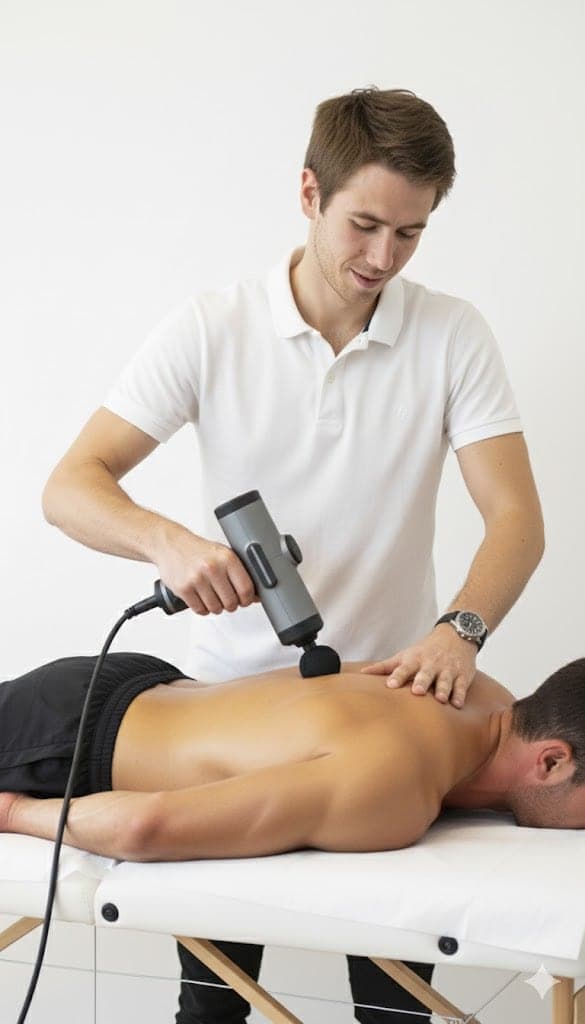
After years of practicing traditional manual therapy, I made a decision that fundamentally transformed the results I could deliver for clients. I invested in specialized mechanical tools that provide three critical advantages: precision, power, and consistency.
Precision: Treating the Cause, Not Just the Symptom
The machine I use allows me to target specific fiber directions within individual muscles. When addressing chronic tension in the upper trapezius, I can work along the fiber orientation from the occiput to the acromion process with exact pressure application. This precision is impossible to maintain with thumbs or elbows throughout an entire treatment session.
I remember treating a client who had developed thoracic outlet syndrome from years of computer work. Traditional massage had provided maybe 20-30 minutes of relief before symptoms returned. Using mechanical precision to release the scalenes and pectoralis minor at depths that manual work couldn’t sustain, we achieved structural change that persisted. Three months later, she remains symptom-free.
Power: Deeper Than Hands Can Reach
There’s a frank reality about deep-tissue work that many therapists won’t acknowledge: truly effective treatment sometimes requires uncomfortable levels of pressure for brief periods. The difference between 8kg of force and 15kg of force can be the difference between superficial fascia manipulation and actual myofascial release.
Human hands cannot consistently deliver and sustain that force without compromising technique. My specialized equipment can. This means we can work at therapeutic depths that produce lasting structural changes rather than temporary symptomatic relief.
For athletes requiring performance optimization, this depth is non-negotiable. A runner trying to correct ITB syndrome needs sustained, deep mechanical work along the entire fascial line from the hip to the knee. Anything less is simply massage theater.
Consistency: Eliminating the Variable of “Off Days”
Every manual therapist has experienced days when they’re fatigued, when previous clients have depleted their strength, when personal circumstances affect their focus. This variability means clients receive inconsistent treatment quality.
The mechanical approach eliminates this variable entirely. Session fifteen delivers the same precise pressure, angle, and duration as session one. This consistency is crucial for clients following structured treatment plans where progressive tissue adaptation depends on reliable stimulus application.
How to Find Legitimate Value in Tala’s Massage Market
Now that we’ve established why cheap massage services Tala often fail to deliver results, let’s discuss how you can find genuine value—services that are affordable relative to the outcomes they produce.
Evaluation Criteria Beyond Price Per Hour
When assessing any massage provider in Tala, apply these diagnostic questions:
- Can they explain your pain’s mechanical cause? A qualified therapist should be able to describe the biomechanical dysfunction creating your symptoms, not just identify where you feel discomfort.
- Do they assess before treating? Proper treatment begins with movement screening and postural analysis. If someone starts rubbing without assessment, they’re guessing.
- What’s their success metric? Are they measuring relaxation or functional improvement? Can they track range of motion changes, pain scale reduction, or performance enhancement?
- Do they offer treatment plans or single sessions? Structural change requires progressive intervention. One-off relaxation sessions have their place, but they’re not solutions for chronic pain.
- What happens if results aren’t achieved? A confident practitioner will stand behind their methodology with clear expectations and willingness to adjust approach.
Red Flags That Indicate False Economy
These warning signs suggest you’re about to waste money regardless of how cheap the advertised price:
- Practitioners who promise pain elimination in a single session for chronic conditions
- Services that emphasize ambiance and “experience” over measurable outcomes
- Therapists who cannot explain their technique’s physiological mechanism
- Facilities pushing product sales or elaborate membership schemes
- Providers who treat everyone identically regardless of their specific dysfunction
I’ve seen clients spend thousands of pesos at upscale spas that checked every aesthetic box while delivering zero functional improvement. The marble floors and aromatherapy diffusers don’t correct your forward head posture or release your frozen shoulder.
The Mobile Advantage: Professional Treatment Without Facility Overhead
One reason I can offer advanced specialized treatment at competitive rates is simple economics: I don’t maintain an expensive facility. I travel to your location with a professional treatment bench and all necessary equipment.
This mobile approach eliminates the overhead costs that traditional establishments pass to clients. No rent for premium locations. No staffing for reception areas. No expenses for decorative ambiance that contributes nothing to treatment outcomes.
Why In-Home Treatment Often Provides Better Results
Beyond cost efficiency, there are legitimate therapeutic advantages to receiving treatment in your own environment:
Reduced pre-treatment tension: Many clients arrive at clinics already carrying stress from traffic, parking challenges, or unfamiliar surroundings. When I arrive at your home, you’re already in your comfort zone, which means your nervous system isn’t in defensive mode before we even begin.
Immediate functional integration: After treatment, you can immediately test results in your actual daily environment. We can assess whether your improved shoulder mobility translates to easier overhead cabinet access or whether your hip work allows better stair climbing.
Privacy for comprehensive treatment: Some therapeutic work requires treating areas that clients prefer not to expose in clinical settings. Your own space provides privacy that enables more thorough treatment.
Investment Versus Expense: Reframing Your Massage Budget
Here’s where I need to directly challenge how most people think about massage costs. When you frame bodywork as an “expense,” you’re implicitly categorizing it as discretionary spending—something to minimize or eliminate when budgets tighten.
This perspective fundamentally misunderstands what we’re actually doing here.
The Real ROI of Structural Bodywork
Let me share a case that illustrates this point. A 34-year-old client came to me spending approximately 800 pesos monthly on chiropractic adjustments and basic massage for chronic lower back pain. The pain had persisted for three years, limiting his ability to play with his children and reducing his productivity at work.
After comprehensive assessment, I identified significant hip flexor tightness creating anterior pelvic tilt, compounded by weak glute medius allowing excessive internal rotation during gait. The solution required six sessions of targeted mechanical deep-tissue work combined with specific corrective exercises.
Total investment: 7,200 pesos over six weeks.
Result: Complete resolution of his back pain. Eighteen months later, he remains pain-free. He’s no longer spending 9,600 pesos yearly on temporary relief. He’s regained recreational activities he had abandoned. His work performance improved measurably.
That 7,200-peso investment has returned multiples of its value through eliminated ongoing treatment costs, improved quality of life, and enhanced functional capacity. This is what I mean by investment rather than expense.
The Hidden Cost of Inadequate Treatment
When you choose cheap massage services Tala that don’t address your actual problem, you’re not saving money. You’re deferring costs while allowing conditions to worsen.
Untreated myofascial dysfunction doesn’t remain static. It progresses. Compensation patterns develop. Secondary problems emerge. The shoulder issue you ignore becomes cervical spine involvement. The knee discomfort you manage with anti-inflammatories becomes hip deterioration.
I’ve treated clients who spent years trying to economize on bodywork only to eventually require medical interventions costing tens of thousands of pesos. The irony is profound—the expensive medical treatment often still doesn’t resolve the underlying biomechanical cause, so the cycle continues.
Building a Sustainable Treatment Partnership
My approach to client relationships differs fundamentally from the transactional model most massage services employ. I don’t view our interaction as a series of disconnected hourly appointments. Instead, I’m proposing a dedicated partnership focused on your long-term structural health and performance optimization.
What a Treatment Partnership Actually Means
When we begin working together, I’m committing to understanding your specific biomechanical situation comprehensively. This means:
- Detailed initial assessment examining postural patterns, movement quality, and fascial restrictions
- Clear identification of primary dysfunctions and secondary compensations
- Customized treatment plan with defined objectives and measurable outcomes
- Progressive intervention that adapts as your tissue quality and movement capacity improve
- Education so you understand exactly what we’re addressing and why
- Between-session support for any questions or concerns that arise
This partnership approach means I’m invested in your results, not just in delivering a pleasant hour of bodywork. If we’re not achieving the outcomes we’ve defined, I adjust methodology until we do.
The Economics of Long-Term Structural Health
Think about your body as you would your vehicle. You can perform minimal maintenance—change oil only when the engine starts making concerning noises, ignore minor issues until they become major failures. This approach seems economical short-term but proves expensive over the vehicle’s lifetime.
Alternatively, you can invest in preventive maintenance, address small problems before they cascade, and maintain optimal functioning throughout the vehicle’s service life. This approach costs more initially but proves far more economical long-term.
Your musculoskeletal system operates identically. Proactive structural maintenance prevents the expensive breakdowns that require medical intervention.
Common Misconceptions About Affordable Quality Massage
Let me address some pervasive myths that prevent people from finding genuine value in Tala’s massage market.
Misconception #1: Longer Sessions Provide Better Results
I regularly encounter clients who believe that a 2-hour massage must be superior to a 60-minute session. This assumption ignores basic physiology.
Quality therapeutic work has a point of diminishing returns, usually around 60-75 minutes. Beyond this duration, several negative factors emerge:
The nervous system becomes overstimulated and begins defensive guarding. Tissue becomes inflamed from excessive manipulation. The therapist’s focus and precision decline. The client’s body cannot effectively process and integrate more stimulus.
I can deliver more structural change in a precisely targeted 60-minute session than most practitioners achieve in two hours of generalized work. You’re not paying for time—you’re paying for expertise, precision, and results.
Misconception #2: Pain During Treatment Indicates Damage
Effective deep-tissue work sometimes involves discomfort. This reality makes some people gravitate toward gentler, cheaper services that feel more pleasant in the moment but deliver minimal results.
There’s a critical distinction between therapeutic discomfort and harmful pain. Therapeutic discomfort occurs when we’re releasing densely adhered tissue or working through protective muscle guarding. This sensation should be intense but tolerable, should diminish as tissue releases, and should not persist after treatment.
Harmful pain is sharp, burning, or produces lasting soreness that worsens over hours. This indicates tissue damage and improper technique.
Understanding this difference allows you to tolerate the temporary discomfort required for lasting results rather than choosing pleasant but ineffective treatment.
Misconception #3: All Deep-Tissue Work Is Equivalent
The term “deep-tissue massage” has become essentially meaningless in the marketplace. Every practitioner claims to offer it, but the actual depth, precision, and effectiveness vary enormously.
True deep-tissue work requires:
- Advanced anatomical knowledge to identify target structures
- Sufficient mechanical force to reach therapeutic depths
- Precise pressure direction along specific tissue planes
- Appropriate duration and frequency for progressive adaptation
- Integration with movement re-education and corrective exercise
Simply pressing harder during a relaxation massage doesn’t constitute legitimate deep-tissue therapy. This is why cheap massage services Tala claiming to offer deep-tissue work often disappoint—they’re using the terminology without possessing the methodology.
Practical Strategies for Maximizing Massage Value in Tala
Let’s translate this information into actionable strategies you can implement immediately when searching for massage services.
Strategy #1: Prioritize Expertise Over Ambiance
The facility’s aesthetic quality has zero correlation with treatment effectiveness. I’ve seen practitioners operating from basic home setups who deliver superior results compared to therapists in luxury spas charging triple their rates.
Focus your evaluation on the practitioner’s education, experience, and methodology. Can they explain their approach scientifically? Do they specialize in specific conditions? Can they demonstrate measurable outcomes from previous clients?
The money you don’t spend on decorative surroundings can instead fund more frequent or longer treatment sessions that actually impact your structural health.
Strategy #2: Establish Clear Treatment Objectives
Before beginning with any provider, define specific, measurable goals. Not “I want to feel better” but “I want to eliminate my morning lower back stiffness” or “I want to restore 90-degree shoulder flexion for swimming.”
This specificity forces the practitioner to propose concrete treatment plans rather than vague ongoing sessions. It also provides clear metrics for assessing whether you’re receiving value.
If a therapist cannot or will not establish measurable objectives, that’s your signal to look elsewhere regardless of their pricing.
Strategy #3: Understand the Progressive Nature of Structural Change
Legitimate structural work requires multiple sessions. Fascia doesn’t durably reorganize from single interventions. Movement patterns don’t correct after one treatment. Neural pathways don’t reprogram instantly.
A qualified practitioner will propose a treatment plan—typically 4-8 sessions for most chronic conditions—with defined progression. They’ll explain what we’re addressing in each phase and what outcomes we expect.
This understanding prevents the trap of endless weekly “maintenance” sessions that never actually resolve your underlying problem. It also helps you budget appropriately for meaningful intervention rather than wasting money on scattered, disconnected appointments.
Strategy #4: Combine Professional Treatment with Self-Care
The most cost-effective approach to structural health combines periodic professional intervention with consistent self-maintenance. I provide every client with specific exercises, stretches, and self-massage techniques to extend treatment effects between sessions.
This hybrid approach might mean professional treatment every 2-3 weeks instead of weekly, significantly reducing your long-term costs while maintaining or even improving results. You’re leveraging professional expertise strategically rather than depending on it completely.
When to Choose Premium Services (And When Not To)
Not all situations warrant the specialized mechanical deep-tissue approach I provide. Understanding when premium services deliver proportional value helps optimize your overall massage budget.
Premium Service Is Warranted For:
- Chronic pain conditions that haven’t responded to conventional treatment
- Athletic performance optimization where small improvements yield significant competitive advantages
- Occupational dysfunction that’s limiting your professional productivity or causing workplace discomfort
- Post-injury rehabilitation requiring precise scar tissue mobilization
- Preventive maintenance for people with demanding physical professions
In these scenarios, the differential results between basic massage and advanced mechanical work justify the higher per-session investment.
Basic Services May Be Sufficient For:
- Simple stress management and relaxation
- Occasional minor muscle tension without chronic patterns
- General wellness maintenance for people without specific dysfunctions
- Complementary treatment to other primary interventions
Be honest with yourself about your actual needs. If you genuinely just want an hour of relaxation without therapeutic objectives, a basic service at 400-600 pesos may perfectly meet your needs. But if you’re trying to resolve a structural problem, that’s where specialized expertise becomes non-negotiable.
The Science Behind Mechanical Versus Manual Treatment
I want to address the technical distinctions between approaches because understanding the mechanisms helps you evaluate value properly.
Tissue Response to Mechanical Intervention
When we apply sustained pressure to myofascial tissue, we’re triggering several physiological responses:
Piezoelectric effect: Mechanical pressure creates electrical potentials in fascial tissue, stimulating fibroblast activity and collagen remodeling.
Thixotropic change: The gel-sol transition in ground substance, where mechanically agitated fascia shifts from dense gel to more fluid sol state, improving tissue mobility.
Neural inhibition: Golgi tendon organs respond to sustained pressure by reducing muscle tone through autogenic inhibition.
Inflammatory cascade: Controlled microtrauma initiates healing responses that ultimately strengthen and reorganize tissue architecture.
The critical factor is that these responses require specific pressure thresholds, duration, and directional application. Manual work often cannot consistently achieve these parameters throughout an entire treatment session. Mechanical tools can.
This isn’t theoretical—I’ve seen countless clients who received months of manual massage with minimal progress achieve dramatic improvements when we switched to mechanical intervention. The difference isn’t practitioner skill; it’s the physics of force application.
Consistency and Progressive Overload
Structural adaptation requires progressive stimulus—slightly increasing challenge as tissue capacity improves. This principle, well-established in strength training, applies equally to fascial treatment.
Mechanical tools allow precise tracking and progressive increase of treatment intensity. Manual work inevitably varies based on therapist condition each session. This consistency difference accumulates over treatment plans to produce significantly different outcomes.
Frequently Asked Questions About Massage Services in Tala
How much should I expect to pay for quality massage in Tala?
Legitimate therapeutic massage typically ranges from 800-1,500 pesos per hour depending on the practitioner’s specialization and methodology. Services below 600 pesos usually indicate limited training or very basic relaxation work. Services above 2,000 pesos often include facility overhead that doesn’t enhance treatment effectiveness.
The key is evaluating cost per outcome achieved rather than cost per hour delivered. A 1,200-peso session that resolves your problem durably provides far better value than twelve 400-peso sessions that provide temporary relief.
How can I tell if a massage therapist is qualified?
Ask about their education, specifically regarding anatomy, physiology, and biomechanics. Legitimate therapeutic practitioners should hold degrees or certifications from recognized institutions, not just weekend workshop attendance.
Request that they explain your condition’s mechanical cause and their treatment approach. A qualified therapist can describe specific anatomical structures, their dysfunction pattern, and the physiological mechanisms through which treatment will create change.
Finally, observe whether they perform assessment before treatment. Proper therapy begins with movement screening and postural analysis, not immediately applying oil.
Is deep-tissue massage supposed to hurt?
Effective deep-tissue work often involves intense sensation, but this should be therapeutic discomfort rather than sharp pain. You should be able to maintain relatively normal breathing throughout treatment. The sensation should feel like “good pain”—intense pressure creating a release sensation rather than injury pain.
If you experience sharp, burning, or stabbing sensations, that indicates excessive pressure or improper technique. Always communicate with your therapist about intensity levels.
Remember that some discomfort during treatment is often necessary for lasting structural change. Techniques that feel entirely pleasant typically work too superficially to address chronic fascial restrictions.
How many sessions will I need to see results?
This depends entirely on your condition’s nature and duration. Acute issues (present less than 6 weeks) often respond within 2-3 sessions. Chronic conditions (present more than 3 months) typically require 6-8 sessions for substantial improvement.
However, you should notice measurable changes after the first session—improved range of motion, reduced pain intensity, better movement quality. If you’re not seeing any improvement after 2-3 sessions, either the diagnosis is incorrect or the treatment approach is ineffective.
Be wary of practitioners who cannot provide estimates or suggest indefinite ongoing treatment without defined objectives.
Should I get massage weekly, or is that too frequent?
Treatment frequency should match your specific situation. Active rehabilitation of chronic conditions often benefits from weekly sessions initially, then spacing to every 2-3 weeks as improvement occurs.
For general maintenance without specific dysfunction, monthly to quarterly sessions typically suffice if you’re performing appropriate self-care between appointments.
The goal should always be reducing dependency on professional treatment over time, not creating lasting need for weekly appointments. If your practitioner isn’t working toward your independence, question their motivation.
What’s the difference between massage and physical therapy?
Physical therapy is a medical profession requiring specific licensure and typically focusing on rehabilitation from injury or surgery. Massage therapy focuses on soft tissue manipulation for pain relief, performance enhancement, and wellness maintenance.
There’s significant overlap in techniques and objectives, but physical therapists can provide diagnosis and medical documentation while massage therapists generally cannot. Many clients benefit from both approaches—physical therapy for diagnosis and exercise prescription, massage therapy for manual tissue work.
My background in Physical Education and Nutrition provides deeper understanding of biomechanics than typical massage training, positioning my services somewhere between traditional massage and physical therapy in terms of technical approach.
Can massage fix my chronic back pain?
Massage alone rarely “fixes” anything durably. However, advanced mechanical deep-tissue work addressing the specific myofascial restrictions causing your pain, combined with corrective exercises and movement re-education, can absolutely resolve chronic back pain in many cases.
The key is accurate identification of the mechanical cause. Is your back pain from hip flexor tightness creating anterior pelvic tilt? Weak core stability allowing excessive lumbar lordosis? Upper cross syndrome referring to the thoracic spine? Each requires different intervention.
This is why assessment and expertise matter so much more than just the physical act of massage. The manual work is the tool; the knowledge is what makes it effective.
Do you provide receipts for insurance reimbursement?
I provide detailed receipts documenting services rendered. Whether your insurance provides reimbursement depends on your specific policy. Many Philippine health insurance plans now include wellness benefits that cover massage therapy, but you’ll need to verify your coverage details.
Some clients use Health Savings Accounts or Flexible Spending Accounts to cover massage expenses, as therapeutic bodywork often qualifies as medical expense. Check with your financial advisor or insurance provider about your specific options.
Making Your Decision: Finding Your Optimal Massage Solution in Tala
We’ve covered extensive ground in this guide, from the economics of massage services to the technical distinctions between approaches. Let me synthesize this into practical decision-making framework.
Your Personal Value Calculation
The right massage service for you depends on three factors:
Your current condition: Chronic structural problems requiring correction warrant specialized intervention. Simple stress management can utilize basic services.
Your timeline: If you need rapid results for specific events or activities, intensive specialized treatment makes sense. If you’re working on long-term wellness without urgency, you can utilize more gradual approaches.
Your budget reality: Consider total investment over time rather than per-session cost. Six sessions at 1,200 pesos resolving your problem costs less than six months of weekly 500-peso sessions providing temporary relief.
The Partnership I’m Offering
If you’ve read this far, you’re clearly someone who values understanding over superficial solutions. You’re willing to invest in genuine resolution rather than just symptom management.
That’s exactly the type of client I work with most effectively.
I’m offering you a dedicated partnership focused on lasting results. Not relaxation sessions you’ll need forever, but structural intervention that resolves your specific dysfunction so you can return to unrestricted activity.
My specialized mechanical deep-tissue approach isn’t the cheapest option in Tala per session. But it’s consistently the most cost-effective solution per problem resolved. I travel to your location with professional equipment, eliminating facility overhead while maintaining treatment quality. I bring ten years of experience and university-level education in body mechanics, not just massage technique training.
Most importantly, I’m committed to measurable outcomes, not just pleasant appointments. We establish clear objectives, track progress systematically, and adjust approach if results aren’t materializing.
Taking the Next Step
If your current approach to managing pain or dysfunction isn’t working—if you’re caught in the cycle of temporary relief followed by recurring problems—it’s time to consider a different methodology.
The investment in proper structural treatment pays returns throughout your life: improved daily comfort, enhanced performance capacity, prevention of progressive deterioration, and elimination of ongoing treatment dependency.
Stop viewing massage as either an unaffordable luxury or a cheap temporary fix. Start understanding it as strategic investment in your functional longevity.
Your body is the only one you’ll ever have. The question isn’t whether you can afford specialized treatment. The question is whether you can afford to continue without it.
Final Thoughts: Redefining Cheap Massage Services Tala
The cheapest massage service isn’t the one with the lowest price per hour. It’s the service that delivers the greatest value per peso invested over your lifetime.
Sometimes that’s a basic relaxation session that effectively manages stress without pretending to be therapeutic intervention. Sometimes that’s premium specialized treatment that resolves structural problems other approaches cannot address.
What it’s never, under any circumstance, is repeatedly purchasing ineffective treatment just because each individual session costs less. That’s not economical—it’s expensive ineffectiveness disguised as affordability.
I’ve built my practice on a simple principle: deliver results so clear and lasting that clients measure value by problems resolved rather than hours purchased. This approach means some people work with me for 6-8 sessions and never need regular treatment again. Others utilize quarterly maintenance after achieving their primary objectives.
Either way, they’re investing strategically in structural health rather than renting temporary relief.
That’s what separates cheap massage services Tala from valuable massage services Tala. And that distinction makes all the difference in your long-term functional quality of life.
Written by
Chris
Massage therapist & body mechanics specialist
Norwegian-certified with a Bachelor’s in Physical Education and Nutrition and over ten years of clinical practice, working from a portable table in clients’ homes across the Paphos district.
This article is general information from clinical practice, not a medical diagnosis. If you have severe, worsening or unexplained pain, numbness, weakness, or pain after an accident, see a doctor first.