Massage Tsada: mechanical deep-tissue therapy at home
In short
Massage Tsada is a mobile deep-tissue treatment I bring to your home in the village, working slowly through the layers of muscle and fascia that hold chronic tension, with a proper assessment first and a plan for what comes next.
I am Chris, a mobile massage therapist based in Chlorakas, and I drive up to the village several times a month. If you have searched for massage Tsada, this is what I actually offer: mobile deep-tissue therapy in Tsada, done on a proper table in your home, with an assessment before I touch you. It is not a spa treatment.
Tsada sits high enough above Paphos that the drive itself is a small climb, and I mention that because it matters for how people there live. Many of my clients in the village have gardens on slopes, steps into every part of the house, and a car journey for almost everything else. That combination shows up in the body in a fairly recognisable way, and it is what this article is about.
Why I treat in Tsada rather than in a clinic
I made the decision to work mobile only after a few years in a fixed room. Part of it is practical. Tsada is a twenty-minute drive from most of the Paphos clinics, and a person with a sore back who has just been worked on deeply does not benefit from folding themselves into a car afterwards. But the larger reason is what happens to the nervous system in a familiar space.
When you are lying on a table in your own room, with your own light and your own quiet, the guarding that most people carry in the shoulders and hips settles faster. I can get to the deeper tissue sooner and with less pressure than I would need in an unfamiliar room. That is not mystical. It is simply that muscle tone follows the state of the nervous system, and the nervous system settles at home.
There are a few things you can expect from the mobile format:
- I bring the table, linens, oils and everything else. You need a space roughly two metres by three.
- Sessions are 60 or 90 minutes of actual treatment time. Setting up and packing away is on my time, not yours.
- I take a short history and do a movement check before starting. This is not skipped because we are in a house rather than a clinic.
- You can go straight to the sofa or to bed afterwards, which is where deep work does its best consolidating.
Booking is by WhatsApp or a phone call, and I confirm the address and a rough parking note the day before.
What is actually happening in a deep-tissue session
The phrase mechanical deep-tissue therapy sounds more complicated than it is. Mechanical means I am working on the physical properties of the tissue: its length, its glide against the layers around it, its tolerance for load. I am not primarily aiming for relaxation, though relaxation tends to arrive on its own once the tissue lets go.
Muscle that has been held short for months develops a few predictable changes. The fascia around and through it becomes stiffer and less hydrated. Adjacent layers that should slide over each other begin to stick. The muscle spindles reset to treat the shortened length as normal, so the muscle fights any attempt to lengthen it. And the local nerve endings become more sensitive, so ordinary pressure starts to read as pain.
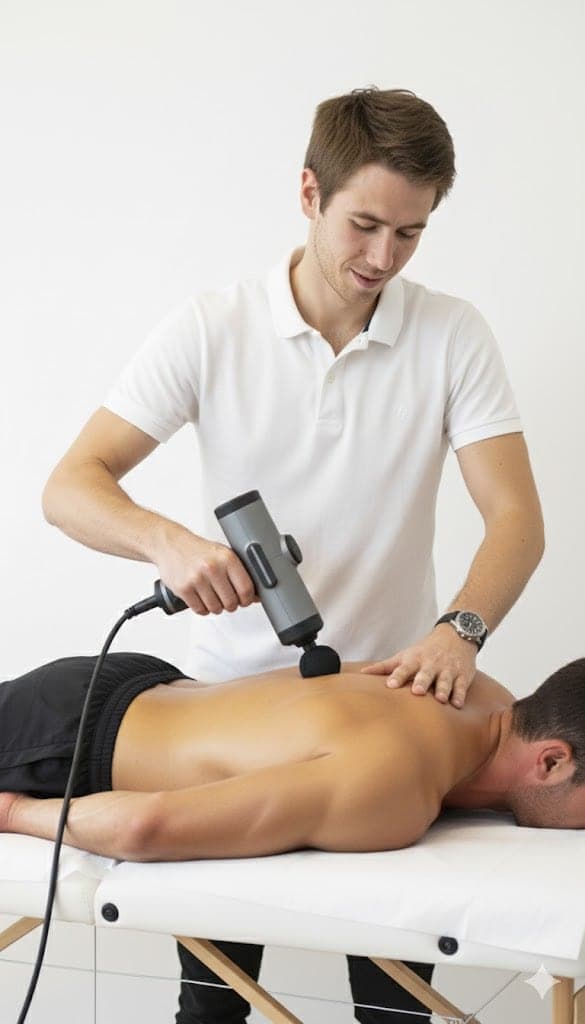
Deep-tissue work addresses those changes in order. Slow, sustained pressure warms and hydrates the fascia. Cross-fibre and longitudinal strokes restore glide between layers. Holding a muscle at a length it has forgotten, while it is under load from my forearm or elbow, gives the spindles new information. And repeated exposure to firm pressure that does not cause harm gradually turns down the sensitivity of the local nerves.
I use my hands, forearms and elbows, and I lean my body weight into the table rather than pushing with my arms. That is what lets me sustain pressure through a whole 90-minute session without the quality dropping off towards the end.
The presentation I see most often in Tsada
Every area I work in has its own pattern, and Tsada's is shaped by the terrain and by who lives there. A good part of my Tsada work is with people in their fifties, sixties and beyond who have retired to the village and are more active than they were at any point in their working lives. Gardening on a slope, walking the hill roads, swimming daily in summer.
The pattern I see most often is a combination of three things. The first is a tight, sore lower back and hip complex from bending, lifting and stepping up and down all day. The gluteal muscles, the deep hip rotators and the lumbar erectors all take that load. The second is a stiff thoracic spine and rounded shoulders, partly from age and partly from the sheer number of hours spent driving on winding roads with the shoulders raised. The third is calf and foot tension from steep walking on hard ground.
| Where it hurts | What is usually tight | What I work on first |
|---|---|---|
| Low back, worse after gardening | Gluteus medius, piriformis, quadratus lumborum | Hips before the back |
| Between the shoulder blades | Rhomboids, upper trapezius, pectorals | Front of the chest, then the back |
| Calves and heels, worse in the morning | Soleus, plantar fascia, tibialis posterior | The whole posterior chain from the hamstrings down |
There is a second, smaller group in Tsada: younger people who commute down to Paphos for work and sit for most of the day. Their pattern is closer to what I see across the district, forward head, tight hip flexors, and a lower back that complains at the end of the week. It responds well to the same approach, though the emphasis moves towards the front of the hip.
None of this is a diagnosis. It is a description of what tends to be tight, and where I usually start.
Massage Tsada: how a session runs in your home
The first visit takes a little longer at the front. I ask what hurts, when it started, what makes it better or worse, and what you would like to be able to do that you cannot do comfortably now. Then I watch you move: a forward bend, a squat, arms overhead, turning the head. Five minutes of this tells me more than any amount of pressing on the sore spot.
Treatment then follows a rough sequence, adjusted to what I found:
- Warming and general work across the whole area, so the tissue is ready for deeper pressure.
- Specific work on the muscles that are actually holding the pattern, which is often not where the pain is.
- Lengthening and glide work to consolidate the change.
- A short check of the same movements from the start, so we both know whether anything shifted.
A 60-minute session is enough for one region done properly, say the whole hip and lower back complex, or the neck, shoulders and upper back. A 90-minute session lets me treat the whole posterior chain from neck to heel, which is what I usually recommend for the Tsada pattern above, since the three parts of it are linked. Current rates are €90 for 60 minutes and €130 for 90, with every fifth session free, and full details are on the pricing page.
How many sessions, and what I can and cannot help with
I am careful with this question because the honest answer is that it varies. Something that has been building for years does not resolve in a single visit, and I do not promise that it will. What I can say is that most people know after the first session whether this approach suits their body, and that after three or four sessions spaced a week or two apart, we usually have a clear sense of what is changing and what is not.
After that, the pattern for most of my Tsada clients is maintenance rather than repair. Some come monthly, some every six weeks, some only when the garden has been particularly demanding. I do not have a subscription model and I do not push for one.
Here is roughly what to expect over time:
- First session: assessment, whole-area work, some soreness the next day, and often a clear sense of what is tight.
- Sessions two to four: more specific and deeper work as the tissue tolerates it, with movement improving between visits.
- Beyond that: maintenance at whatever interval keeps you moving well.
I can help with muscular tension, stiffness, movement restriction, and the general aches of an active life; I cannot help with, and will not treat, anything that needs a diagnosis first, so see a doctor first if you have pain that came on suddenly with no clear cause, numbness or weakness in a limb, night pain that wakes you, unexplained weight loss, or a recent fall or injury. Once you have been checked, I am glad to work alongside whatever your doctor or physiotherapist recommends. If your concern is more about a specific sport or training load, my sports massage in Paphos page describes how I approach that.
Frequently asked questions
Is there a mobile massage therapist near me in Tsada?
Yes. I am based in Chlorakas, roughly a twenty-minute drive from Tsada, and I treat in the village regularly. I bring a full professional table and everything else needed, so you only need a clear space and a little time. Booking is by WhatsApp or phone, and I usually have availability within a few days, sometimes sooner.
How is this different from a relaxation massage?
A relaxation massage works on the surface with flowing strokes and aims to calm you. Deep-tissue therapy works slowly into the deeper layers of muscle and fascia, with the aim of changing how the tissue moves and tolerates load. It is firmer and more specific, it involves an assessment first, and it can leave you sore for a day or two, though most people also find it deeply relaxing.
Will it hurt?
It should be intense in places but not painful. My rule is that if you are holding your breath or tensing against my hand, the pressure is too much and I ease off. You will feel some spots more than others, and a day of mild soreness afterwards is normal. Sharp pain, bruising or lasting discomfort are not, and I want to hear about them.
Do you need a special room or equipment?
No. I bring a folding treatment table, linens, oil and anything else I need. A space of roughly two by three metres works, in a bedroom, living room or shaded terrace. Some warmth in winter is helpful, since cold tissue does not respond as well. Everything else, including setting up and packing away, is on my time rather than yours.
Can I book a longer session or two people?
I offer 60 and 90 minutes; the 90-minute session suits the Tsada pattern of hips, back and calves treated together. I can treat two people back to back at the same address, one after the other, which is common for couples in the village. Let me know when you book so I can allow enough time.
How far in advance should I book?
A few days is usually enough, though summer weekends and the run-up to holidays fill earlier. If you have a specific problem you want to work on ahead of a trip or an event, give yourself two or three weeks so we can fit in more than one session. For maintenance, most people simply book the next visit as I leave.
Written by
Chris
Massage therapist & body mechanics specialist
Norwegian-certified with a Bachelor’s in Physical Education and Nutrition and over ten years of clinical practice, working from a portable table in clients’ homes across the Paphos district.
- Norwegian-certified
- BSc Physical Education & Nutrition
- 10+ years clinical practice
- Based in Chlorakas · all of Paphos district
- No call-out fee anywhere in Paphos district
Last reviewed
This article is general information from clinical practice, not a medical diagnosis. If you have severe, worsening or unexplained pain, numbness, weakness, or pain after an accident, see a doctor first.