Affordable Trigger Point Massage Kato Paphos: Finding Professional Results Without Compromising Quality
In short
Discover how to access professional trigger point massage in Kato Paphos that delivers lasting pain relief without breaking the bank. Learn what separates clinical results from temporary spa treatments.
When clients first contact me about affordable trigger point massage Kato Paphos, I understand immediately what they’re really asking: “Can I get effective treatment without spending a fortune?” The answer is yes—but only if you understand what you’re actually paying for. After a decade working with everyone from chronic pain sufferers to professional athletes, I’ve learned that “affordable” doesn’t mean “cheap,” and “expensive” doesn’t guarantee results.
The confusion around pricing in Kato Paphos stems from a fundamental misunderstanding of what trigger point therapy actually is. Walk into most spas offering “trigger point massage,” and you’ll receive a pleasant relaxation session with some thumb pressure applied to sore spots. That’s not trigger point therapy—that’s guesswork with a clinical-sounding name attached. True trigger point work requires precision, sustained pressure at specific depths, and consistent mechanical advantage that human hands simply cannot maintain for the duration necessary to create lasting change.
Understanding the Real Cost of Inadequate Treatment
Let me share something I see repeatedly in my practice: A client comes to me after spending €600-800 over three months visiting various massage therapists in Paphos. They’ve tried hotel spas, wellness centers, even reputable therapists with good online reviews. Each session costs €50-70, feels nice during the treatment, provides relief for perhaps two or three days, then the pain returns—sometimes worse than before.
This isn’t the therapist’s fault. It’s a limitation of traditional manual therapy when applied to deep fascial restrictions and chronic trigger points. Human hands fatigue. Pressure becomes inconsistent. The therapist cannot maintain the precise angle and sustained force required to break down adhesions at the mechanical level where they exist. What feels “deep” to the recipient is often only reaching superficial tissue layers.
The Mathematics of False Economy
Consider this calculation I walk every potential client through: Eight sessions at €60 each equals €480. If those sessions provide temporary relief requiring continuous maintenance, you’re looking at €1,920 annually—forever. That’s not treatment. That’s dependency.
Compare that to a properly executed treatment protocol using advanced mechanical deep-tissue methods: Four to six sessions over six to eight weeks, creating measurable, lasting improvement in range of motion, pain levels, and functional capacity. The initial investment might appear higher per session, but the outcome is fundamentally different. You’re not managing symptoms. You’re eliminating the biomechanical dysfunction causing them.
What Makes Trigger Point Therapy Affordable in Kato Paphos
After completing my Bachelor’s degree in Physical Education and Nutrition in Norway and spending ten years refining my approach to body mechanics, I can state with confidence: affordable trigger point massage Kato Paphos exists when you focus on cost-per-result rather than cost-per-session.
Precision Over Time
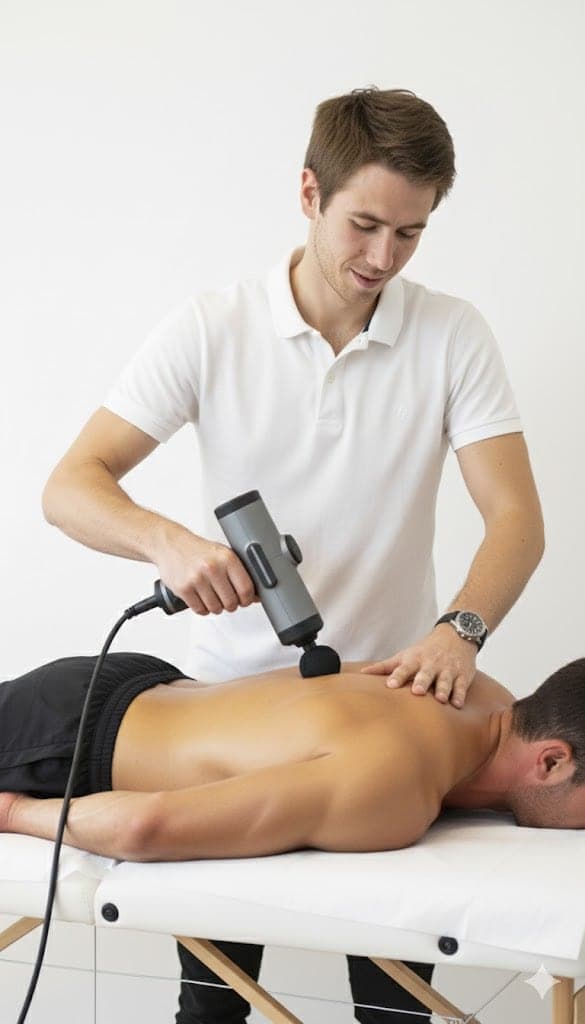
I use a specialized mechanical device that delivers what human hands cannot: unwavering pressure at precise depths for extended periods. This isn’t a luxury—it’s mechanical necessity. Trigger points exist in deep fascial layers, often beneath multiple tissue planes. Reaching them requires:
- Sustained compression at 15-40 pounds of force depending on the tissue structure
- Precise angle of approach determined by muscle fiber orientation
- Consistent pressure for 30-90 seconds per point to achieve ischemic release
- Immediate reassessment and adjustment based on tissue response
The machine I employ provides all of these elements without the variability introduced by human fatigue, distraction, or inconsistent technique. When I say the treatment is deeper than hands, I mean it literally—we’re working at fascial planes that manual therapy cannot consistently access.
The Economics of Results-Based Treatment
Let me explain how I structure treatment to make it genuinely affordable while delivering clinical outcomes. This requires understanding your body mechanics, not just your symptoms.
Initial Assessment and Treatment Planning
When you first contact me, we don’t start with a massage. We start with a comprehensive assessment of your movement patterns, pain triggers, and functional limitations. I’m analyzing:
- Compensation patterns in your gait and posture
- Restricted ranges of motion indicating fascial adhesions
- Trigger point referral patterns explaining your pain distribution
- Biomechanical inefficiencies creating chronic overload
This assessment informs a customized treatment plan—not an open-ended series of sessions, but a specific protocol designed to address your mechanical dysfunction. Most clients require 4-6 sessions. Some athletes seeking performance optimization continue with monthly maintenance. Chronic cases with significant fascial restriction may need 8-10 sessions. But we know this from the beginning, because I’m treating causes, not chasing symptoms.
Why I Travel to Your Location
Here’s something that surprises people: I bring my professional equipment directly to your home, apartment, or hotel in Kato Paphos. This isn’t a convenience service—it’s part of making effective treatment accessible.
Consider the logistics of traditional clinic-based therapy in Paphos: You drive 20 minutes each way. You wait in reception. You’re shown to a room. The therapist has twelve clients that day and is already fatigued by the time they reach you. The treatment is rushed because the next client is waiting. You drive home, hitting traffic on Poseidonos Avenue, which immediately reactivates the tension we just addressed in your neck and shoulders.
That’s not a treatment environment conducive to healing. When I travel to you, we eliminate those variables. You receive treatment in a calm, familiar environment. Afterward, you can rest, hydrate properly, and allow your nervous system to integrate the changes without immediately subjecting your body to stress.
Understanding the Machine Method: Why It’s More Affordable Long-Term
I need to address this directly because it’s central to understanding value: The specialized mechanical device I use isn’t a gadget or gimmick. It’s a clinical tool that changes the economics of effective treatment.
Deeper Than Hands—The Mechanical Reality
Fascia—the connective tissue surrounding and interpenetrating every muscle—can develop adhesions and restrictions that limit movement and create pain. These adhesions exist at varying depths. Superficial fascia sits just beneath the skin. Deep fascia surrounds muscle bellies. Visceral fascia connects to organs. To release a trigger point in the deep external rotators of your hip, for instance, I need to apply sustained pressure through the gluteal muscle group, penetrating 4-6 centimeters of tissue.
A human thumb, no matter how strong, begins to fatigue after 20-30 seconds at that depth. The pressure becomes inconsistent. The angle shifts. The therapist compensates by using body weight, which reduces precision. With the mechanical device, I maintain exact pressure at exact depth for as long as necessary—often 60-90 seconds per point—without any degradation in quality.
This isn’t about being “better” than manual therapy. It’s about physics. The tool provides mechanical advantage that makes deep fascial release possible in a timeframe that’s practical and affordable.
Complete Control Equals Predictable Outcomes
One of my competitive athletes in Kato Paphos—a cyclist dealing with chronic IT band syndrome—put this perfectly: “Other therapists hurt me randomly. You hurt me precisely.” That precision is what creates affordable treatment.
When working on his vastus lateralis and tensor fasciae latae, I can calibrate pressure from light exploratory touch to powerfully deep targeted release. The adjustment is instantaneous and exact. As tissue releases, I follow that release deeper, maintaining optimal therapeutic pressure throughout. This level of control means:
- No wasted time working at ineffective depths
- No tissue damage from excessive force applied imprecisely
- No need for multiple sessions to “try different approaches”
- Measurable progress in every single treatment
What Affordable Actually Means: A Framework for Evaluation
Let me give you a framework I developed for evaluating whether trigger point massage in Kato Paphos represents genuine value or false economy.
| Factor | Temporary Relief Model | Lasting Resolution Model |
|---|---|---|
| Treatment Goal | Symptom management | Mechanical correction |
| Session Frequency | Weekly, ongoing | 6-8 sessions over 2 months |
| Annual Cost | €1,800-2,400 | €400-700 initial, minimal maintenance |
| Pain Reduction | 20-30% improvement maintained | 70-95% improvement sustained |
| Functional Improvement | Minimal lasting change | Measurable ROM and strength gains |
| Return to Activity | Modified activity with restrictions | Full activity without compensation |
The numbers tell a clear story. What appears affordable in the moment—a €50 massage that feels good—becomes extraordinarily expensive when it doesn’t solve the underlying problem. What seems like a larger investment—comprehensive treatment that addresses biomechanical dysfunction—becomes remarkably affordable when you measure cost against outcome.
The Investment Philosophy: Why I Reject the Spa Model
I’ll be direct: I don’t offer relaxation massage. I don’t provide spa experiences. I don’t use aromatherapy or play meditation music. Those things have value for stress management and wellbeing, but they’re not what I do, and they’re not what you need if you’re searching for affordable trigger point massage Kato Paphos.
The Partnership Approach
What I offer is a dedicated partnership toward a specific outcome: lasting pain relief and optimized physical function. This means several things practically:
When you work with me, you’re not purchasing a series of massages. You’re investing in a comprehensive treatment protocol that includes:
- Detailed biomechanical assessment identifying dysfunction patterns
- Customized treatment plan with clear milestones and outcome measures
- Progressive mechanical release of fascial restrictions and trigger points
- Movement re-education to prevent recurrence
- Specific strengthening and mobility protocols for your situation
- Ongoing assessment and plan adjustment based on your response
This is why my clients stop needing me. That might sound like poor business strategy, but it’s the entire point. If you’re dependent on weekly treatments indefinitely, I haven’t solved your problem—I’ve become part of it.
A Case Study in Affordability
A property developer in Kato Paphos contacted me last year with chronic lower back pain. He’d spent eighteen months and over €2,000 trying various treatments: physiotherapy, osteopathy, sports massage, even acupuncture. Each provided temporary relief, but the pain always returned. He was taking ibuprofen daily and considering more aggressive interventions.
During assessment, I identified severe trigger points in his quadratus lumborum and multifidus muscles, caused by prolonged sitting with poor lumbar support and a previous injury that had created compensatory movement patterns. His hip flexors were chronically shortened, creating anterior pelvic tilt that overloaded his lumbar erectors.
We implemented a six-session protocol over seven weeks. Sessions one through three focused on releasing the active trigger points and restoring length to his hip flexor complex. Sessions four through six addressed his thoracolumbar fascia restrictions and retrained proper spinal stabilization patterns. I also prescribed specific daily mobility work taking twelve minutes.
The result: After six weeks, his pain had decreased from 7/10 daily to 1/10 occasional. Six months later, he remains pain-free and has discontinued all pain medication. Total investment: €540. Compare that to the €2,000 he’d already spent managing symptoms or the €15,000+ surgical interventions that were being discussed.
Common Misconceptions About Affordable Treatment in Kato Paphos
My decade of experience has exposed several persistent myths that prevent people from accessing effective, affordable trigger point massage in Kato Paphos.
Myth: Longer Sessions Are Better Value
Many massage services in Paphos advertise 90-minute or 120-minute sessions as “better value.” This is almost always false when treating trigger points. Here’s why:
Effective trigger point release requires high-intensity, precisely targeted work. After 45-60 minutes of this, your nervous system becomes saturated. Additional time yields diminishing returns and can actually slow recovery by overloading your system’s ability to process the changes. I structure sessions at 60-75 minutes not because that’s what’s convenient, but because that’s what’s mechanically optimal for tissue response and nervous system integration.
Myth: More Frequent Sessions Accelerate Results
Another misconception: If one session helps, three sessions per week must be three times as effective. In reality, fascial remodeling requires time. After significant trigger point release, your body needs 4-7 days to reorganize tissue, rehydrate the extracellular matrix, and integrate new movement patterns.
Treating too frequently doesn’t allow this process to complete. You’re essentially disrupting partially healed tissue, which extends recovery time. The optimal frequency for most conditions is once weekly initially, progressing to every 10-14 days as symptoms resolve. This isn’t about maximizing revenue—it’s about respecting tissue healing timelines.
Myth: Light Pressure Is Safer and More Sustainable
Some therapists in Kato Paphos promote “gentle trigger point work” as more sustainable. This fundamentally misunderstands trigger point physiology. A trigger point is a localized contracture in muscle fiber—essentially a microscopic cramp that won’t release on its own. Light pressure might feel pleasant, but it doesn’t create the ischemic compression necessary to disrupt the contracture.
Effective trigger point release requires sufficient pressure to temporarily restrict blood flow to the point, forcing it to release. This isn’t about causing pain—it’s about applying appropriate mechanical force to achieve a specific physiological response. With my mechanical device, I can calibrate this precisely, applying exactly what’s needed without excess.
How to Evaluate Trigger Point Services in Kato Paphos
If you’re researching affordable trigger point massage Kato Paphos, here’s the framework I recommend for evaluation:
Questions to Ask Any Provider
- What is your assessment process? If they don’t assess movement patterns and biomechanics before treating, they’re not treating causes.
- What’s your treatment plan structure? If they can’t estimate how many sessions you’ll need, they’re managing symptoms indefinitely.
- How do you measure progress? Without objective measures (ROM, pain scales, functional tests), you can’t evaluate value.
- What’s your success rate for lasting improvement? If most clients need ongoing weekly treatment, that’s maintenance, not resolution.
- What happens between sessions? Effective protocols include homework—specific movements and activities that support the treatment.
Red Flags Indicating Poor Value
Avoid services that exhibit these characteristics:
- Selling packages of 10+ sessions upfront without assessment
- Using “trigger point” as a marketing term without specific methodology
- Inability to explain the biomechanics of your condition
- Pressure to book weekly indefinitely
- Claims that you need monthly treatments “for maintenance” after initial resolution
- Generic treatment regardless of your specific dysfunction
The True Cost of Delayed Effective Treatment
Something I discuss with every new client: the hidden costs of living with unresolved pain and dysfunction. When evaluating affordable trigger point massage Kato Paphos, most people calculate only the direct treatment cost. They overlook the broader economic impact of their condition.
The Compensation Cascade
Your body is remarkably adaptive—usually to its own detriment. When you have a trigger point creating pain in your right shoulder, you unconsciously shift movement patterns to avoid that pain. This overloads your left shoulder, your neck, and your upper back. Within weeks, you’ve developed secondary trigger points in compensating muscles. Within months, you’ve altered your posture, which affects your breathing mechanics, which influences your stress response, which worsens muscle tension globally.
I’ve treated this cascade in dozens of clients in Kato Paphos. A simple trigger point in the infraspinatus, left untreated for six months, cascades into a complex myofascial pain syndrome requiring significantly more intensive intervention. What could have been resolved in three sessions now requires eight. What could have cost €300 now costs €700-800.
Affordable treatment means intervening before compensation patterns become entrenched. It means addressing dysfunction when it’s localized, not systemic.
The Performance Cost
For athletes and active individuals in Kato Paphos, unresolved trigger points don’t just cause pain—they limit performance. A cyclist with trigger points in the hip flexors loses power output. A tennis player with shoulder restrictions loses serve velocity. A runner with calf trigger points loses efficiency.
I’ve measured these effects directly using functional tests. A cyclist I treated last year had chronic trigger points in his vastus lateralis. Before treatment, his functional threshold power was 245 watts. After releasing those trigger points and restoring proper muscle recruitment patterns, his FTP increased to 268 watts—a 9% improvement with no additional training. That’s the performance cost of mechanical dysfunction.
My Approach: Making Professional Treatment Accessible in Kato Paphos
Given everything I’ve discussed about the limitations of traditional massage and the economics of effective treatment, let me explain specifically how I structure my services to be genuinely affordable while delivering clinical results.
Transparent Pricing and Outcome Predictions
After your initial assessment, I provide a clear treatment plan with estimated sessions required and projected outcomes. For example:
Acute Trigger Points (Recent Onset): Typically 3-4 sessions over 4 weeks. Expected outcome: 80-90% pain reduction, full ROM restoration. Investment: €300-400.
Chronic Myofascial Pain (3+ Months): Typically 6-8 sessions over 8-10 weeks. Expected outcome: 70-85% pain reduction, significant functional improvement. Investment: €540-720.
Athletic Performance Optimization: Initial 4-session protocol, then monthly maintenance. Expected outcome: Improved power output, reduced injury risk, faster recovery. Initial investment: €360, maintenance: €90-180 per month.
These aren’t guarantees—every body responds differently—but they’re realistic projections based on a decade of clinical experience. Most importantly, we’re measuring progress objectively, so you know whether the investment is yielding results.
The Mobile Service Advantage
Bringing professional equipment to your location in Kato Paphos accomplishes several things simultaneously. It eliminates your transportation time and stress. It allows treatment in your optimal recovery environment. It makes scheduling more flexible, which improves adherence to the treatment plan.
But there’s another advantage rarely discussed: I can observe your actual living and working environment. Where do you sit? How’s your workstation ergonomics? What’s your bed like? These environmental factors often perpetuate trigger points. When I see them, I can address them immediately.
I had a client with chronic neck tension that wouldn’t fully resolve despite effective trigger point treatment. During a session at her apartment, I noticed her desk setup forced her into constant cervical rotation. We corrected that immediately—a €40 monitor arm eliminated the perpetuating factor. That’s the kind of comprehensive problem-solving that mobile service enables.
Beyond Trigger Points: The Complete Mechanical Approach
While we’re discussing affordable trigger point massage Kato Paphos, I want to emphasize that isolated trigger point release, while valuable, represents only one aspect of comprehensive treatment. My education in physical education and nutrition informs a broader approach.
Integrated Biomechanical Correction
When I treat your trigger points, I’m simultaneously assessing and addressing:
- Joint mobility restrictions limiting normal movement patterns
- Muscle strength imbalances creating chronic overload
- Fascial restrictions reducing tissue glide and causing adhesions
- Postural deviations increasing mechanical stress
- Movement compensations perpetuating dysfunction
This integrated approach means you’re not just getting relief from pain—you’re developing a more resilient, efficient body that’s less prone to injury and dysfunction. That’s what makes treatment truly affordable: it’s preventive, not just corrective.
The Education Component
Every session includes education about your specific biomechanics. I explain why you developed these trigger points, what movement patterns perpetuate them, and what you can do daily to prevent recurrence. This knowledge is valuable—it empowers you to maintain results independently.
Many clients continue some of the mobility and strengthening work I prescribe years after treatment, not because they need to but because they’ve experienced the benefits. That sustained improvement is the ultimate affordability: an initial investment that continues paying dividends indefinitely.
Frequently Asked Questions About Affordable Trigger Point Massage in Kato Paphos
How quickly will I experience results?
Most clients notice significant improvement after the first session—typically 30-50% pain reduction and increased range of motion. However, this initial improvement often partially regresses within 48-72 hours as compensatory patterns reassert themselves. Sustained improvement requires completing the full treatment protocol, allowing your nervous system and fascia time to reorganize around new patterns.
Is the mechanical method painful?
The sensation during trigger point release is intense but should never be unbearable. I describe it as “productive discomfort”—you feel pressure and a specific quality of sensation at the trigger point that often matches your familiar pain pattern. This recognition—”that’s exactly where my pain is”—indicates we’re working at the correct location and depth. The intensity is completely under your control through immediate feedback to me.
How is this different from physiotherapy?
Physiotherapy and what I provide are complementary but distinct. Physiotherapy emphasizes rehabilitation through exercise, modalities like ultrasound or electrical stimulation, and general manual therapy. My focus is specifically on advanced mechanical deep-tissue work using specialized equipment that most physiotherapy clinics don’t possess. Many of my clients see physiotherapists concurrently—the combination is often highly effective.
Do I need to do anything between sessions?
Yes. I prescribe specific mobility work, stretches, and often strengthening exercises tailored to your condition. These typically require 10-15 minutes daily. Compliance with this homework significantly accelerates results—clients who do the work consistently typically need 30-40% fewer sessions than those who don’t.
What if I have a medical condition affecting my muscles?
I work with clients with various conditions—fibromyalgia, chronic fatigue, autoimmune conditions affecting connective tissue—but always in coordination with their medical team. Some conditions require modified treatment approaches. During your assessment, we discuss your complete medical history to ensure treatment is safe and appropriate. In some cases, I may request medical clearance from your physician before proceeding.
Can you guarantee results?
I don’t guarantee specific outcomes because individual responses vary based on factors including condition severity, duration, compliance with recommendations, and individual healing capacity. What I guarantee is a thorough assessment, a scientifically-grounded treatment plan, and professional execution of that plan using optimal mechanical methods. The vast majority of clients—I estimate 85-90%—achieve substantial, lasting improvement when they complete the recommended protocol.
Is the treatment suitable for athletes?
Absolutely. Many of my clients in Kato Paphos are competitive or recreational athletes—cyclists, triathletes, tennis players, runners, swimmers. Athletic populations often develop sport-specific trigger points from repetitive loading patterns. The mechanical precision I provide is particularly valuable for athletes because it allows very deep work without the tissue damage that can occur from imprecise manual pressure. Many athletes report improved performance metrics after treatment.
How long do results last?
When we address the underlying biomechanical cause—not just the trigger points themselves but the movement dysfunction creating them—results are typically lasting for that specific issue. However, new stresses can create new dysfunctions. Some clients return annually or semi-annually for “tune-ups” if they’ve taken on new training loads or experienced injuries. But the specific condition we treat should not recur if we’ve corrected the mechanical cause.
Taking the First Step: What to Expect
If you’re considering working with me, here’s what the process looks like:
Initial Contact: We discuss your situation briefly—your symptoms, their duration, what you’ve tried, your goals. This helps me determine if I’m the right fit for your needs. If your condition is outside my scope—requiring medical intervention, for instance—I’ll tell you immediately and recommend appropriate alternatives.
Assessment Session: This is where we truly begin. I evaluate your movement patterns, pain distribution, trigger point locations, fascial restrictions, and compensation strategies. This typically takes 30-40 minutes and forms the foundation of your treatment plan.
Treatment Plan Discussion: Based on assessment findings, I explain exactly what I’ve identified, why it’s causing your symptoms, and what correcting it requires. I provide realistic timelines and cost projections. We discuss your schedule, preferences, and any constraints affecting treatment.
First Treatment: We begin immediately if appropriate, or schedule your first treatment session. I explain everything as we proceed—which tissues we’re addressing, what sensations you should expect, how your body should respond.
Progressive Treatment: Subsequent sessions build on previous results, progressively releasing restrictions and retraining movement patterns. We measure progress objectively, adjusting the plan if necessary.
Graduation: When you’ve achieved your functional goals and can maintain results independently, we conclude the treatment protocol. You have the knowledge and tools to sustain improvement. Some clients schedule occasional follow-ups; many never need to return.
The Philosophy Behind Affordable Excellence
I want to conclude with the philosophy that guides my practice, because it directly relates to affordability and value. I could charge significantly more for my services—my education, experience, and specialized methodology would justify higher rates in many markets. I could position myself as a luxury service accessible only to affluent clients.
I choose not to because I fundamentally believe effective pain treatment should be accessible to anyone genuinely committed to improvement. Living with chronic pain isn’t a luxury problem—it affects people across all economic situations. The property developer and the restaurant server both deserve access to treatment that actually works.
What I require isn’t wealth—it’s engagement. I require that you commit to the process: attend sessions consistently, do the homework, communicate honestly about your progress, and trust the methodology even when it challenges your assumptions about how treatment should feel or proceed.
When you bring that commitment, I bring my expertise, my equipment, and a decade of clinical experience toward your specific outcome. That partnership—mutual investment toward a concrete goal—is how we make professional treatment genuinely affordable.
The Cost of Settling for Less
I’ve watched people in Kato Paphos spend thousands of euros over years, seeking affordable solutions that simply didn’t work. They chose “cheap” over “effective” repeatedly, and the cumulative cost far exceeded what comprehensive treatment would have required initially.
There’s a difference between affordable and cheap. Cheap is a €30 massage that does nothing. Affordable is a €90 treatment that relieves your pain durably. The math is simple, but only when you measure cost against outcome.
Your Pain Has a Mechanical Cause—And Therefore a Mechanical Solution
Everything I’ve discussed in this article comes down to a fundamental principle that guides my work: your pain, dysfunction, and limitation have mechanical causes rooted in tissue restriction, fascial adhesion, and movement compensation. Those mechanical problems require mechanical solutions delivered with precision, consistency, and adequate force.
When you search for affordable trigger point massage Kato Paphos, you’re really searching for a solution that addresses these mechanical realities without requiring indefinite investment. That solution exists—but only when treatment targets causes rather than chasing symptoms, when methodology is based on biomechanics rather than tradition, and when success is measured by lasting functional improvement rather than temporary relief.
I’ve built my practice around these principles because I’ve seen their results in hundreds of clients over ten years. I’ve witnessed chronic pain resolve, athletic performance improve, and quality of life transform when we apply appropriate mechanical force at precise locations with consistent methodology.
If you’re ready to invest in lasting results rather than temporary management, if you’re willing to engage actively in your recovery, and if you want treatment that respects both your budget and your body’s actual mechanics, then we should talk. The approach I provide represents genuine affordability—not because it’s cheap, but because it works.
Your pain doesn’t have to be lasting. The mechanical dysfunction creating it can be corrected. And that correction, delivered properly, is an investment that pays returns for the rest of your life. That’s what affordable actually means—value that extends far beyond the immediate transaction into lasting improvement in how you move, function, and live.
Written by
Chris
Massage therapist & body mechanics specialist
Norwegian-certified with a Bachelor’s in Physical Education and Nutrition and over ten years of clinical practice, working from a portable table in clients’ homes across the Paphos district.
This article is general information from clinical practice, not a medical diagnosis. If you have severe, worsening or unexplained pain, numbness, weakness, or pain after an accident, see a doctor first.