
Advanced Sports Massage Therapist: Mechanical Precision for Athletic Excellence
In short
Discover how an advanced sports massage therapist with a decade of clinical experience uses specialized mechanical deep-tissue techniques to targets the cause of performance barriers, accelerate recovery, and deliver measurable results that traditional hands-on therapy simply cannot match.
Three years ago, I worked with a competitive cyclist who had plateaued. He’d tried everything—physiotherapy, traditional massage, even acupuncture. His hip flexors were so chronically tight that his power output had dropped 12% over six months. After our third session using advanced mechanical deep-tissue techniques, he messaged me: “I just hit a personal record on my climb. First time in two years.” That’s not luck. That’s what happens when you address the mechanical root of dysfunction rather than temporarily relaxing surface tissue.
I’m not interested in making you feel relaxed for an afternoon. My work as an advanced sports massage therapist focuses exclusively on one outcome: durably resolving the biomechanical restrictions that prevent you from performing at your highest level. With a Bachelor’s degree in Physical Education and Nutrition from Norway and ten years of specialized clinical practice, I’ve developed a method that combines anatomical precision with mechanical consistency—a combination that hands alone cannot deliver.
What Defines an Advanced Sports Massage Therapist
The term “massage therapist” has been diluted. Most practitioners in the wellness industry focus on relaxation, stress relief, and temporary symptom management. That’s fine for what it is, but it’s not sports medicine. An advanced sports massage therapist operates at the intersection of biomechanics, physiology, and performance optimization. We don’t just work on muscles—we analyze movement patterns, identify compensatory mechanisms, and methodically restore functional range of motion.
My background in physical education gave me a foundational understanding of how the body moves under load, how training adaptations occur, and how chronic tension patterns develop. A decade of hands-on clinical experience taught me something equally important: human hands have limits. No matter how skilled the therapist, manual pressure is inconsistent, fatigues over time, and cannot penetrate deeply enough to address severe adhesions in dense tissue like the iliotibial band or thoracolumbar fascia.
The Limitation of Traditional Manual Techniques
I spent my first three years in practice using exclusively manual techniques. I was good at it. Clients felt better temporarily. But I noticed a pattern: athletes would return with the same restrictions after intense training cycles. Chronic pain clients would experience relief for a few days, then revert. I was treating symptoms, not causes. The pressure I could generate with my thumbs and elbows simply wasn’t sufficient to create lasting change in dense, chronically contracted tissue.
This realization led me to mechanical deep-tissue therapy—a method that eliminates the inherent inconsistencies of manual work while delivering the depth and precision required for lasting results.
Mechanical Deep-Tissue Therapy: Precision, Power, and Consistency
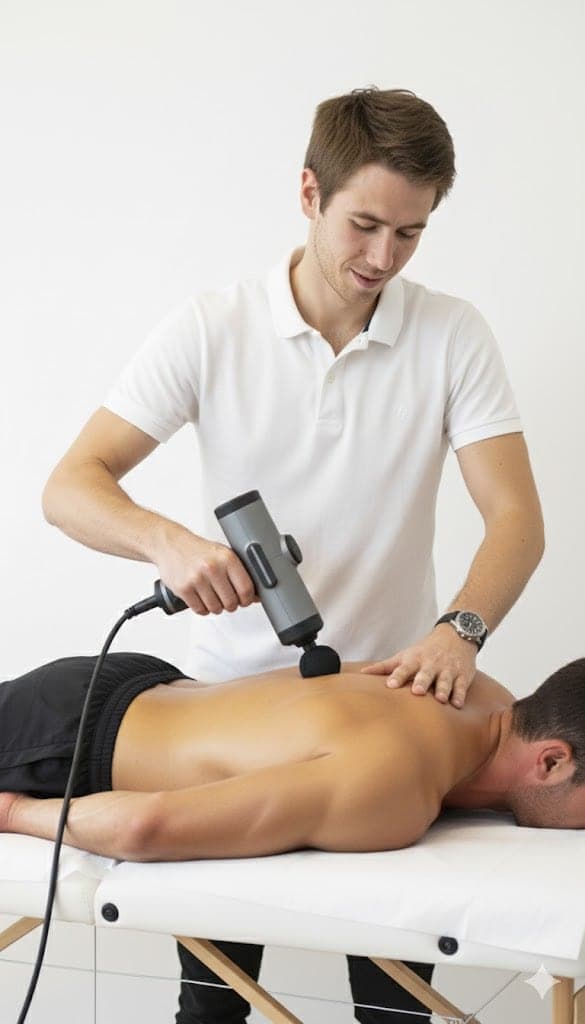
I use a specialized machine designed for one purpose: delivering controlled, consistent mechanical pressure to exact anatomical structures. This isn’t a massage gun you can buy online. This is a clinical-grade instrument that allows me to work with three distinct advantages over traditional massage.
Deeper Than Hands
The machine penetrates tissue layers that are simply inaccessible through manual pressure. When I’m working on a runner’s hamstring origin at the ischial tuberosity, I’m not just compressing surface muscle—I’m reaching the tendinous attachments where chronic tension accumulates. When treating a competitive weightlifter’s subscapularis, I can access the anterior shoulder capsule without the geometric limitations of hand positioning.
This depth matters because pain rarely originates where you feel it. That burning sensation in your knee? It’s often coming from adhesions in your vastus lateralis or restrictions in your hip capsule. Surface-level work will never address that. You need mechanical precision to reach the source.
Complete Control
Intensity is adjustable with millimeter-level precision. For a professional athlete preparing for competition, I can deliver powerfully deep fascial release that would be impossible to sustain manually. For someone recovering from injury, I can maintain the exact pressure threshold that promotes tissue remodeling without triggering protective muscle guarding. This level of control means I can customize every session to your current physiological state—something that’s impossible when my own fatigue becomes a variable.
Consistent Results
I don’t have off days. The machine delivers identical pressure and frequency every single session. You’re never getting a compromised treatment because I’m tired from seeing six clients before you. This consistency is what allows me to create customized treatment protocols that build progressively—each session designed to advance your tissue quality and functional capacity in a predictable, measurable way.
How Advanced Sports Massage Improves Athletic Performance
Athletic performance is limited by the weakest link in your kinetic chain. You can have world-class cardiovascular capacity, but if your hip internal rotation is restricted by 20 degrees, you’re generating force inefficiently and setting yourself up for compensatory injuries. My role as an advanced sports massage therapist is to identify and eliminate these mechanical restrictions.
| Performance Metric | Mechanical Restriction | Tissue Target | Expected Outcome |
|---|---|---|---|
| Sprint Speed | Limited hip extension | Iliopsoas, rectus femoris | Increased stride length, reduced ground contact time |
| Overhead Strength | Scapular dyskinesis | Levator scapulae, rhomboids | Improved force transfer, reduced shoulder impingement |
| Endurance | Restricted thoracic mobility | Intercostals, erector spinae | Enhanced respiratory efficiency, delayed fatigue |
| Agility | Ankle dorsiflexion limitation | Gastrocnemius, soleus | Improved deceleration control, faster direction changes |
Case Study: Restoring Power Output in a Competitive Rower
I worked with a national-level rower who had developed chronic thoracic pain that was limiting her catch position. She couldn’t achieve full compression at the front of the stroke, which was costing her approximately 15 watts of power—significant at elite levels. Traditional sports massage had provided temporary relief but never resolved the underlying issue.
Through detailed assessment, I identified severe restrictions in her serratus anterior and external obliques, combined with fascial adhesions along her rib cage from years of repetitive loading. Over six sessions, I used mechanical deep-tissue therapy to systematically release these structures, working progressively deeper as her tissue tolerance improved. By session four, her catch angle had improved by 8 degrees. By session six, she reported her highest wattage test in eighteen months.
That’s not subjective improvement. That’s measurable performance enhancement through biomechanical optimization.
Accelerating Recovery: The Science of Tissue Remodeling
Recovery isn’t about rest alone. It’s about actively facilitating the physiological processes that repair tissue damage, clear metabolic waste, and restore functional capacity. As an advanced sports massage therapist, I’m targeting three distinct mechanisms that accelerate recovery.
Mechanical Disruption of Adhesions
When you train intensely, micro-tears occur in muscle fibers. Your body repairs these tears with collagen—but collagen deposition isn’t organized. It forms random cross-links between tissue layers that should glide independently. These adhesions restrict movement and create compensatory patterns. Mechanical deep-tissue therapy physically breaks these cross-links, allowing tissue layers to restore their natural sliding mechanism.
I’ve seen this most dramatically with runners who develop IT band syndrome. The iliotibial band isn’t actually tight—it’s adhered to the underlying vastus lateralis. No amount of stretching will fix that. You need mechanical intervention to separate those tissue planes.
Increased Local Circulation
The mechanical pressure I apply creates a localized hyperemia—increased blood flow to the treated area. This isn’t just about bringing nutrients in; it’s about removing metabolic waste products like lactate and hydrogen ions that accumulate during intense training. Enhanced circulation accelerates the transition from the inflammatory phase of recovery to the proliferative phase, reducing the time you spend in a compromised state.
When I work on a cyclist’s quadriceps immediately after a hard interval session, they typically report significantly reduced soreness the following day. That’s not placebo—that’s physiological acceleration of metabolic clearance.
Neurological Reset of Muscle Tone
Chronic muscle tension isn’t just mechanical—it’s neurological. Your nervous system maintains baseline muscle tone through gamma motor neurons. When you develop compensatory movement patterns, certain muscles become neurologically “locked” in a state of hypertonicity. Mechanical deep-tissue therapy provides proprioceptive input that can reset this baseline tone, allowing chronically contracted muscles to finally release.
I regularly work with office workers who have developed chronic neck tension from years of forward head posture. Their upper trapezius isn’t tight because it needs stretching—it’s neurologically overactive because it’s compensating for weak deep cervical flexors. By providing targeted mechanical input, I can temporarily downregulate that hypertonicity, creating a window where corrective exercises can actually be effective.
Why My Method Produces Superior Results
I’m going to be direct: most massage therapy provides temporary symptom relief, not lasting solutions. Clients leave feeling relaxed, but within days, the pain returns. That’s because traditional massage doesn’t address the underlying biomechanical dysfunction. My method is different because it’s built on three principles that most therapists either don’t understand or don’t have the tools to implement.
Treating Cause, Not Symptoms
When you tell me your lower back hurts, I don’t start by massaging your lower back. I assess your entire kinetic chain—hip mobility, thoracic rotation, ankle dorsiflexion, core stability patterns. More often than not, your back pain is a symptom of dysfunction elsewhere. Maybe your hip flexors are so tight that your lumbar spine is compensating with excessive extension. Maybe your glutes aren’t firing properly, forcing your erector spinae to work overtime.
I find the cause and treat it systematically. That’s why my clients don’t just feel better temporarily—they stop having the problem entirely.
Progressive Tissue Remodeling
You can’t fix chronic dysfunction in one session. Tissue adaptation takes time. I create customized treatment protocols that progressively challenge your tissue tolerance, working deeper and more specifically as your body responds. This isn’t a one-time fix—it’s a strategic partnership where each session builds on the previous one.
For an athlete preparing for competition, this might be an eight-week protocol focused on optimizing specific movement patterns. For someone with chronic pain, it might be a twelve-week program designed to systematically eliminate compensatory patterns and restore normal biomechanics.
Accountability and Measurement
I don’t rely on subjective feedback alone. I measure range of motion, assess movement quality, and track functional improvements. When I tell you we’ve increased your hip internal rotation by 15 degrees, that’s not an estimate—that’s measured with a goniometer. When I say your squat depth has improved, I’ve documented it.
This level of precision allows me to adjust protocols in real-time and demonstrate tangible progress. You’re not just investing in feeling better—you’re investing in measurable functional improvement.
The Mobile Advantage: Clinical Quality at Your Location
I travel to your place. This isn’t a convenience feature—it’s a strategic choice that enhances treatment effectiveness. When you come to a clinic, you’re immediately in post-session mode: getting dressed, driving home, returning to normal activities. That transition disrupts the neurological integration that occurs after deep tissue work.
When I bring my professional bench and equipment to your location, you can go directly into recovery mode. Take a hot shower. Stretch. Rest. Your nervous system has time to process the proprioceptive input from the session without the stress of travel and re-engagement.
This also eliminates the friction that causes clients to skip sessions. No commute, no parking, no waiting room. I arrive, we execute your protocol with clinical precision, and you’re immediately in an optimal recovery environment.
Who Benefits Most from Advanced Sports Massage Therapy
My ideal clients fall into three categories, each with distinct needs but all requiring the same thing: lasting solutions, not temporary relief.
Competitive Athletes
If you’re training seriously—whether for marathons, triathlons, powerlifting, or team sports—you’re operating at the edge of your body’s adaptive capacity. Small mechanical inefficiencies compound over thousands of repetitions, creating performance ceilings and injury risks. You need someone who understands biomechanics at a sophisticated level and can identify the specific restrictions limiting your performance.
I’ve worked with professional cyclists, Olympic weightlifters, and ultra-endurance athletes. What they all have in common is that they can’t afford to waste time on treatments that don’t produce measurable results. When your livelihood depends on performance, you need clinical precision, not wellness spa relaxation.
Active Professionals with Chronic Pain
You’re in your thirties or forties, you’re active and health-conscious, but you’re dealing with persistent pain that’s affecting your quality of life. Maybe it’s lower back pain from years of sitting. Maybe it’s shoulder pain that’s limiting your training. You’ve tried physiotherapy, chiropractic, and traditional massage, but the problem keeps returning.
You need someone who will actually fix the problem, not just manage symptoms. My clients in this category typically achieve lasting resolution within 8-12 sessions because we’re addressing the biomechanical root cause, not just treating the area that hurts.
Post-Injury Recovery
If you’re recovering from injury—whether surgical or traumatic—your rehabilitation needs to go beyond basic range-of-motion exercises. Scar tissue formation, compensatory movement patterns, and neurological changes all require specialized intervention. I work alongside your physiotherapist or surgeon to accelerate tissue remodeling, restore normal movement patterns, and minimize the risk of re-injury.
I recently worked with a runner recovering from Achilles tendon surgery. His physiotherapist had done excellent work restoring ankle mobility, but he still had significant restrictions in his gastrocnemius and soleus that were limiting his gait mechanics. Six sessions of targeted mechanical deep-tissue work resolved those restrictions, and he returned to running without compensatory patterns that would have led to secondary injuries.
Common Misconceptions About Sports Massage
I need to address several misconceptions that prevent people from seeking the treatment they actually need.
“Massage is Just for Relaxation”
This is the most damaging misconception in the industry. Clinical massage therapy is a medical intervention designed to restore functional capacity. When I’m working on your body, I’m not trying to relax you—I’m systematically addressing biomechanical dysfunction. It’s closer to manual physical therapy than it is to spa treatment.
“It Shouldn’t Hurt”
Effective deep-tissue work is uncomfortable. Not because I’m causing damage, but because I’m accessing tissue layers that have been chronically contracted for months or years. Your nervous system registers this as intense sensation. I constantly communicate with clients to ensure we’re working at the edge of tolerance—not beyond it, but definitely not in a comfortable range. If you want comfortable, book a Swedish relaxation massage. If you want results, expect intensity.
“One Session Should Fix Everything”
Chronic dysfunction doesn’t develop overnight, and it doesn’t resolve overnight. Tissue remodeling is a biological process that takes time. Anyone who promises you a miracle cure in one session is either lying or treating symptoms superficially. Real results require a strategic protocol executed over multiple sessions with progressive intensity.
“All Therapists Are Basically the Same”
The quality variance in this industry is enormous. Some therapists have weekend certifications and focus on spa-style relaxation. Others have university degrees in related fields and approach this work with clinical rigor. The difference in outcomes is dramatic. When you’re choosing a therapist, you’re not just choosing a service—you’re choosing a clinical partner who will either genuinely solve your problem or waste your time and money on ineffective treatments.
Investment in Performance, Not an Expense
Let me reframe how you think about this. When you pay for a training program, you don’t consider it an expense—you consider it an investment in your performance. When you buy quality running shoes or a properly fitted bike, you’re investing in your body’s ability to perform optimally. Advanced sports massage therapy is exactly the same.
You’re not paying for an hour of someone rubbing your muscles. You’re paying for a decade of specialized education and clinical experience. You’re paying for a customized protocol designed specifically for your biomechanical needs. You’re paying for measurable improvements in performance, reductions in pain, and prevention of future injuries.
Consider the alternative cost: repeated visits to physiotherapists that provide temporary relief but never solve the problem. Time lost from training due to injuries that could have been prevented. Performance plateaus that persist because underlying mechanical restrictions are never addressed. The actual cost of not investing in proper treatment is far higher than the cost of doing it right the first time.
What to Expect in Your First Session
When we begin working together, the first session is always assessment-focused. I need to understand your movement patterns, injury history, training demands, and specific goals. This isn’t a standard intake form—it’s a detailed biomechanical evaluation.
Movement Assessment
I’ll watch you perform basic movement patterns: squat, hinge, overhead reach, rotation. I’m looking for asymmetries, compensations, and restrictions that indicate underlying dysfunction. Most clients are surprised by what this reveals. You might think your problem is in your shoulder, but the movement assessment shows that your thoracic spine has almost no rotation, forcing your shoulder to move through an unstable range.
Palpation and Tissue Quality Evaluation
I’ll manually assess tissue density, adhesions, and trigger points throughout your kinetic chain—not just in the area you’re complaining about. This gives me a map of where restrictions exist and how they’re interconnected.
Initial Treatment Protocol
Based on the assessment, I’ll design an initial treatment protocol. This might focus on one region in depth during the first session, or it might address multiple areas more superficially to begin the process of systematic release. I’ll explain exactly what I’m doing and why, so you understand the strategic approach rather than just experiencing the treatment passively.
Post-Session Recommendations
After the session, I’ll provide specific recommendations—hydration, stretching protocols, movement modifications. This isn’t generic advice; it’s tailored to the specific tissues we’ve worked on and the adaptations your body needs to make.
Frequently Asked Questions
How is this different from regular massage?
Regular massage typically focuses on relaxation and superficial muscle tension. My approach is clinical and performance-oriented, using mechanical tools to access deeper tissue layers and address biomechanical dysfunction at its root. The goal isn’t relaxation—it’s lasting resolution of pain and optimization of movement quality.
How many sessions will I need?
That depends entirely on your specific situation. Acute issues might resolve in 3-4 sessions. Chronic dysfunction that’s been developing for years typically requires 8-12 sessions to fully address. I’ll give you an honest assessment after the initial evaluation and adjust as we track your progress.
Is the mechanical treatment painful?
It’s intense, not painful. We’re working at the edge of your tissue tolerance, which means you’ll feel significant pressure and discomfort. But this is productive discomfort—the sensation that indicates we’re accessing restricted tissue and creating change. I constantly communicate with you to ensure we’re working at the optimal intensity.
Can you help with specific injuries or conditions?
I work with a wide range of conditions: chronic back pain, shoulder impingement, IT band syndrome, plantar fasciitis, hip restrictions, thoracic outlet syndrome, and many others. If your issue is biomechanical in nature—meaning it stems from movement dysfunction or tissue restrictions—I can almost certainly help. If it’s pathological (disease-based), you need medical treatment first.
Do you work with insurance?
I don’t directly bill insurance, but I can provide detailed receipts that many clients successfully submit for reimbursement. My focus is on delivering results, not navigating insurance bureaucracy. Clients who are serious about solving their problems understand this is an investment in their long-term health and performance.
How often should I schedule sessions?
For active treatment of chronic issues, I typically recommend weekly sessions initially, then spacing them out as we achieve stability. For performance maintenance and injury prevention, many athletes schedule bi-weekly or monthly sessions. This isn’t something you do once and forget—it’s an ongoing partnership that adapts to your training demands and goals.
What should I do to prepare for a session?
Arrive hydrated and avoid eating a large meal immediately before. Wear comfortable clothing that allows access to the areas we’ll be treating. Be prepared to discuss your training schedule, recent injuries, and specific goals. The more information you provide, the more precisely I can customize your treatment.
Will I be sore after treatment?
Most clients experience some soreness for 24-48 hours after deep tissue work, similar to post-workout soreness. This is a normal inflammatory response as tissue begins remodeling. I provide specific post-session protocols to minimize this and accelerate recovery. The soreness is temporary; the functional improvements are lasting.
Building a Long-Term Partnership
The most successful outcomes I’ve seen happen when clients commit to a genuine partnership rather than seeking quick fixes. I’m not interested in one-time sessions where I temporarily reduce your symptoms. I’m interested in working with people who want lasting solutions and are willing to invest the time required to achieve them.
This means showing up consistently, following post-session recommendations, communicating honestly about what’s working and what isn’t, and trusting the process even when progress feels slow. Tissue adaptation takes time. Movement pattern correction takes repetition. But when you commit to the process, the results are transformative.
I’ve had clients who came to me with chronic pain that had limited their lives for years—unable to play with their children, unable to train, unable to sleep comfortably. After three months of consistent work, they’re not just pain-free—they’re performing better than they did before the pain started. That’s what’s possible when you treat causes rather than symptoms and commit to genuine biomechanical optimization.
Taking the Next Step
If you’re an athlete struggling with performance plateaus, an active professional dealing with chronic pain, or someone recovering from injury who wants to return to full function, you need more than generic massage. You need clinical precision, biomechanical expertise, and a treatment method that produces measurable, lasting results.
I bring ten years of specialized experience, a mechanical approach that eliminates human inconsistency, and a commitment to treating causes rather than symptoms. I travel to your location with professional equipment, providing clinical-quality treatment without the friction of commuting to a clinic.
This isn’t relaxation therapy. This isn’t symptom management. This is performance optimization and lasting pain resolution through advanced mechanical deep-tissue techniques. If that’s what you’re looking for, we should talk.
Your body is capable of far more than you’re currently experiencing. The restrictions you’re living with—the pain, the limited mobility, the performance ceiling—aren’t inevitable. They’re mechanical problems with mechanical solutions. I have the knowledge, the tools, and the experience to solve them. The question is whether you’re ready to invest in getting it done right.
Written by
Chris
Massage therapist & body mechanics specialist
Norwegian-certified with a Bachelor’s in Physical Education and Nutrition and over ten years of clinical practice, working from a portable table in clients’ homes across the Paphos district.
This article is general information from clinical practice, not a medical diagnosis. If you have severe, worsening or unexplained pain, numbness, weakness, or pain after an accident, see a doctor first.